Quick Take
- Narration: Phoebe Strole captures Violette’s careful, guilt-laden interiority with genuine sensitivity; her reading avoids the melodrama that could easily overtake this material.
- Themes: Redemption and self-erasure, the cost of a parent’s conditional love, second chances and their limits
- Mood: Quietly heartbreaking, with an undertow of tension throughout
- Verdict: A light novel adaptation that earns its emotional heaviness through specificity and moral complexity rather than melodrama.
I came to this one skeptically. Isekai villainess stories, where a character is reborn or rewound into a narrative they already know, have proliferated enough that the premise now carries its own clichés. The duke’s daughter who committed terrible crimes and gets a second chance. The determination to live quietly this time. The fate that has other plans. I’ve heard this structure before, and I was prepared to like it moderately and move on.
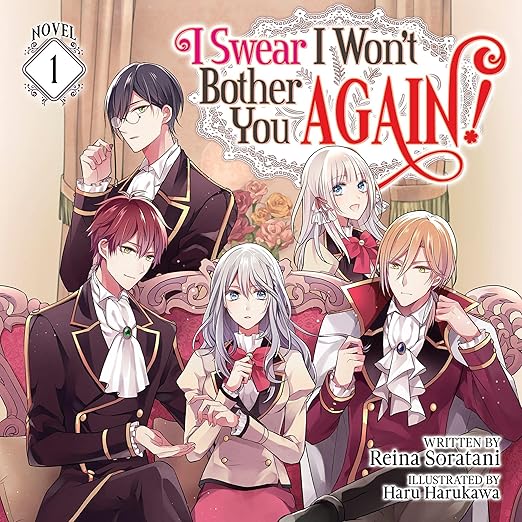
What I wasn’t prepared for was how seriously I Swear I Won’t Bother You Again! takes its own moral questions. Violette doesn’t return to her earlier life with a simple corrective plan and a clean conscience. The book begins with her in prison, carrying the full weight of what she did to her half-sister, and it asks an uncomfortable question before the rewind even happens: do the circumstances that drove her to that act actually justify it? One reviewer put it clearly, the feelings behind Violette’s actions in the original timeline are understandable, which makes them harder to simply dismiss as villainy, not easier.
Our Take on I Swear I Won’t Bother You Again!, Vol. 1
What distinguishes this from many entries in the isekai villainess subgenre is the author’s commitment to psychological specificity. Violette’s crime was rooted in jealousy over her father’s affection, affection she had been systematically denied while her half-sister received it freely. The book doesn’t frame this as a simple villain origin story. It frames it as a portrait of a person broken by conditional love, and the second chance she’s given isn’t presented as a clean slate but as an opportunity she doesn’t quite believe she deserves.
The decision to retreat and stop seeking her father’s approval, which gives the book its title, is not triumphant. It’s melancholy. Violette’s strategy for her second life is essentially self-erasure: ask for nothing, take up no space, cause no disturbance. That’s a psychologically coherent response to her history, but it’s also a kind of continued punishment. Phoebe Strole navigates these layers with genuine skill. Her narration is restrained where the text is restrained, and she doesn’t over-dramatize the grief that runs underneath Violette’s careful composure.
Why Listen to I Swear I Won’t Bother You Again!, Vol. 1
Readers of translated Japanese light novels will find a faithful adaptation here. Seven Seas Entertainment has developed a reliable track record with light novel publishing, and the audio version released January 2026 marks this title’s arrival in a format that suits the material’s introspective quality. The story is better heard than skimmed, Strole’s pacing allows the emotional subtext to accumulate in ways that silent reading can sometimes rush past.
The moral complexity is genuinely unusual for this subgenre. One reviewer described every character as having their own coherent idea of right and wrong, which is an accurate characterization of how the supporting cast is written. The half-sister, the father, the friends Violette cautiously approaches, none of them are simply positioned as villains or rescuers. This is a book that is interested in how people rationalize harm and how people try, imperfectly, to do better.
What to Watch For in I Swear I Won’t Bother You Again!, Vol. 1
A few listeners noted that the story begins without clearly explaining what harm Violette actually caused, you’re given the emotional aftermath before the facts, which some readers found disorienting. This is a deliberate structural choice: the author is more interested in Violette’s guilt and its context than in delivering a plot summary. If you prefer narrative clarity up front, that choice may require some patience in the opening chapters.
The pace of character growth is also slower than many genre readers might expect. The book is more interested in Violette’s internal landscape than in external plot mechanics. One reviewer specifically noted that the speed of character development is the thing most likely to determine whether this book works for a given reader, if you find quiet psychological portraits engaging, this is the right speed. If you’re looking for the plot-driven momentum that characterizes more action-oriented fantasy, volume one may frustrate.
Who Should Listen to I Swear I Won’t Bother You Again!, Vol. 1
This is a strong choice for listeners who appreciate character-driven YA or light novel adaptations with genuine moral weight. Fans of the villainess isekai subgenre who have found other entries too cheerful or too uncomplicated will find this one substantially more textured. Phoebe Strole’s narration makes the six-hour runtime feel well-paced. Those who prefer fast-moving fantasy plotting or clean redemption arcs should know this book is deliberately quieter and more ambiguous than that. And if you find yourself wanting more at the end, be forewarned: at the time of this writing, listeners were already waiting impatiently for the second volume.
Frequently Asked Questions
Do you need to know the isekai or villainess subgenre to appreciate this book?
No prior genre knowledge is required, though familiarity with the tropes, reincarnation, a foreknowledge of events, a second chance at life, helps you appreciate how this title uses and departs from the conventions. The emotional core of the book is accessible to general YA listeners regardless of genre background.
How does Phoebe Strole’s narration handle the novel’s dual timeline structure?
Strole navigates the transitions between Violette’s original timeline memories and her present-tense second chance with clear tonal differentiation. The memory sequences carry more emotional weight in her reading, which helps distinguish them from the quieter forward-moving present without requiring explicit narrative markers.
Is this appropriate for younger teens, or is it aimed at an older YA audience?
The themes, parental neglect, guilt over serious harm caused to a sibling, psychological self-erasure, make this better suited to older teens and adult readers. The content itself is not explicit or violent in the conventional sense, but the emotional register is heavy enough that younger readers may benefit from some context.
Does volume one tell a complete story, or does it end on a cliffhanger?
Volume one establishes the premise, Violette’s psychological state, and the early social dynamics of her second chance, but it does not resolve the larger narrative threads. Several reviewers noted their frustration at having to wait for volume two, which suggests the book ends at a point that will leave invested listeners wanting the continuation rather than feeling satisfied with a standalone arc.