Quick Take
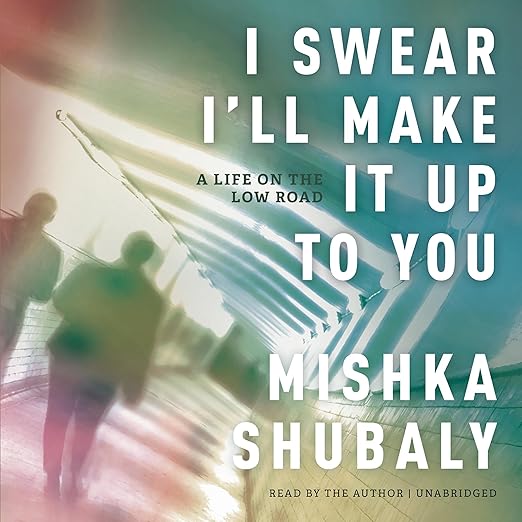
- Narration: Mishka Shubaly reads his own memoir with the kind of lived-in rawness that no hired narrator could replicate, delivering self-lacerating wit and genuine devastation in the same breath.
- Themes: Addiction and recovery, estranged fathers, the question of who we owe apologies to
- Mood: Brutally honest, darkly funny, and unexpectedly moving by the final third
- Verdict: One of the more honest addiction memoirs in audio, anchored by a narrator who has earned the right to tell this story in precisely this voice.
I came to Mishka Shubaly’s memoir having read exactly none of his prior work, which turned out to be the right way to approach it. No expectations, no comparative framework, just thirteen and a half hours of a man reading the story of his own catastrophic relationship with alcohol and the unlikely thread of distance running that pulled him toward something resembling survival. I listened on a series of morning walks, which felt appropriate given the subject matter. Something about being in motion made the darker stretches easier to stay with.
The memoir opens with a compressed but devastating prologue: in a single 24-hour span in 1992, Shubaly survived a mass shooting on his school’s campus and learned that his parents were getting divorced. His father, a rocket scientist, left. The house went to foreclosure. Shubaly channeled the resulting wreckage into two decades of alcohol and the kind of self-destruction that reads, in his telling, as both funny and genuinely terrifying. One reviewer compared his work to Bukowski, but less sexist, and that framing is more accurate than it first appears.
Our Take on I Swear I’ll Make It Up to You
The book’s structural gamble is that it trusts you to stay through the drinking years, which are long, chaotic, and sometimes repetitive by design. Shubaly isn’t pacing the narrative for your comfort. He’s pacing it for accuracy, and the cumulative effect of watching someone burn through relationship after relationship, city after city, opportunity after opportunity, is meant to feel exhausting. It does. But it also earns the turn that comes when a post-bar-fight five-mile run unexpectedly becomes the thing that saves him.
What distinguishes this book from the standard recovery memoir is Shubaly’s refusal to locate the problem in a single cause or its solution in a single revelation. Running didn’t fix him. His estranged father’s reappearance didn’t fix him. What the book offers instead is a portrait of gradual, unspectacular change, the kind that accrues slowly and then suddenly means something. The reconciliation with his father, and the discovery that his childhood narrative was radically different from what he thought he knew, is handled with real delicacy for a writer who spends the majority of the book being deliberately, almost aggressively undelicate.
Why Listen to I Swear I’ll Make It Up to You
Author narration is a gamble that pays off in full here. Shubaly has a punk musician’s timing and a writer’s ear for emphasis, and the combination produces something that a trained narrator could approximate but not replicate. The self-lacerating wit that multiple reviewers flag is inseparable from his delivery. The line readings land differently when the person saying them is the person who lived them, and there are passages in the middle section, the cough syrup and the bar fights and the extended relationship post-mortems, where you sense he is performing a kind of honest reckoning rather than simply recounting events.
At thirteen and a half hours this is a substantial listen, and there will be moments in the middle third where forward momentum stalls. A reviewer noted that the book sometimes comes across as cynical, but argued persuasively that this registers as refreshingly honest rather than self-indulgent. I agree with that reading. The cynicism is diagnostic rather than performative.
What to Watch For in I Swear I’ll Make It Up to You
The running sections are shorter and less central than the title and genre tag might suggest. This is not an ultramarathon memoir or a fitness narrative. Distance running appears as a vehicle for sobriety and self-reconstruction, but Shubaly is not interested in race times or training philosophy. Listeners expecting the kind of running-focused memoir that dominates the sports-outdoors category will find this sits closer to literary memoir with running as metaphor.
The father-son reconciliation in the later chapters is the book’s emotional core, and it lands harder than the drinking material for being quieter. Shubaly discovers that his memories of the divorce, of the abandonment, and of what the family lost are not entirely the story his father tells. That gap is not resolved into easy forgiveness, and that choice is what separates this book from lesser memoirs in the genre.
Who Should Listen to I Swear I’ll Make It Up to You
Listen if you have personal familiarity with addiction, estrangement, or the particular kind of self-sabotage that looks like free choice from the outside. Listen if you want author narration at its most authentic. Skip if you need a recovery narrative that moves efficiently toward resolution, or if explicit descriptions of alcohol abuse and its consequences would be actively harmful for you to listen to right now. This is not a gentle book.
Frequently Asked Questions
Is I Swear I’ll Make It Up to You primarily a running memoir or an addiction memoir?
Addiction memoir, definitively. The running element is real and important as a recovery tool, but Shubaly spends the majority of the book inside the drinking years. Distance running appears in the final third as the unexpected catalyst for change rather than as the book’s central subject.
How does Mishka Shubaly narrating his own memoir affect the listening experience?
It’s the book’s strongest asset. Shubaly has a timing and delivery that come directly from his background as a musician and performer. The self-deprecating wit in particular lands differently when you hear him say it rather than reading it on a page. Some listeners will find the voice initially rough-edged, but it fits the material completely.
Does the book handle the reconciliation with Shubaly’s estranged father honestly, or does it resolve too neatly?
Honestly is the right word. The discovery that Shubaly’s memory of his childhood was incomplete rather than simply accurate is handled with real nuance. The reconciliation doesn’t erase the abandonment or manufacture forgiveness, but it does shift the emotional landscape in ways that feel true rather than convenient.
How explicit are the descriptions of alcohol abuse and self-destructive behavior?
Quite explicit and detailed, covering roughly two decades of heavy drinking, poor decisions, and physical and relational damage. Shubaly is not protective of the reader’s comfort in this regard. Listeners who are in early recovery or who find detailed addiction narratives difficult should approach with that awareness.