Quick Take
- Narration: Amin El Gamal brings genuine energy to Zack’s first-person voice, capturing the character’s self-conscious bravado without overdoing it.
- Themes: Identity and authenticity, queer coming-of-age, moral accountability
- Mood: Sunny and breezy, with enough substance beneath the surface to avoid feeling lightweight
- Verdict: A bright, well-executed YA romance that earns its feel-good conclusion by actually making Zack work for it.
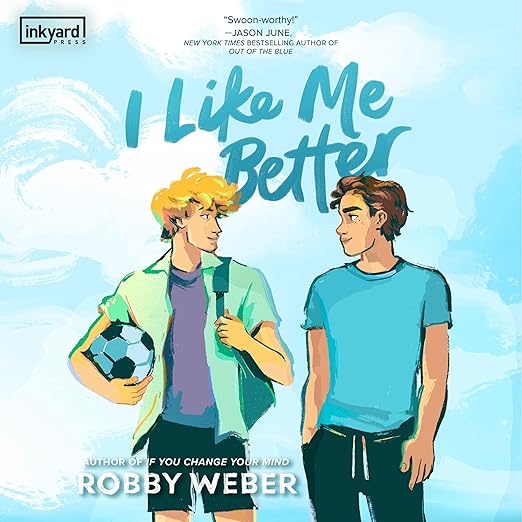
I put on I Like Me Better during a long drive with good intentions to only listen to an hour or so. I arrived home two hours later than planned, sitting in my driveway finishing the last stretch before going inside. Robby Weber’s second novel has that particular quality of YA done well: it is easy to enter and genuinely difficult to leave, not because it is manipulative but because the characters feel like people you have come to care about in a very short time.
Zack Martin is a high school soccer star covering for his captain’s mistake as an act of misguided loyalty. The community service sentence drops him into a seaside marine conservation center, far from the social ecosystem that defines his identity at school. There he meets Chip, an intern who has already heard the story of what Zack supposedly did and wants nothing to do with him. The setup is a familiar YA engine, character placed in situation that forces growth, but Weber runs it with specificity and affection that lift it above the template.
Our Take on I Like Me Better
The most interesting structural choice Weber makes is the first-person present tense narration, which one reviewer correctly identifies as giving the novel an unusual immediacy. We experience Zack’s rationalizations in real time, which means we are inside his head as he deceives himself and others. It is a format that can become claustrophobic in less skilled hands, there is nowhere to hide from a protagonist making poor decisions. Weber manages the tension between Zack’s likability and his culpability with more sophistication than many adult writers bring to comparable problems.
The title is the novel’s thesis, and it pays off. By the time Zack reaches a version of himself he genuinely likes, the reader has watched that version being constructed through specific choices rather than vague character-growth summary. The dolphin encounters, the shark costume disasters, the gradual trust built with Chip through shared awkwardness, these accumulate into something that feels earned rather than inevitable.
Why Listen to I Like Me Better
Amin El Gamal’s narration is a significant asset. He has a warm, slightly wry quality that suits Zack’s self-aware narration, Zack knows he is making bad choices even as he makes them, and El Gamal captures that discomfort without turning it into self-pity. The marine conservation setting comes through vividly in the descriptions of animal encounters, and El Gamal’s pacing through the lighter, more comedic sequences (the shark costume sequence in particular) is well-timed.
At just under ten hours, the audiobook is appropriately compact for the story it tells. Weber does not pad the narrative, which keeps the energy consistent. The secondary characters, including the teammates and conservation center staff, are economically but distinctly drawn, and El Gamal gives each enough vocal distinctness that the cast feels populated without being crowded.
What to Watch For in I Like Me Better
This is a book where the protagonist’s central lie is known to the reader from the beginning. The tension is not whether Zack did the thing he is accused of doing, we know he did not, but whether he will come clean about the thing he is actually covering for. That dramatic irony requires some investment in the outcome. Listeners who find coming-of-age moral accountability storylines frustrating rather than engaging will likely agree with the one-star reviewer who found the book tedious, not because something is wrong with the book, but because the genre’s machinery genuinely is not for everyone.
The representation is handled lightly, which some readers will appreciate and others will find insufficient. This is a queer romance that does not make the queerness a source of conflict, the world of the book is, as one reviewer notes, utopian in concept. Whether that reads as wish fulfillment or as simply a different kind of realism depends on what you are looking for.
Who Should Listen to I Like Me Better
Ideal for YA readers who want queer romance with a coastal summer setting and genuine character growth. The marine conservation backdrop gives it texture that pure school-based romances lack. Adults who enjoy the genre will find Weber’s voice controlled and the pacing comfortable. Skip it if YA internal monologue generally frustrates you, or if you need conflict generated by the characters’ queer identities rather than their personal failures.
Frequently Asked Questions
Is I Like Me Better appropriate for the 14+ age range listed, or does it skew older?
The content is solidly YA appropriate. The romance is sweet rather than explicit, the themes, moral accountability, identity, community service, are immediately relevant to the target age group, and the tone is warm without being condescending.
Does Amin El Gamal’s narration capture the first-person present tense style Weber uses?
Yes, and the present tense is actually well-suited to audio. El Gamal leans into the immediacy of Zack’s narration without making it feel breathless, and the result is a performance that keeps you inside the character’s head in a way that print sometimes cannot match.
Is the queer content central to the plot, or is it incidental to the story?
It is central to the romance, Chip and Zack’s relationship is the emotional core of the book, but the book treats the characters’ sexuality as unremarkable within its world. There is no coming-out arc or homophobia-as-conflict. The tension is generated by Zack’s lie and his avoidance, not by their genders.
Does I Like Me Better connect to Weber’s other books set in Citrus Harbor?
Weber has set other work in Citrus Harbor, and readers familiar with that setting will recognize the environment. I Like Me Better reads as a fully standalone novel, however, and requires no prior reading.