Quick Take
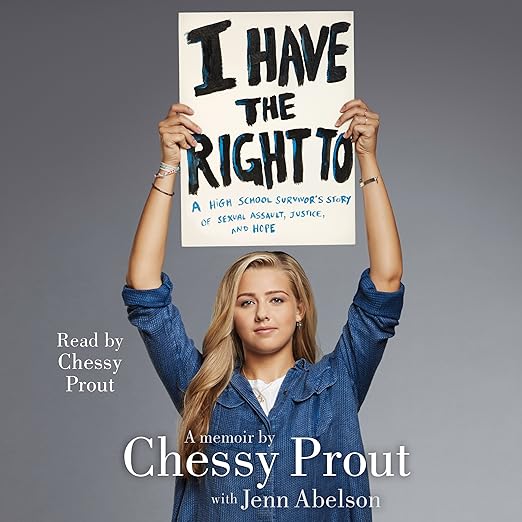
- Narration: Chessy Prout narrates her own memoir, which brings an authenticity that no other voice could replicate. The rawness of listening to a survivor tell her own story is the audiobook’s defining quality.
- Themes: Sexual assault, institutional accountability, survivor advocacy and the decision to go public
- Mood: Searingly honest and at times difficult, but grounded in the forward motion of someone who decided her story had power
- Verdict: A memoir that demands to be heard in the author’s own voice. Prout’s decision to narrate makes the audio format the definitive version of this book.
I listened to most of I Have the Right To on a train journey, which I’d later realize was appropriate in a way I hadn’t planned. There’s something about being in motion, surrounded by people going about their ordinary days, that makes Chessy Prout’s story land with particular weight. Her assault at St. Paul’s School in New Hampshire in 2014, at fourteen years old, happened in an ordinary institutional world that had constructed elaborate social mechanisms to protect itself rather than her. The memoir is about what happens when someone decides not to accept that protection.
Prout narrates her own book, and this is the most important thing to know about the audiobook format. Memoirs narrated by their authors are not uniformly more effective than professional narration. But in Prout’s case, the choice is essential. The moments when her voice tightens or catches, the way she describes the senior boy’s assault as part of a ritualized conquest game, the controlled fury beneath her description of the school’s institutional response, none of that is manufactured. You are hearing someone who lived through it tell you what it was like. That’s an entirely different register from the most skilled professional narration.
Our Take on I Have the Right To
The book doesn’t begin with the assault. Prout establishes her life before it: her family, her excitement about attending St. Paul’s, the social world of the school that she was entering as a freshman. That architecture matters because it makes clear who Chessy Prout was before the assault and makes the before-and-after legible rather than assumed. One reviewer, a high school librarian, noted this foundation as a deliberate choice that contextualizes everything that follows.
The institutional betrayal section is the part of the memoir that extends beyond personal testimony into something more systemic. Prout doesn’t just document what happened to her. She documents what happened when she reported it: the backlash, the school community’s response, the trial, and the decision to shed her anonymity and go public by name. That last decision, which came after the verdict, is where the memoir’s argument crystallizes. Prout’s position is that survivors should not have to choose between justice and invisibility.
Why Listen to I Have the Right To
The audio format makes this one of those rare cases where the listening experience is substantively different from and, for many readers, more affecting than the print version. One reviewer attended St. Paul’s School in the 1990s and found the memoir resonant with their own experience of the school’s culture, describing toxicity that they escaped relative to Prout but recognized entirely. That recognition, that this was a systemic culture and not an individual aberration, comes through with particular force in audio.
The memoir is also, despite its subject, not a book without hope. Prout moves through the account with the forward orientation of someone who has decided her experience has a purpose beyond itself. Reviewers describe feeling inspired rather than only devastated, and the balance between those responses is a genuine achievement of both the writing and the narration.
What to Watch For in I Have the Right To
The memoir is graphic about the assault in ways that are necessary to the honesty of the account but that may be difficult for survivors of sexual violence. This is not a book that softens what happened in order to make it more palatable. People Magazine described Prout as “a bold, new voice,” and Vice called the book “a nuanced addition to the #MeToo conversation.” Both descriptions capture the tone: direct and specific rather than euphemistic.
One German-language reviewer offered a much more skeptical reading of the book, characterizing Prout’s account in ways that dismiss her agency and frame her as responsible for her own situation. This represents a minority critical position and reflects the same kind of victim-blaming culture Prout’s memoir specifically addresses. It is worth noting that this perspective exists in the reviews, and that Prout anticipated and addresses it directly in the text.
Who Should Listen to I Have the Right To
This is for readers who want to understand the institutional and social mechanisms that surround sexual assault cases, not just the individual experience. Educators, school administrators, parents of teenagers, and students themselves have found this memoir useful as documentation of a system and not only as personal testimony. Survivors of sexual violence should approach with awareness of the content’s specificity. The audiobook format is the recommended experience given Prout’s narration, but the print version is equally powerful for those who find audio more challenging with this kind of content.
Frequently Asked Questions
Does Chessy Prout’s self-narration affect the quality of the audiobook compared to professional narration?
It defines it. Prout’s voice carries the emotional authenticity of someone who actually lived through what she’s describing. There are moments of rawness that no professional narrator could replicate. This is one of the cases where author narration is the definitive format.
How much does the memoir cover about St. Paul’s School’s institutional response versus the assault itself?
The memoir covers both extensively. Prout documents the trial, the school community’s backlash, and the decision to go public with her identity after the verdict. The institutional accountability argument is woven throughout rather than confined to a separate section.
Is this appropriate for teenage readers given the YA genre tag and the graphic content?
The memoir is classified in the teen and young adult category, and Prout has explicitly targeted young readers as part of her advocacy mission. However, the content is graphic and emotionally demanding. Parents and educators should assess individual readiness rather than treating the YA classification as an automatic approval.
How does the book address the school community’s response and the backlash Prout faced after reporting?
Prout covers the backlash extensively, describing how the school community’s loyalties organized against her in ways she describes as a secondary trauma. One reviewer who attended the school in the 1990s confirmed the culture Prout describes as recognizable from their own time there.