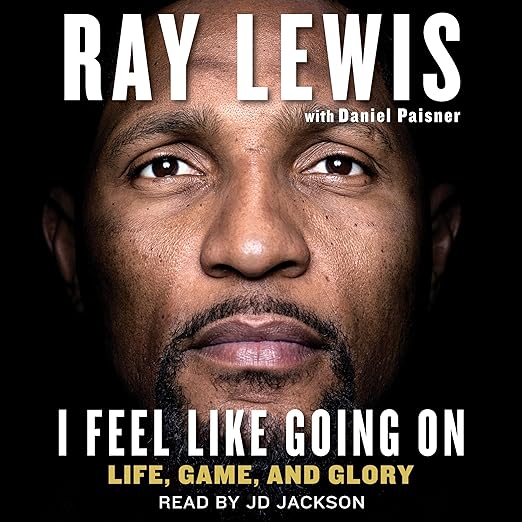
Quick Take
- Narration: JD Jackson delivers a performance that matches the emotional scale of Lewis’s story, powerful without being overwrought, and clearly invested in the material.
- Themes: Faith under pressure, redemption after public disgrace, the cost of growing up without stability
- Mood: Intense and searching, like a very long conversation with someone who has earned the right to speak
- Verdict: A sports memoir that transcends its genre by insisting on the full complexity of the life it describes, controversy and all.
I started I Feel Like Going On on a rainy Tuesday evening, expecting the standard arc of a professional athlete’s life story: humble origins, breakthrough achievement, some trouble, then triumph. Ray Lewis’s memoir begins that way and then keeps going into territory that most sports biographies are careful to stay away from. By the time JD Jackson finished reading the section on Atlanta, I had stopped doing anything else and was just listening.
Lewis was one of the most dominant defensive players in NFL history, a seventeen-year Baltimore Ravens linebacker who won two Super Bowls and was widely considered the best at his position during the peak years of his career. None of that is the hardest part of the story to tell. The hardest part is 2000, when two men were killed after a post-Super Bowl party, and Lewis was there. The criminal case that followed nearly ended his career, his reputation, and by his own account very nearly ended him. His memoir goes into this period at length and with a directness that has clearly meant different things to different readers.
What Lewis Is Actually Willing to Say
The question of what Lewis does and does not disclose about the Atlanta incident is the center of gravity around which this memoir orbits. Several reviewers praised him for clearing up confusion, for telling his story, for the courage of honesty. Others remain skeptical of what the book’s version of events leaves out. Lewis is not naive about this. He knows that the account he gives will be assessed against what people already believe about him, and he writes with awareness of that scrutiny rather than pretending it does not exist.
The childhood sections, which cover Lewis’s early years in Bartow, Florida, with a young mother and an absent father, are where the book does its most uncomplicated emotional work. The portrait of a boy who found in football not just an escape route but a substitute for a family structure that was not there, this is familiar memoir territory, but Lewis and his co-author Daniel Paisner execute it with enough specific detail to make it feel individual rather than archetypal. The relationship with his mother, and the specific character of the neighborhood that shaped him, are rendered with a granularity that earns the emotional weight the book later places on them.
JD Jackson and the Emotional Architecture of the Listen
JD Jackson is one of the more gifted narrators working in this space, and this recording shows why. Lewis’s voice in the memoir ranges from boasting to confession to prayer, sometimes within the same paragraph. Jackson tracks those transitions with precision. When the text reaches for something spiritual, and it reaches often, because Lewis’s faith is not a footnote but a structural element of the whole story, Jackson does not domesticate the intensity. He honors it. One reviewer who described herself as not a football fan at all and never watching it said she could not put the book down, and I think Jackson’s narration is part of why.
At nine hours and twenty-eight minutes, the runtime is substantial. Jackson earns it. There are stretches of the football-season narrative that will reward fans and feel slower to non-fans, but the book’s emotional peaks are distributed generously enough that even a disinterested listener will find the momentum maintained. Jackson’s voice has a particular authority in the Atlanta passages, where the prose tightens and the emotional stakes become most visible.
The Faith Question
Lewis’s memoir is explicit about the role of Christian faith in his life in a way that is not decorative or strategic. It is the organizing principle of how he understands what happened to him and what he is supposed to do about it. Readers who share that framework will likely find the memoir’s faith passages among its most powerful. Readers who do not share it will need to decide whether they can engage with those passages as expressions of how Lewis actually lives rather than as claims they must evaluate. The book earns the faith by earning the preceding darkness, you understand why someone who went through what Lewis went through might need an account of things that is larger than cause and effect.
The Audience for This Memoir
Listeners who want a rigorous, journalistically accountable reconstruction of the 2000 Atlanta events will not find it here. This is Lewis’s account on Lewis’s terms. Listeners who want an honest, complicated memoir from someone who has genuinely been tested and who is willing to confront that testing in print will find more here than they might expect from a football book. Non-fans who have found other athlete memoirs inaccessible should not let the sport category deter them. The game is context. The life is the subject. The 4.6 rating from 675 reviewers reflects consistent appreciation from both audiences, which is the mark of a memoir that works across the expected readership boundaries.
Frequently Asked Questions
Does I Feel Like Going On give a full account of what happened during the 2000 Atlanta incident?
Lewis discusses the Atlanta events at length and with evident seriousness, but this is his own account and it should be understood as such. Listeners looking for a journalistically independent reconstruction will need to supplement with outside reporting. The memoir is candid about its own perspective rather than claiming objectivity.
Is this audiobook accessible for listeners who are not NFL fans?
Yes. Multiple reviewers who described themselves as having no interest in football found it absorbing. The football career provides the scaffolding, but the book’s real concerns are faith, redemption, family, and the consequences of public failure, none of which require any knowledge of the game.
How does JD Jackson handle the book’s religious content, which is extensive throughout?
Jackson treats the faith passages with full commitment rather than distancing. He is a narrator who does not underplay what the text is doing, and in this case that means delivering the spiritual content with the weight it carries in Lewis’s telling. Listeners who find that approach uncomfortable should know it is present throughout.
Does Ray Lewis narrate any portion of the audiobook himself?
No. JD Jackson performs the entire audiobook. Lewis co-wrote the memoir with Daniel Paisner but is not the audio narrator. Jackson’s performance is strong enough that this is not a loss, he has clearly read the text carefully and understands its emotional architecture.