Quick Take
- Narration: Sarah Naughton carries the maternal grief and investigative determination with balance, she doesn’t push the emotion too hard, which actually makes the harder scenes more effective.
- Themes: Grief and reopened wounds, the gap between institutional truth and actual truth, who we think our children are
- Mood: Emotionally dense and methodically unsettling, with a mother’s resolve as the through-line
- Verdict: Kate White at her most emotionally sophisticated, the cold case reopen structure is well-chosen, and the revelations about Melanie’s hidden life add a dimension most domestic thrillers leave out.
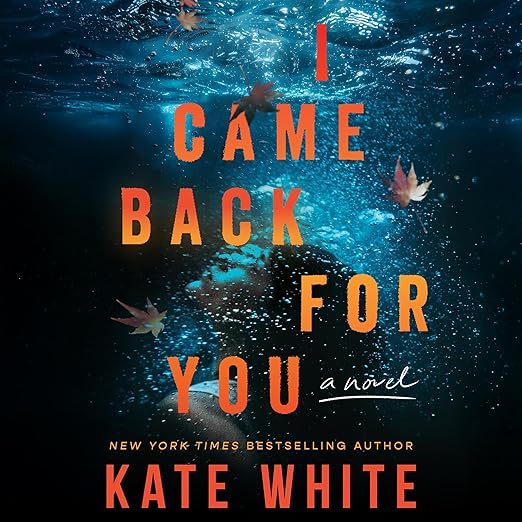
I started I Came Back for You on a quiet Sunday morning, knowing only that it was a Kate White novel about a mother whose daughter’s murder conviction had just been thrown into doubt. That’s enough of a premise to carry an audiobook on its own. What White adds to the formula, and why this entry stands out in her catalog, is that the investigation into Melanie’s death also becomes an investigation into who Melanie was, and the distance between what Bree believed about her daughter and what actually existed is genuinely unsettling.
The setup is precisely constructed. Ten years after Melanie’s murder, Bree Winter has rebuilt a life, new love, new home, new beginning. The deathbed confession from the convicted killer upends everything: he admits to four murders but not Melanie’s. Bree and her ex-husband Logan initially reject it. Then the inconsistencies emerge. White does not rush this section, which is the right call, the transition from certainty to doubt needs to feel earned, not mechanical, and she earns it.
Our Take on I Came Back for You
The most interesting element White introduces is the requirement that Bree return to the upstate New York college town where Melanie died. The Carter College memorial reception, a donation Logan has made in Melanie’s name, is the mechanism that gets Bree back into proximity with people who knew her daughter in ways she didn’t. What she discovers calls into question not just the crime but Melanie herself, and White handles that double revelation with care. The daughter we’ve been grieving alongside Bree is not quite who we assumed.
Reviewers consistently praise the female lead as complex and multi-dimensional. One describes Bree’s intuitive ability to see through the loopholes of the convicted killer’s story, her questioning spirit and her interpretation of Allison’s art, as making her a particularly rich protagonist. Another emphasizes the character development arc across the full novel as immense and believable: by the end, Bree is a different person than the one who received the news of the deathbed confession. That growth is what separates a character-driven thriller from a plot-delivery vehicle.
Why Listen to I Came Back for You
Sarah Naughton’s narration is well-matched to White’s material. The grief in Bree’s voice needs to be present without being operatic, this is a woman who has spent ten years learning to carry something terrible, and Naughton conveys that practiced containment rather than raw wound. When the containment breaks, the effect is proportionally more powerful. At ten hours and eight minutes, the pacing is comfortable for the emotional weight of the material.
White’s Amazon Prime First Reads positioning for this title gave it early exposure to a wide readership, and the review response indicates the book held up under that scrutiny. One early reviewer calls it a genuine treat from an author who excels at complex characters and plenty of suspects to consider, which is the kind of specific endorsement that tells you the reviewer knows what they came for.
What to Watch For in I Came Back for You
One reviewer, three stars, raises some editorial concerns: missing words in sentences and what they describe as excessive clothing description that interrupts narrative momentum. These are manuscript-level issues that a major publisher would typically address, and their presence in the final Brilliance Audio production is a mild surprise. They’re not pervasive enough to damage the listening experience, but listeners who are sensitive to that kind of polish gap may notice.
The multi-language elements scattered through character dialogue (noted by the same reviewer) may also be an occasional friction point. White is clearly using linguistic detail to characterize certain figures, but the execution apparently doesn’t land uniformly. Naughton’s narration smooths some of this over in the audio version.
Who Should Listen to I Came Back for You
Recommended for readers who want their domestic thrillers rooted in genuine maternal grief rather than using parenthood as a plot device, listeners who appreciate female protagonists with tenacity and emotional intelligence rather than procedural expertise, and fans of cold case reopened investigations that complicate rather than restore prior certainty. Also a good entry point for Kate White’s fiction. Skip if you need clean procedural plotting without emotional complexity, or if you’re sensitive to mid-pace sections where the investigation moves through character revelation rather than action. Also pass if you require a protagonist who knows what she’s doing from the start, Bree learns as she goes, and that learning is the book.
Frequently Asked Questions
Does the deathbed confession premise hold up as a thriller device, or does it feel contrived?
Reviewers generally find it well-executed. White uses the confession as a slow destabilizer rather than an immediate action trigger, Bree and Logan initially reject it, and the transition from disbelief to investigation is given proper emotional time.
How does the investigation into Melanie’s murder connect to revelations about Melanie’s hidden life?
The two are structurally linked, what Bree discovers about who actually killed Melanie requires understanding who Melanie actually was, which diverges from Bree’s maternal perception. White uses this double investigation to add depth beyond a standard cold case plot.
How does Sarah Naughton handle the long grief arc that frames the narrative?
With restraint that serves the material. Bree is a woman who has learned to carry loss across ten years, and Naughton’s performance reflects that practiced containment rather than presenting fresh grief. When the emotional breaks come, they land harder for being delayed.
Is this Kate White’s strongest thriller, and where does it fit in her catalog?
One reviewer who knows her work calls it a genuine treat and notes she excels at complex characters with multiple suspects. Without a full catalog comparison, it appears to represent her at a strong midpoint, emotionally sophisticated and well-plotted, with minor editorial rough edges that don’t undermine the whole.