Quick Take
- Narration: Terrence Scott Miller brings a grounded, controlled energy to Hunter Kage that fits the character’s calculating nature, never overwrought, which is the right call for a protagonist defined by operational discipline.
- Themes: vigilante justice and systemic corruption, grief as motivation, the moral cost of living outside the law
- Mood: Tense and propulsive, built for back-to-back chapters
- Verdict: A competent series opener for listeners who want military-adjacent action with psychological underpinning and minimal downtime.
I listened to Hunter Kade on a Friday evening when I needed something that would not ask too much of me intellectually but would hold my attention without difficulty. At four and a half hours, it is essentially a single sitting book, I finished it before midnight with time to spare and immediately thought about whether I would follow the series. That calculation, and what it says about the book’s construction, is where this review begins.
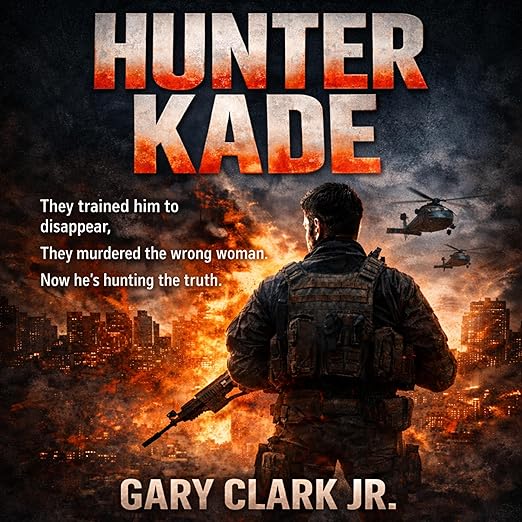
Hunter Kage is a former Marine turned off-the-books operator, a man who, we are told, stopped playing by anyone else’s rules when the system failed the one person he loved. That framing is familiar. The vigilante-shaped-by-personal-loss is the genre’s foundation stone, and Gary Clark Jr. is not trying to reinvent it. What he is doing is executing it with sufficient craft and pace to make the familiar feel fresh enough for the runtime he has to work with.
Our Take on Hunter Kade
The book’s greatest structural asset is its pacing. The thirty-two chapters move quickly, short, punchy, ending at moments that pull you toward the next one. One reviewer called it “one of those books where you listen and let your brain go into entertainment mode,” which is both a compliment and an accurate description of the experience. Clark Jr. is not interested in lingering. The conspiracies involving powerful figures who believed themselves untouchable unfurl at a speed that keeps character complexity secondary to forward motion. Kage himself is efficiently drawn: intelligent, haunted, brutally efficient in ways that feel credible rather than superhuman.
What distinguishes this from genre wallpaper is the book’s conscious choice to make the antagonists’ power structural rather than individual. One reviewer noted that “this fight was never just personal, it’s systemic,” and that framing gives Kage’s mission a scope that pure revenge thrillers often lack. Whether Clark Jr. fully capitalizes on that scope across the series remains to be seen, but the setup here is more thoughtful than the marketing suggests.
Why Listen to Hunter Kade
Terrence Scott Miller’s narration is well-matched to the material. He reads Kage’s interiority without editorializing, the character’s grief and controlled fury come through the restraint of the performance rather than any vocal emoting. This is the right choice. A character defined by operational discipline should not sound like he is performing his own biography. Miller gives Kage the quality of someone who thinks before he acts, which is exactly what the character requires.
One reviewer compared the book favorably to Riley Sager and Jeneva Rose for its “polished on the surface, unraveling underneath energy” and its interest in “how far someone will go to protect what they’ve built.” That comparison is more apt than the military thriller genre label might suggest, the psychological chess match at the story’s center has more in common with domestic suspense than with door-kicking action fiction, even when the surface elements look like the latter.
What to Watch For in Hunter Kade
The book’s brevity is its main limitation. At just over four hours, there is not enough room to fully develop the secondary characters or to let the conspiracy breathe at the scale it implies. The resolution feels efficient to the point of abruptness, and the setup for subsequent books is more prominent than a standalone reading might prefer. If you go in treating this as an extended pilot episode rather than a complete narrative, it works considerably better than if you expect comprehensive closure.
The writing style is also deliberately simple, one reviewer called the language “easy to comprehend” as a positive, but it means the prose itself will not carry you through slow sections the way more stylistically ambitious fiction might. The engine here is plot, and when plot pauses, there is not much else doing the work.
Who Should Listen to Hunter Kade
This book suits listeners who want something fast and direct, a commute book, a plane book, a Friday-evening book. Fans of Vince Flynn’s Mitch Rapp series or Brad Thor’s early work will recognize the template and appreciate the execution. Those looking for character depth, moral ambiguity that goes beyond the genre’s standard register, or prose that justifies the listening experience on its own terms should probably look elsewhere. But for what it sets out to do, it does it well.
Frequently Asked Questions
Is Hunter Kade a standalone story or does it end on a cliffhanger?
The central conflict of this book reaches a resolution, but the series setup is prominent enough that several plot threads extend clearly into future volumes. It functions as a satisfying first episode with an established larger arc rather than an unresolved cliffhanger, but listeners who prefer fully closed stories may notice the loose ends.
How violent is the book, and is the action described in graphic detail?
One reviewer specifically noted that the book takes ‘a cerebral tone’ with Kage outthinking opponents rather than brutalizing them, ‘very little actual violence’ by the standards of the genre. The action is more about strategy and positioning than prolonged combat sequences. The emotional violence of loss and betrayal is more present than physical gore.
Does Terrence Scott Miller use different voices for different characters, or does he narrate in a consistent tone throughout?
Miller’s approach is measured and consistent rather than heavily characterized, he distinguishes between speakers without deploying exaggerated accents or dramatic shifts in register. This suits the book’s controlled, efficient style but means the narration does not add the layer of theatrical differentiation that some listeners prefer in ensemble casts.
Is Gary Clark Jr. the musician or a different author with the same name?
Based on the book’s publisher, publication details, and the series self-publishing profile, this appears to be a different person using the same name as the blues-rock guitarist. The author bio does not claim a music career connection, and the book’s style and themes are unrelated to the musician’s public persona.