Quick Take
- Narration: George Newbern reads with engaged intelligence, handling both the sports analysis and the geopolitical digressions without losing the book’s essential wit.
- Themes: Globalization through sport, tribal identity, the politics of fandom
- Mood: Intellectually playful and sharply observed, occasionally unsettling
- Verdict: An unlikely and durable work of cultural analysis that uses soccer as a genuinely illuminating lens rather than a thin pretext, newly relevant with the 2026 World Cup edition.
I came to this audiobook two decades after the original publication and in the year of the 2026 World Cup edition, and what struck me immediately was how much the book’s central argument has aged into relevance rather than away from it. Franklin Foer published the original in 2004 with a preface about globalization that seemed, to some readers at the time, like it might be overstating the case. Reading it now, with everything that has happened between Glasgow and Glasgow and Budapest and Tehran and beyond, the case seems understated.
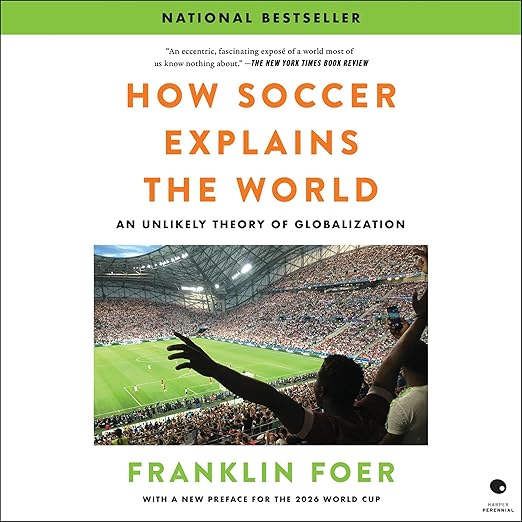
The premise is simple and somewhat counterintuitive. Soccer, the world’s most popular sport and also the one Americans have been slowest to fully embrace, is a better index of how globalization actually functions than most of the economic literature written about it. Foer travels from Brazil to Bosnia to Italy to Iran and reads each football culture as a diagnostic of the society that produced it. The anti-Semitism embedded in certain European club rivalries, the decline of communism in former Eastern Bloc football, the relationship between Iranian political Islam and the national team, these are not analogies or metaphors. They are, Foer argues, the same phenomenon expressed through different registers.
Our Take on How Soccer Explains the World
The book is organized into chapters that each address a different country and a different form of the central argument. This structure means the book is strong at the granular level and somewhat thinner at the theoretical level. Foer is a journalist, not an academic, and the book reads like very good long-form journalism: anecdote-rich, specific, persuasive in individual cases, occasionally inconsistent in the larger architecture. The chapter on Glasgow and the Protestant-Catholic rivalry embedded in the Rangers-Celtic fixture is remarkable. The Iran chapter is quietly damning. The chapter on Brazilian club culture addresses corruption and racial politics with more nuance than most readers will expect.
One reviewer, a self-described huge fan of international soccer, found the politics subplot less satisfying than the sporting content, which is a legitimate response but also somewhat inverts what the book is actually doing. Foer is not using politics to explain soccer. He is using soccer to explain politics. Readers who come for sports analysis and find themselves getting geopolitics are experiencing the argument rather than departing from it.
Why Listen to How Soccer Explains the World
The 2026 edition, released ahead of the World Cup in North America, includes a new preface from the author that acknowledges both what has changed and what has remained grimly consistent since 2004. That preface is worth the price of the edition alone for anyone who read the original. George Newbern reads with an intelligence and some warmth that matches Foer’s own prose tone, which is dark and witty in roughly equal measure. Robert Kagan’s blurb, cited in the synopsis, gets the combination right: the soccer world reveals the meaning of globalization in all its joys and horrors. Newbern’s narration holds both registers simultaneously rather than leaning into one at the expense of the other.
The book was named one of the five most influential sports books of the decade by Sports Illustrated, and that recognition points to something real: it expanded what sports writing was allowed to be. Before Foer, the intersection of sports and serious political analysis was a relatively narrow genre. How Soccer Explains the World helped establish a mode of sports writing that treats the stadium as a legitimate site of cultural analysis, and that legacy is visible in a generation of books that followed it.
What to Watch For in How Soccer Explains the World
The book is explicitly not about the mechanics or aesthetics of soccer as a sport. If you want tactical analysis, historical tournament coverage, or player biography, this will frustrate you. One reviewer warned against falling into the title’s trap, which is fair: the title promises explanation through soccer, not explanation of soccer, and that distinction matters for setting expectations. Additionally, some of the specific facts and club situations described in the original chapters have changed since 2004. The new preface addresses some of this but cannot update the full text, so listeners should hold the more time-bound claims with appropriate context.
Who Should Listen to How Soccer Explains the World
People who are curious about globalization but bored by economics textbooks, soccer fans who want their sport taken seriously as a cultural phenomenon, and readers who enjoyed other examples of using a specific lens to illuminate large patterns will find this rewarding. With the 2026 World Cup arriving in North America, there is no better moment to understand why soccer generates the specific intensities it does, and why those intensities tell us something true about the world. Those who want sports purely as entertainment, without the political freight, should probably look elsewhere.
Frequently Asked Questions
Do you need to know soccer or care about the sport to appreciate this book?
No. Several reviewers who had limited prior interest in soccer found the book fully engaging. Foer uses the sport as a lens rather than a subject, so familiarity with specific clubs or players matters less than curiosity about what fanaticism, tribal identity, and cultural politics reveal about globalization.
What does the new preface in the 2026 edition add to the original?
The new preface from Foer addresses what has changed and what has remained consistent since the original 2004 publication, updating the argument’s relevance for the 2026 World Cup context. It is a substantive addition for readers familiar with the original, though the full text of the original chapters was not updated.
How does the book handle the anti-Semitism embedded in European football rivalries?
Directly and with considerable historical specificity. The Glasgow Rangers-Celtic fixture and the Jewish identity associated with certain London and Budapest clubs are among the book’s most closely analyzed cases. Foer treats these not as aberrations but as diagnostic of the broader cultural tensions that soccer cultures amplify and express.
Is this primarily a sports book or a politics and culture book?
Politics and culture, with soccer as the consistent vehicle. Foer’s central argument is that soccer illuminates globalization, not that globalization illuminates soccer. Readers who come expecting tactical sports analysis will be surprised. Readers who come curious about what sport reveals about societies will find exactly what they came for.