Quick Take
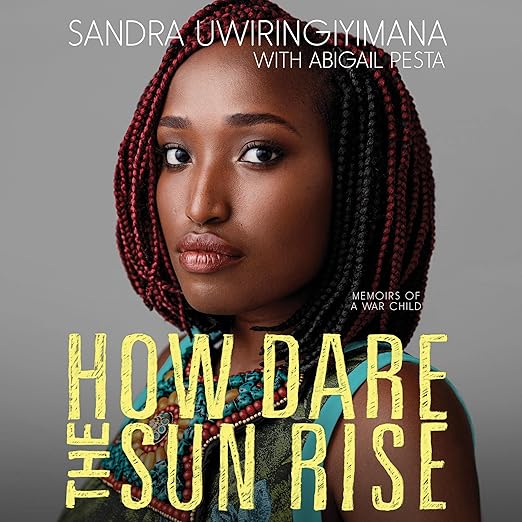
- Narration: Sandra Uwiringiyimana reads her own story, and the intimacy of that choice is undeniable, her voice carries grief and defiance in equal measure, though pacing grows uneven in the middle sections.
- Themes: refugee survival, identity across cultures, healing through activism
- Mood: Raw and quietly heroic
- Verdict: A memoir that earns every award it has received, narrated with personal authenticity no professional voice actor could replicate.
I started listening to this on a Tuesday morning commute, expecting something moving. I was not prepared for the first twenty minutes. Sandra Uwiringiyimana describes being ten years old, a gun pointed at her head, her mother and six-year-old sister already shot by rebels in a refugee camp in the Democratic Republic of the Congo. The audio stopped me cold on a crowded subway platform. I stepped aside and stood there for a moment, needing the world to be still around me before I could continue.
What followed across the next six and a half hours is one of the most quietly devastating accounts of displacement, survival, and reinvention I have encountered in years of reviewing memoirs. Uwiringiyimana, a Banyamulenge girl from South Kivu, guides us from the mountains of eastern Congo through the chaos of statelessness to the brutal disorientation of middle school in New York City. That last part is not a throwaway detail. The gap between surviving a massacre and navigating American adolescence is exactly the kind of subject this book handles with unflinching honesty.
The Weight of a Voice Reading Its Own Words
Author-narrated memoirs carry a particular risk. The person who lived through something is not always the person best equipped to vocalize it. Here, though, the choice feels not just right but necessary. Uwiringiyimana’s accent, her particular cadences, the way her voice tightens around the hardest passages, all of it tells you something no production notes could communicate. You are not listening to a performance of grief. You are listening to someone who has processed it enough to share it, but not so much that the edges have been sanded smooth.
One reviewer described this as a contribution to the refugee narrative that is complex and nuanced, and the narration is inseparable from that complexity. The New York Times Book Review noted this book refuses to reduce her story to the word refugee, and that refusal is most audible in the narration itself. When she describes her surviving family members struggling to stay alive after the massacre, the voice does not dramatize. It remembers. That restraint is its own form of courage, and it takes a particular kind of inner discipline to maintain it across six-plus hours of audio when the material is this personal. There are moments where the pacing becomes slightly uneven, passages that feel rushed where I wanted more time, and others that circle back when the narrative would benefit from moving forward. These are small complaints against an overall listening experience that stays with you.
The America That Waited on the Other Side
The first half of this memoir covers events most listeners will find devastating but perhaps familiar in broad outline: war, displacement, the United Nations refugee program, the crossing of an ocean. The part that caught me off guard, and that I think makes this book genuinely important for young adult readers especially, is what happens after arrival. Sandra Uwiringiyimana makes clear that crossing an ocean was not the end of the story. The ethnic and cultural disconnect she encountered in a New York middle school was its own form of alienation. She was expected, it seems, to be simply grateful. To assimilate. To become legible to systems that had no vocabulary for what she had survived.
The book is at its sharpest in these American chapters. Uwiringiyimana describes the secondary trauma and difficulty of immigration in terms that complicate the simple rescue narrative that refugee stories are often forced to adopt. She had to endure things she did not expect from the country she had been told represented freedom. That dissonance is named, not euphemized. It is the reason the New York Times review described this as a memoir that refuses reduction. Reduction would have been easier and less honest.
What the Awards Recognize and What They Cannot
This book has accumulated significant recognition: Junior Library Guild Selection, New York Public Library Best Books for Teens, Goodreads Choice Awards Nonfiction Finalist, YALSA Quick Picks, Bank Street Best Books. Awards tend to gesture toward a book’s cultural position rather than its texture, so let me be specific about what makes this worth the accolades. It is not simply that the story is harrowing. It is that Uwiringiyimana has structured a coming-of-age narrative inside a survival story, and somehow made both feel true simultaneously.
The arc of a girl finding her voice through art and activism does not feel bolted on as an uplifting conclusion. It feels earned through everything the reader has witnessed alongside her. One reviewer described it as a story of resilience, courage, hope, healing, and growth, which is accurate but undersells how the book refuses to make those qualities feel easy or inevitable. Another noted giving it to a teenage daughter specifically to learn about other people’s struggles and how determination can help overcome adversity. That pedagogical purpose is served without the book ever feeling like a lesson rather than a life.
Who Should Listen and Who Should Know This First
The memoir is written accessibly, aimed at a young adult audience but readable and listenable for adults without any sense of condescension in either direction. It is genuinely excellent for classroom settings, book clubs with high schoolers, and any reader who wants to understand the Banyamulenge experience of the DRC conflicts with both historical context and human specificity. Listeners who have appreciated works like I Am Malala or A Long Way Gone will find a natural companion here, with the distinction that Uwiringiyimana’s American chapters add a dimension those books do not explore.
The only real caveat is for listeners who want deep historical or political background on the conflicts in eastern Congo. This is a memoir, not a history, and Uwiringiyimana explains her family’s context as she needs to rather than comprehensively. Listeners seeking that context should supplement with other sources. What the book provides is something those sources cannot: the specific weight of one person’s survival, narrated by the person who survived it.
Frequently Asked Questions
Does Sandra Uwiringiyimana narrating her own memoir significantly affect the emotional impact compared to a professional narrator?
Significantly and positively. Her voice carries authentic weight in the hardest passages, the gun-at-her-head scene, the deaths of her mother and sister, that a professional performance would struggle to match. The unevenness that sometimes accompanies author narration is present, but the intimacy far outweighs it.
Is this memoir appropriate for younger teen readers, or does the violence make it better suited to older audiences?
It is published as a YA memoir and has earned multiple teen library selections. The violence, including the massacre in the refugee camp, is described with clarity but without graphic detail. Most librarians and reviewers place it comfortably at middle school and up, around age 12 or 13.
Does the book cover Uwiringiyimana’s activism and advocacy work, or does it stop at the immigration story?
The memoir addresses how she found purpose through art and activism after arriving in America, framing these as the means by which she processed trauma and found community. It is not a deep dive into her public advocacy specifically, but those threads run through the final sections and give the book its sense of forward momentum.
How much historical background does the book provide on the Banyamulenge conflict in the DRC for listeners unfamiliar with the region?
Enough to follow the story without prior knowledge, but this is a memoir, not a history. Uwiringiyimana explains her family’s context as a Banyamulenge minority in South Kivu, but listeners seeking deep political or historical analysis will need to supplement with other sources. The personal experience is the primary frame throughout.