Quick Take
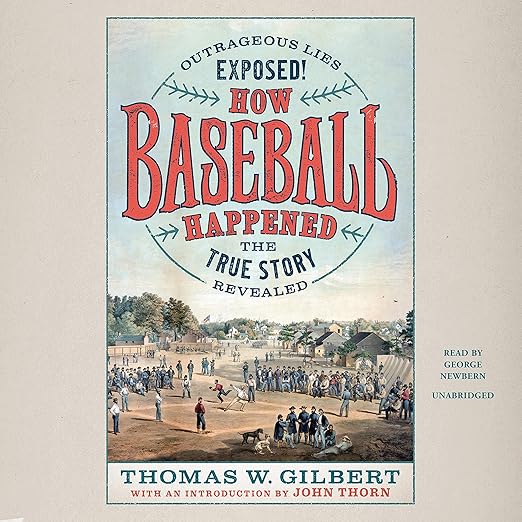
- Narration: George Newbern delivers Thomas W. Gilbert’s revisionist baseball history with the engaged authority of a knowledgeable guide rather than a dry academic, keeping 10-plus hours of historical analysis genuinely listenable.
- Themes: myth-making versus historical reality, Brooklyn as the forgotten birthplace of modern baseball, the role of amateurs in creating professional sport
- Mood: Enthusiastically revisionist, with the pleasure of a long-held misconception being cheerfully demolished
- Verdict: An essential listen for anyone who thinks they know how baseball began, especially for the sustained argument about Brooklyn’s role that the sport’s official history has consistently undervalued.
I was halfway through a long train journey when I started How Baseball Happened, and I arrived at my destination annoyed that the trip was not longer. Thomas W. Gilbert has written the kind of sports history that makes you want to argue with someone about it immediately, not because it is wrong, but because it is so convincingly right about things you did not know you believed incorrectly.
The central claim is clean and well-supported: the founding myths of baseball, Abner Doubleday inventing the game in Cooperstown, the Knickerbockers playing the first game in 1846, Jackie Robinson as the sole crosser of baseball’s color line, are wrong. All of them. Gilbert dismantles each myth with the patience of someone who has spent years in the primary sources and emerges with a counter-narrative that is considerably more interesting than the official version. The real founders of baseball were ordinary 19th-century Americans: workers, businessmen, Civil War soldiers, and the fans who crashed a game that was supposed to be played, not watched. Brooklyn, not Cooperstown or Hoboken, was where the sport actually developed its modern form.
Our Take on How Baseball Happened
What makes Gilbert’s argument compelling is that he does not simply correct the record; he explains why the record was falsified and what interests were served by the falsification. The Cooperstown myth was a deliberate invention, and Gilbert’s excavation of that process is as interesting as the actual history. He is also honest about the injustices that got erased: the color line was not unchallenged before Jackie Robinson, and the Black players who competed in early amateur baseball deserve to be part of the origin story that Cooperstown chose to tell without them.
George Newbern’s narration is well-matched to the material. Gilbert writes like a host rather than an academic, and Newbern picks up that register easily. One reviewer described him as providing good company during a pandemic, which is a specific and accurate way of capturing how the book works as audio. The 10-plus hours move with the energy of an enthusiastic expert who finds his subject genuinely fascinating, rather than someone delivering a lecture.
Why Listen to How Baseball Happened
The revisionist energy of How Baseball Happened is its greatest strength. Gilbert is not writing for people who want to have their assumptions confirmed; he is writing for people who want to understand how a sport becomes a mythology, and what gets lost in that process. The Brooklyn argument is particularly well-developed. Gilbert’s case that the first ballpark, the first organized fans, and the first professionalism experiment all happened in Brooklyn is built from period sources rather than assertion, and it holds up.
The book also handles the intersection of baseball and American history with more sophistication than most sports histories attempt. The Civil War sections, in which the amateur players who built the sport went off to fight and brought the game with them to encampments across the country, are genuinely moving. Gilbert understands that baseball’s expansion during and after the war was not incidental but structural, and he traces that expansion with the kind of detail that lets you follow the argument rather than simply accept it.
What to Watch For in How Baseball Happened
One reviewer found the New York argument repetitive by the midpoint, noting that Gilbert returns to the Brooklyn and New York City origin claims more often than necessary. That is a fair criticism. Gilbert is making a corrective argument against a century of official myth, and he occasionally over-corrects by over-repeating. Listeners who absorb the main thesis in the first few hours may find the later chapters more redundant than reinforcing.
The book is also specifically written for baseball fans and American history enthusiasts, and it does not make many concessions to readers who have neither interest. The cast of 19th-century figures, many of them obscure, is dense, and the narrative does not always pause long enough to let them become fully three-dimensional before moving on. This is the nature of the material rather than a failure of craft, but listeners who prefer their history with stronger individual portraits may find the biographical texture thin.
Who Should Listen to How Baseball Happened
Baseball fans who want their understanding of the sport’s origins genuinely revised will find this among the more satisfying sports history audiobooks available. It is also a strong choice for American history enthusiasts interested in how sports and culture intersected in the 19th century, particularly around the Civil War and Reconstruction. Skip it if you have no interest in the sport and are looking for this as a general American history, since the argument is specifically baseball-centric. Those sensitive to repetition in argumentative nonfiction may want to be prepared for the Brooklyn thesis to return several times more than necessary.
Frequently Asked Questions
Does How Baseball Happened require deep knowledge of baseball history to follow the argument?
No, though it helps to have a passing familiarity with names like Abner Doubleday and Alexander Cartwright, since Gilbert’s argument is partly structured as a refutation of their mythologized status. The book provides enough context for casual fans to follow, while offering new material even to serious historians.
Is the claim about Jackie Robinson and the color line presented fairly, or is it sensationalized?
Gilbert makes a measured, evidence-based case that the color line was not as absolute before Robinson as the official history suggests. He is not diminishing Robinson’s significance but arguing that the pre-Robinson history was more complex and that Black players who competed earlier deserve historical recognition.
How does George Newbern’s narration handle the density of 19th-century names and facts?
Newbern reads with enough warmth and engagement that the density of historical detail stays accessible rather than overwhelming. He is particularly effective at maintaining the conversational energy that Gilbert builds into his prose, which keeps the corrective argument from feeling like a lecture.
Is the book repetitive enough to be a significant problem across 10 hours?
Some listeners find the central Brooklyn and New York origin argument returns more often than necessary in the second half. If you absorb the main thesis early, some later sections will feel like reinforcement rather than new information. It is a real issue but not severe enough to undermine the overall experience.