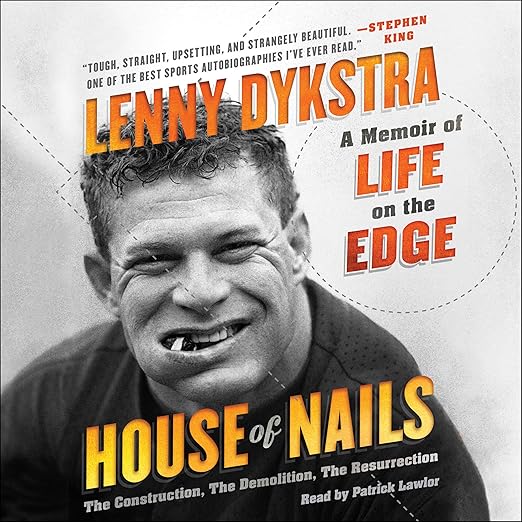
Quick Take
- Narration: Patrick Lawlor captures Dykstra’s brash energy with a gravel-edged delivery that suits the bravado perfectly, though the softer reflective passages feel somewhat uniform in tone.
- Themes: American excess and downfall, athletic identity beyond the game, the slippery line between confidence and self-delusion
- Mood: Loud, unrepentant, and strangely entertaining
- Verdict: If you can tolerate a narrator who insists on his own innocence while confessing everything else, this is one of the more compulsively listenable sports memoirs in recent memory.
I started House of Nails on a Saturday morning thinking I would get through the first couple of chapters before moving on to something else. Four hours later I was still walking circles around my apartment, completely unable to put it down. That does not happen often with sports memoirs, a genre I have come to approach with measured expectations after years of reviewing material that oscillates between hagiography and polished PR. Lenny Dykstra has written neither of those things. What he has written is something far more bewildering, frequently infuriating, and in its own lopsided way, genuinely compelling. The book holds you through sheer force of personality even when the personality in question is arguing something you do not believe.
Stephen King called this one of the best sports autobiographies he had ever read, and while I would stop short of that particular superlative, I understand what he means. There is a Shakespearean quality to the Dykstra story that the synopsis promises and the book more or less delivers. The arc is almost too dramatic to be believable: All-Star center fielder, celebrated Moneyball prototype, self-made multimillionaire, and then federal felon. No novelist would dare plot it this way because readers would find it implausible. Yet every element is documented, contested in some cases, but documented. Jon Stewart famously called Dykstra’s rise and fall the greatest story he had ever witnessed, and the raw material justifies the excitement even when the storyteller fails it.
The Baseball Years: When the Swagger Had a Point
The first half of the audiobook covers Dykstra’s career with the 1986 Mets and later the Phillies, and this is where the production earns its four-star average. Patrick Lawlor’s narration, while not especially flexible, has a naturally gruff quality that fits Dykstra’s voice on the page. The baseball stories are the engine here. Dykstra’s account of what it actually took to compete at the major-league level, the obsessive preparation, the willingness to play through injuries that would hospitalize most people, reads as genuinely illuminating. He is not a graceful writer, but the rawness functions as authenticity. When he describes stepping into the box during a World Series game, the visceral quality of the prose carries real weight that more polished memoirs often fail to achieve.
He also burns a few bridges along the way. Specific teammates and managers are criticized by name, which some listeners will find unsavory and others will appreciate as the cost of candor. The steroid admissions are handled with the same casual bluntness that characterizes the whole book. Dykstra does not moralize about them. He frames performance-enhancing drugs as a pragmatic survival strategy in an era when they were ubiquitous, and he moves on. Whether you accept that framing is up to you, but it does not feel like spin in the way his later financial chapters do. What is refreshing, strangely, is the absence of elaborate self-justification in these passages. He simply states what happened and continues. The moral complexity is left to the listener to work through.
The Business Act: Where the Story Strains Credibility
After retirement, Dykstra pivoted into finance and became, briefly, a celebrated investment figure. Jim Cramer praised him on CNBC. The New Yorker profiled him. He acquired a mansion worth $17.5 million and traveled by private jet. And then, as the 2008 financial crisis arrived, everything collapsed. He was convicted of bankruptcy fraud and spent more than two years in prison, where he describes a brutal beating at the hands of prison guards that resulted in the loss of his front teeth. The book’s account of this period is genuinely harrowing in places, and the details of his prison experience have a specificity that feels impossible to fabricate.
The problem in this section is the one several reviewers have identified with precision: Dykstra will not concede wrongdoing. He insists, chapter after chapter, that he was framed, that the system failed him, that he is innocent of the charges. One reviewer noted with dry accuracy that an entire chapter reads as an advertisement for his stock-picking newsletter. The insistence on victimhood sits uneasily beside everything else he has confessed to in other chapters, and it creates a credibility gap that undermines what might have been a genuinely moving account of hubris and consequence. The book is more interesting when it trusts the story enough to get out of its own way.
Patrick Lawlor and the Question of Narration Fit
Lawlor is a capable and experienced audiobook narrator, and his work here is more than serviceable. He finds Dykstra’s cadence naturally, and the swagger in the baseball chapters comes through without feeling performed. Where he is less successful is in the book’s more introspective passages, which arrive in the later chapters as Dykstra reflects on his prison experience and the long aftermath. The emotional register does not shift enough, and the result is that the book’s more vulnerable moments land with less force than they should. This is a structural issue as much as a performance one: Dykstra himself is not a reliable narrator of his own inner life. But a more dynamically flexible reader might have compensated for that on the audio side. As it stands, the narration serves the first half considerably better than the second.
Who Should Listen, and Who Should Skip
If you are a baseball fan who remembers the 1980s Mets or the early 1990s Phillies, this is probably essential listening. Even critics of Dykstra the person tend to acknowledge that his account of what it felt like to play in those teams and those eras is vivid and worthwhile. One reviewer put it well: you want to believe in him, you accept spin from him, and that describes the listening experience precisely. The book rewards listeners who can hold two contradictory responses simultaneously, being both entertained by the storytelling and skeptical of the storyteller. If you come for accountability and genuine reckoning, you will be disappointed. Dykstra never quite arrives there. The book ends more or less where it began: with Nails insisting he was right all along, and somehow still managing to be interesting about it.
Frequently Asked Questions
Do I need to know anything about baseball to enjoy House of Nails?
Basic familiarity with the Mets and Phillies of the 1980s and 1990s helps with context, but Dykstra explains enough that interested non-fans should be able to follow the story. The second half, covering his financial rise and fall, requires no baseball knowledge at all.
Does Dykstra actually admit to steroid use in this audiobook?
Yes, he addresses steroid use directly and without much hand-wringing. He frames it as common practice in that era and moves on quickly. It is one of the more candid passages in a book that is otherwise quite selective about what it admits.
Is the Patrick Lawlor narration well-matched to Dykstra’s voice?
For the baseball chapters, yes. Lawlor has a gruff, energetic quality that fits Dykstra’s swagger on the page. The later, more reflective sections are less convincingly rendered, which some listeners may find jarring given how much the emotional register of the book changes.
How much of the book covers the prison experience?
The prison section is covered but not in exhaustive detail. Dykstra describes the conditions, including the alleged beating by guards, but the account is relatively compressed compared to the baseball material. Listeners expecting a detailed prison narrative will find the baseball years receive considerably more attention.