Quick Take
- Narration: Brittany Pressley captures Lou’s specific brand of anxious, earnest disaster energy without making her grating – a performance that keeps you rooting for a character who makes a lot of bad choices.
- Themes: queer self-discovery, the fear of endings and last summers, the distance between who you want and who you are
- Mood: Warm, fizzy, and occasionally tear-inducing – everything you want from a summer coming-of-age story
- Verdict: Jennifer Dugan’s debut delivers on its rom-com premise while sneaking in genuine emotional depth about identity, self-deception, and the friendships we take for granted.
I listened to Hot Dog Girl in the kind of distracted, hopeful August that this book was clearly made for – between other things, on dog walks and during cooking, the way you consume something that is keeping you company rather than demanding your full attention. But Dugan’s novel kept pulling me back to full attention, because there was more going on underneath the amusement park silliness than I had expected from a YA rom-com about a girl in a hot dog costume.
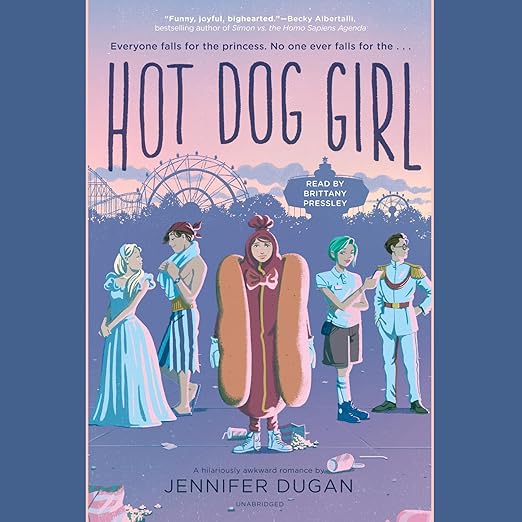
Lou Parker is working as a giant dancing hot dog at Magic Castle Playland, a local amusement park that is about to close forever, while her best friend Seeley operates the carousel. Lou is in love with Nick, the dreamy diving pirate who already has a girlfriend. She wants to save the park. She wants everything to stay the same, precisely because she has not yet figured out that what she actually wants is something else entirely. The setup is classic, and Dugan knows what she is doing with it.
Our Take on Hot Dog Girl
What distinguishes this debut is the way Dugan handles Lou’s self-knowledge, or rather her lack of it. Lou spends a significant portion of the novel in pursuit of Nick while simultaneously devoting enormous energy to finding the perfect girl for Seeley. The reader, and presumably many listeners, will clock what is happening well before Lou does. But Dugan earns the delay rather than relying on it – Lou’s obliviousness is psychologically coherent, rooted in a specific kind of fear rather than authorial convenience, and the moment she catches up to the reader has real emotional force.
The amusement park setting is used with invention. Magic Castle Playland is a place that exists at the intersection of magic and tackiness, where the costumes are faded and the rides need maintenance and people still find meaning in working there. One reviewer describes it as a cute summer movie waiting to happen, and they are right – the visual economy is excellent, and the ensemble of costumed characters has the kind of worn-in specificity that comes from an author who has thought carefully about the world they are building.
Why Listen to Hot Dog Girl
Brittany Pressley’s narration for Listening Library suits the material well. She finds Lou’s specific register – performatively casual about things that matter enormously, genuinely casual about things that do not – and sustains it without monotony across seven and a half hours. The comic timing for Lou’s various disasters is precise, and Pressley’s handling of the shifts into more serious emotional territory earns the transitions rather than announcing them.
The father-daughter dynamic, which several reviewers single out for praise, is given particular care in the audio performance. Lou’s relationship with her dad runs through the book as a quieter counterweight to the louder romantic plots, and it is in those scenes that Pressley’s performance gets noticeably more honest and less performed – which is exactly the right choice.
What to Watch For in Hot Dog Girl
Listeners approaching this as a conventional romance who expect the Nick plotline to be the central arc should know that Dugan is using the Nick pursuit as misdirection in ways that will feel satisfying in retrospect but may feel frustrating in the middle if you are invested in the wrong pairing. The book’s real romance is not the one the synopsis foregrounds, and knowing this makes the experience more comfortable for readers who dislike narrative bait-and-switches.
This is also explicitly YA, and while multiple reviewers in their twenties and beyond found it moving and resonant, listeners who find the particular anxieties of seventeen-year-olds taxing over a sustained period should calibrate their expectations. The teen angst is real and present; it is also, ultimately, what gives the book its emotional truth.
Who Should Listen to Hot Dog Girl
Anyone who has ever worked a summer job in a place they loved that was being threatened, anyone navigating the specific confusion of not knowing who you want until you have been wanting the wrong person for a while, and anyone who enjoys queer coming-of-age stories with real comedic energy will find this satisfying. Readers of Rainbow Rowell’s Eleanor and Park or Adam Silvera’s They Both Die at the End who want something lighter and less devastating will land in exactly the right place. This is a summer listen in the best sense.
Frequently Asked Questions
Is the queer romance in Hot Dog Girl explicit and central, or is it a minor subplot?
It is the central romance of the novel, though the synopsis obscures this somewhat. The Nick pursuit is the stated goal of Lou’s plot, but the actual love story is between Lou and Seeley. This is not a spoiler so much as a corrective to the marketing framing – the book is a sapphic romance at its heart, and Dugan writes it with genuine feeling.
How does Brittany Pressley handle the shift from comedy to emotional sincerity in the second half?
With real skill. The tonal shift is something of a test for any YA rom-com narrator, and Pressley navigates it without overcorrecting. The comedy in the first half is genuinely funny rather than simply energetic, which means the shift to more earnest territory in the second half lands because it is contrasting with something real rather than with performed brightness.
Several reviewers mention the book made them cry – is this a primarily funny book or primarily an emotional one?
Both, and in sequence rather than simultaneously. The first half is primarily comedic with emotional undercurrents; the second half inverts that proportion. The crying tends to come late and is connected to the best friend dynamic and the park’s closing rather than the romance per se. Think of it as a comedy that earns its emotional payoff rather than a tearjerker that deploys jokes.
Is this book appropriate for younger YA readers, or is it aimed at older teens?
The content is appropriate for most teen readers. The romance is emotionally rather than physically explicit – this is a coming-of-age story focused on identity confusion and friendship rather than explicit content. Multiple adult readers note finding it resonant, which suggests the emotional range works across ages, but the core audience is teen and early-twenties readers.