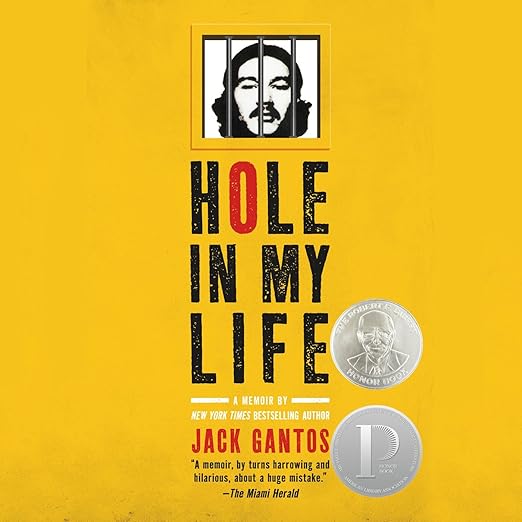
I first read Hole in My Life in a stack of books I was reviewing for a piece on coming-of-age memoir, and I remember being struck by how different it was from the typical YA nonfiction format, books that tend to offer a crisis, a resolution, and a set of lessons extracted with the tidiness of a school assembly. Gantos does not write that kind of book. He is too honest and too good a writer to simplify a story that was genuinely complicated and costly. I listened to the audiobook version more recently, Gantos reads it himself, which is the only way this memoir could work, and the intimacy of his voice brought the material into even sharper focus.
The premise is stark: in the summer of 1971, Jack Gantos was nineteen, desperate for tuition money to attend college, and unable to see a viable path forward. When he was offered ten thousand dollars to help sail a yacht loaded with hashish from the Virgin Islands to New York City, he took it. Federal agents caught up with him eventually, and he was sentenced to serve up to six years in a federal prison. This is not a story that happens to a bad person. It is a story that happens to an ambitious, intelligent young man who made a catastrophic decision from a place of desperation and impatience.
The Verdict, Briefly
What makes the memoir extraordinary is Gantos's refusal to stand outside his younger self in judgment. He does not present a retrospective narrator who has all the answers looking back at a foolish kid. He inhabits the decision-making as it happened: the logic that made the scheme seem viable, the rationalizations, the moments when the right choice was available and not taken. That psychological honesty is rare in any memoir and especially rare in one written for young adults, who are usually offered the sanitized version of what adult failure looks like.
The prison sections are where the book finds its deepest theme. In a small yellow-walled cell, Gantos discovers the gap between wanting to be a writer and actually writing. The memoir is as much about that distinction, between aspiration and practice, between identifying yourself as a person who will do something someday and doing it now, with the materials at hand, as it is about the crime and punishment. One reviewer captured this well: Gantos explains how "dedicating himself more fully to the thing he most wanted to do helped him endure and ultimately overcome the worst experience of his life." That is the book's central argument, and it earns it.
The Best Parts of Hole In My Life
At four hours and twenty minutes, this is among the shortest audiobooks you will find in the YA memoir category, and the brevity feels entirely right. Gantos is not padding. The prose has the economy of someone who learned to write under constraint, literally, in a prison cell with limited materials, and the audiobook reflects that. Every chapter has a purpose and a shape, and the cumulative effect of the short runtime is that nothing is wasted.
Gantos reading his own work is the correct production choice and the only one that makes full sense. His voice has the same dry, self-implicating wit as the prose. When he describes his younger self's thinking, the slight distance between the narrating voice and the nineteen-year-old in the story is audible and functional, you can hear a man who has thought carefully about who he was and what he chose, without either excusing or condemning that person. It is a performance in the truest sense of the word, and it is accomplished.
What Might Not Land
Classroom teachers who assign this, and it is widely assigned, particularly in middle school and high school settings, note that the drug-smuggling and incarceration content requires some contextual framing for younger students. Gantos is not gratuitous, but he is frank, and the book does not warn you before depicting the consequences of federal drug conspiracy charges in real terms. That frankness is a feature rather than a flaw; the book would be diminished if it hedged. But adult facilitators working with the book should be aware of the content.
The book's final chapters, covering Gantos's return to writing and his path to publication after prison, are necessarily brief given the timeline. Some readers who have become invested in the literary ambition strand of the memoir may wish for more detail about how that post-prison writing practice actually developed. The broad outlines are present; the texture of the daily work is implied more than shown.
The Right Listener for Hole In My Life
This is the rare book that works for both the teenage audience it is formally addressed to and for adult readers who have never encountered it. Young adults navigating the tension between ambition and impatience, particularly those who feel the gap between where they are and where they want to be as acutely as Gantos did at nineteen, will find something genuinely useful here, without it being positioned as a lesson. Adult readers interested in memoir, in writing-about-writing, or in the particular American moment of the early 1970s will find this a rich four hours. It is one of the best short memoirs in the YA category, and it stands up outside that category entirely.
Before You Press Play
- Performance: Jack Gantos reading his own memoir is the only narration that could work here, his voice has the same dry, self-implicating humor as the prose, and the intimacy of a person telling their own story of failure transforms the material.
- What it covers: The price of bad decisions made from desperation, writing as a form of survival, the gap between ambition and the choices that betray it
- Feel: Honest and often darkly funny, with a thread of genuine regret that never tips into self-pity
- Our call: A rare young adult memoir that treats its audience as capable of handling real moral complexity, Gantos does not soften the consequences of his choices, which is precisely what makes the book so valuable.
Good to Know
Is the fact that Gantos narrates his own memoir significantly different from having a professional narrator read it?
Entirely different, and in this case irreplaceable. The slight temporal distance between the narrating voice and the nineteen-year-old in the story, audible in Gantos's delivery, is central to how the memoir handles moral complexity. A professional narrator could read the words but could not provide the weight of the person who actually lived them.
Is this appropriate for middle school students, given that it involves drug smuggling and federal prison?
It is widely assigned in middle and high school settings, but the content, drug trafficking, incarceration, and frank discussion of a federal conspiracy charge, requires contextual framing from teachers or parents for younger students. Gantos is not gratuitous, but he is not sanitizing, and that honesty is the book's strength.
How does the book handle the question of regret, does Gantos moralize about his choices, or does he leave the reader to draw conclusions?
He leaves the reader to draw conclusions, which is what makes the book work. There is no self-flagellation and no performed redemption arc. Gantos inhabits the decision-making as it happened, including its logic and its costs, and trusts the reader to understand why those choices were catastrophic without being told explicitly. That restraint is one of the memoir's most valuable qualities.