Quick Take
- Narration: Nathan Leamon reads his own work with the patient clarity of someone who has explained these ideas to professional cricketers, measured, precise, and genuinely enthusiastic.
- Themes: Data analytics in cricket, the gap between received wisdom and evidence, T20 evolution
- Mood: Intellectually energizing, accessible without being simplified
- Verdict: The most important cricket analytics book published in years, and Leamon’s self-narration gives it an authority that reflects his unique position inside the England cricket team’s data operation.
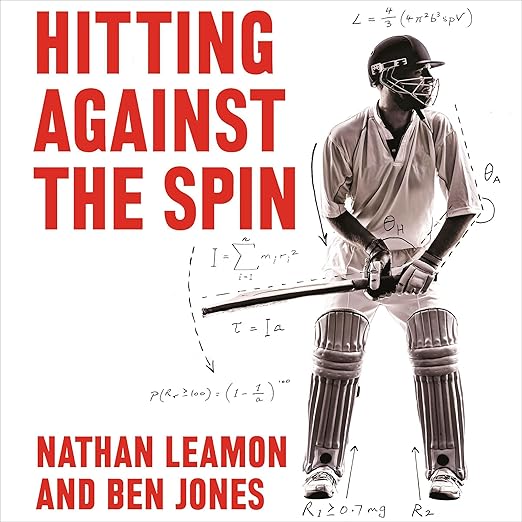
Cricket analytics books occupy a peculiar position: they have to be rigorous enough to satisfy the technically inclined while remaining accessible to the fan who cares about the game but has no background in statistics. Hitting Against the Spin, written by England cricket’s lead analyst Nathan Leamon and journalist Ben Jones, is the best attempt I have encountered at threading that needle. I listened to it over two evening sessions, the first covering the Test cricket material, the second the T20 analysis, and came away understanding the game differently than I had before, which is the only meaningful test of a book making this kind of claim.
The book opens with a question that gives it its title: does hitting against the spin actually work? The title question is a reference to the cricketing orthodoxy that batters should hit in the direction the ball is turning, and Leamon’s data-driven answer to it is one of the book’s sharpest moments. But the title question is really a proxy for the book’s larger project: what does the data actually tell us about how cricket works, and how much of what players and coaches believe is tradition rather than evidence?
The Questions Leamon and Jones Are Actually Asking
The book works through a series of specific questions: how valuable is winning the toss? Why does a cricket ball swing? Why don’t Indians bat left-handed? What is a good length, and why? Why are leg-spinners so successful in T20 cricket? These are the questions that cricketers have argued about for decades without systematic evidence, and Leamon and Jones apply ball-tracking data and match analytics to each of them. The answers are sometimes surprising, sometimes confirmatory of existing wisdom, and always specific in a way that makes the argument feel earned rather than speculative.
The ball-tracking technology that makes this kind of analysis possible, measuring every ball to within millimetres, including release point, speed, bounce point, swing, deviation, and the exact height and line at the stumps, is itself a recent development. Leamon is well positioned to explain both the technology and its implications, having used it professionally as England’s analyst. His authority is not just academic. He has made actual decisions based on this data, and that experience shapes the way he explains the analysis to a general audience.
What the T20 Material Gets Right
The chapters on T20 and franchise cricket are where the book is most forward-looking. Leamon and Jones argue that T20 has not simply accelerated existing cricket dynamics but has genuinely changed the game in ways that challenge Test match orthodoxies. The analysis of why leg-spinners perform differently in T20 than in other formats is particularly sharp, it challenges assumptions about risk and reward in the short format that have guided captaincy decisions for years. Readers who follow the IPL and other franchise tournaments will find this section the most directly applicable to what they watch week to week.
One reviewer noted some frustration with the first chapter, finding the argument on winning the World Cup more qualitative than expected. That is a fair observation about the book’s variation in analytical rigor, some chapters deliver more quantitative evidence than others, and the opening chapter leans more heavily on Leamon’s professional judgment than on raw data. Listeners should know this variation exists. The book is not uniformly statistical throughout; it combines data with insider knowledge in proportions that shift by chapter.
Leamon Narrating Leamon
The author reads his own work, and the result is one of the more convincing self-narrations I have encountered in sports analytics writing. Leamon has clearly explained these ideas to professional cricketers who needed to act on them, and that experience shows in the pacing and emphasis of his delivery. He knows which moments require careful unpacking and which can be stated quickly, and he structures the verbal explanation accordingly. For a book dealing with statistical material, the audio format is more accessible than you might expect, because Leamon’s narration does the interpretive work that a visual chart would normally do.
Shortlisted for the Cricket Society and MCC Book of the Year Awards, and described by The Times as the sporting nerd’s book of the year, Hitting Against the Spin has found its audience among analytically inclined cricket fans. At nine hours, it is a comfortable listen for anyone with a genuine interest in how data is reshaping the game.
Who Should Listen, Who Should Skip
Listen if you follow cricket seriously and have wondered whether the traditional wisdom around tactics and player selection holds up under scrutiny, if you enjoy sports analytics writing that combines professional insider knowledge with data, or if the rise of T20 and franchise cricket has left you wanting a framework for understanding the format’s different logic. Skip if you are new to cricket and need foundational rules before analysis, or if you are expecting uniformly quantitative analysis throughout, some chapters are more data-driven than others, and the variation may frustrate readers expecting a pure analytics text.
Frequently Asked Questions
Does Hitting Against the Spin require cricket knowledge, or is it accessible to newcomers?
It assumes a working familiarity with cricket, the basic formats, the key positions, the fundamental tactics. It is not an introduction to the sport. Listeners with no cricket background will struggle to follow the specific analytical questions, which assume you already care about toss decisions, bowling lengths, and T20 franchise cricket.
What does the title actually mean, and does the book answer the question it poses?
The title refers to the batting orthodoxy that you should hit in the direction the ball is turning. The book uses this question as an entry point into the larger project of testing received wisdom against data. Leamon and Jones do provide an answer to the specific question, and it is one of the book’s more satisfying analytical moments.
Is Nathan Leamon’s narration clear enough to follow statistical arguments in audio?
Yes. Leamon’s experience explaining data analysis to professional players shapes his narration, he knows how to make statistical arguments followable without visual aids, and he paces the dense analytical sections with enough verbal interpretation to keep the listener oriented.
Does the book cover women’s cricket or only the men’s game?
The analysis is focused on men’s international and franchise cricket. Women’s cricket is not a significant focus of the data presented, which reflects the historical availability of ball-tracking data rather than any editorial judgment about its importance.