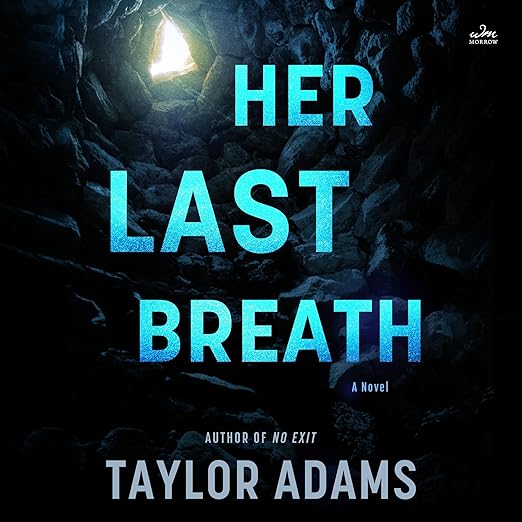
Quick Take
- Narration: Sophie Amoss delivers a taut, claustrophobic performance that keeps Tess’s panic viscerally close throughout the underground sequences.
- Themes: Survival under pressure, female friendship and betrayal, identity concealment
- Mood: Breathless and relentlessly tense, with a slow-burn reveal that pays off
- Verdict: Taylor Adams fans and anyone who loved the confined dread of No Exit will find this one just as consuming, if not more structurally ambitious.
I started listening to Her Last Breath on a Friday evening, thinking I’d do thirty minutes before making dinner. Two hours later I was still on the couch with cold pasta on the stove. Taylor Adams has built a career on claustrophobic, high-concept thrillers, and this one commits fully to that premise: two women descending into a cave system, a stranger who decides to make things very dangerous, and a protagonist with crippling claustrophobia who has absolutely no business being underground. The setup sounds almost too neat, but Adams earns every beat of it.
Tess and Allie are the kind of friends whose relationship the synopsis describes with precision. Years have passed since high school, their lives have split in fundamentally different directions, and there’s a current of jealousy running beneath the surface that Tess is only beginning to acknowledge. She’s a shy legal assistant struggling to fund law school. Allie is a self-made travel influencer who visits dangerous corners of the world and makes it look effortless. That interior tension is what makes the first act so effective before the danger even arrives. You’re reading a thriller about a cave, but you’re also reading something quieter about what happens when two people stop really knowing each other. The threat that materializes in the form of a man named Jacob doesn’t just endanger their physical safety. It forces them to make decisions that reveal exactly who they are under pressure and exactly what they’ve been concealing from each other.
When the Walls Close In
Adams is meticulous about the geography of dread. The cave system in Her Last Breath functions almost as a third character, pressing in around the two women with a patience that is more frightening than any human antagonist could be. The audiobook format actually serves this choice particularly well. Sophie Amoss narrates from deep inside Tess’s perspective, and the audio medium, with its lack of a visible page to skip ahead to, creates its own version of confinement. You cannot skim. You cannot check whether Tess survives the next paragraph. You’re in the crawl space with her, and that’s exactly where Adams wants you. Multiple reviewers noted they finished the audiobook in under twenty-four hours, which tracks with the pacing. There are very few moments where Adams allows the narrative to breathe, and the ones he allows are precisely positioned to make the next constriction feel even tighter.
One reviewer described the book as a fresh and deeply eerie take on the locked room mystery, and that framing is apt. The cave is a locked room with geological weight behind it. Jacob is an antagonist whose motives Adams feeds the listener carefully, in small portions, so that the full picture assembles gradually rather than all at once. When the complete shape of the situation becomes clear, it recasts earlier scenes in ways that reward attentive listening. Adams has done this before with No Exit, but the geography here feels more personal, more interior, more intimate in its particular claustrophobia.
The Detective’s Office Changes Everything
The structural decision that distinguishes Her Last Breath from a more conventional cave-set thriller is the framing device: we meet Tess in a hospital, twenty-four hours after the event, recounting what happened to a detective who is simultaneously a skeptical audience and a source of new information. That kind of framing could easily flatten tension by establishing from the outset that Tess survived. Adams uses it differently. The detective shares shocking revelations about Allie’s true past that reorient everything Tess believed she understood about the friendship and the attack. The investigation that emerges from those revelations is where the novel’s real second act lives, and it’s where the psychological complexity the first act hinted at finally becomes fully explicit.
The question of who Allie really was doesn’t resolve into a neat answer, which is also true of the best real-world friendships. People contain hidden lives. That’s not a thriller’s invention. It’s the premise made literal, given physical stakes, and given a man named Jacob who decided to use what he knew about those hidden lives to devastating effect. Adams earns the twist not by cheating but by having seeded the information so naturally that its significance doesn’t register until the revelation forces a reread of what came before.
Sophie Amoss and the Sound of Contained Fear
The narration is doing significant work here. Tess is written as someone who operates against every instinct she has because there is no other option, and Amoss captures that specific register of contained panic with real skill. Her voice doesn’t perform fear theatrically. It sounds like someone managing fear, which is considerably more disturbing than someone who sounds overtly terrified. The difference between a narrator who broadcasts panic and one who makes you feel it accumulating in your own chest is enormous, and Amoss falls decisively in the latter category throughout.
Adams writes in clean, propulsive prose without extensive interior digression, which means the narration never has to carry long stretches of meditative text. The rhythm is action and revelation, action and revelation, and Amoss handles both registers cleanly. When the pace shifts for the hospital sequences, her delivery adjusts accordingly, settling into something more careful and deliberate that mirrors Tess’s effort to remain credible in front of a skeptical detective who is not yet certain she’s telling the whole truth.
Tess, Jacob, and Whether the Cave Ever Really Ends
If you find enclosed spaces uncomfortable in real life, this audiobook will use that against you effectively and without apology. Listeners who want psychological complexity alongside their thriller mechanics will find both here. The friendship dynamics and the revelation about Allie’s concealed identity give the book something to stand on beyond plot mechanics, but this is not a thriller with literary aspirations above its genre. It knows what it is, executes it exceptionally well, and ends in a place that one reviewer called the best Adams ending since No Exit. I don’t disagree with that assessment.
Frequently Asked Questions
Do I need to have read Taylor Adams’s previous books to follow Her Last Breath?
No. Her Last Breath is a completely standalone thriller with no connections to No Exit or The Last Word beyond sharing Adams’s signature style and interest in high-concept confined-space premises.
How graphic is the violence in the cave sequences?
The violence is present and intense but Adams keeps the focus on psychological threat rather than graphic physical detail. The dread is sustained and real, but it’s not a gore-heavy book.
Does Sophie Amoss’s narration work for a first-person female protagonist in a survival situation?
Yes, effectively. Amoss keeps Tess’s fear internal and contained rather than performative, which suits both the character and the claustrophobic setting. Several listeners specifically highlighted the narration as a standout element.
Is the revelation about Allie’s past convincingly planted, or does it feel like a late twist bolted on?
Adams plants the clues earlier in the narrative, and on reflection the hints are present from the beginning. Most listeners report the reveal as surprising but fair rather than arbitrary or disconnected from the preceding story.