Quick Take
- Narration: Saraya narrates her own memoir with unmistakable authenticity; her British accent and evident emotion make the difficult passages hit harder than any professional actor could manage.
- Themes: Survival and resilience, the cost of stardom, women navigating a male-dominated industry
- Mood: Raw, unguarded, and at moments genuinely harrowing
- Verdict: A self-narrated memoir that gains tremendous power from Saraya’s own voice; the combination of her story and her delivery makes this one of the stronger wrestling memoirs in recent years.
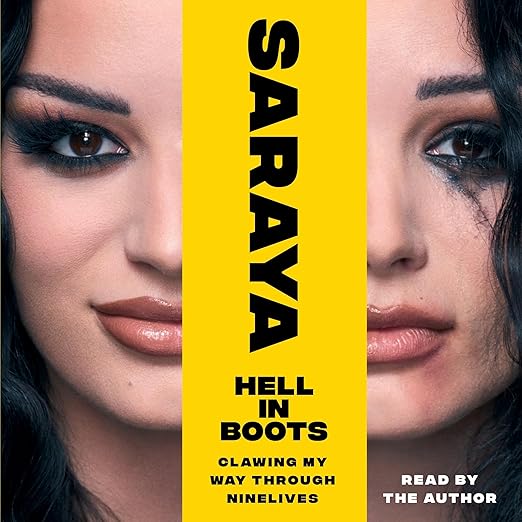
I finished Hell in Boots on a Sunday afternoon in two sittings, which is not how I usually consume memoir. I kept finding reasons to keep the audio running: doing the dishes, a short walk, the particular kind of half-attention that memoir allows when the narrator is compelling enough to sustain it without demanding your full focus. Saraya’s voice is the reason for that. She narrates this herself, and the effect is something a polished audiobook producer could not replicate.
The book opens with Saraya as a child inside a wrestling family described with barely controlled chaos. Her parents worked the independent British circuit. The family traveled, struggled, and built their lives around a business that offered little security and constant physical risk. That background is not framed as colorful backstory; it is the foundation on which everything else rests. When Saraya left home at fifteen to pursue wrestling on her own terms, that context explains both the decision and what it cost her.
Our Take on Hell in Boots
The WWE years are the portion most listeners will come to the book already knowing in outline. Saraya, performing as Paige, became the youngest Divas Champion in company history and the inaugural NXT Women’s Champion. She was named Diva of the Year by Rolling Stone in 2014. She was the subject of a 2019 film featuring Florence Pugh. None of that is background noise; this is a public figure whose career has been widely documented. What the memoir offers that no outside account can is the interior version of those years: what it felt like to navigate a company culture that was still working out how seriously to take women’s wrestling, what the private cost of public stardom was, and how the sex tape leak restructured her sense of self.
Saraya does not flinch from any of it. The substance abuse sections are handled without the redemptive arc softening that often makes memoir addiction narratives feel safe. She describes the descent and the recovery as two distinct experiences rather than a single compressed journey, and that separation gives both phases their proper weight.
Why Listen to Hell in Boots
The self-narration is the single strongest argument for the audio version over a print reading. Reviewers mention her voice as beautiful, and that response tracks: there are passages where you can hear Saraya’s own emotional process in the delivery, where a pause or a shift in register signals something the text alone would not carry. That is rare. Most celebrity memoirs benefit from professional narrators who bring craft but sacrifice intimacy. This one trades craft for something harder to manufacture.
The career arc from the British independent scene through lucha libre training, to WWE, through injury, through the non-wrestling years, and back to AEW as Women’s World Champion is structured to feel earned rather than inevitable. Saraya is not telling a success story in the conventional sense; she is telling a survival story that happens to have a strong second act.
What to Watch For in Hell in Boots
The book carries a national bestseller designation and the production partnership with Simon and Schuster Audio, which means it has been shaped for a wide audience. There are moments where that broadening impulse irons out roughness that the story probably deserves. The industry-specific passages, particularly around the internal dynamics of WWE’s women’s division during her tenure, occasionally read at a level of generality that wrestling observers will find insufficient. The Montreal Screwjob and Owen Hart’s death are mentioned in the product description for Natalya Neidhart’s memoir; Saraya’s book has less of that institutional wrestling history and more of a personal interior arc.
Content warnings apply. This is a memoir that includes substance abuse, a sex tape non-consensually circulated, career-ending injury, and the psychological aftermath of each. It is not a comfortable listen at all points, and it is not intended to be.
Who Should Listen to Hell in Boots
Wrestling fans who followed Paige’s career will find the inside account they have been waiting for. Memoir listeners who gravitate toward resilience narratives rooted in specific professional worlds will also respond to this. Listeners who prefer memoir that keeps at arm’s length from its most painful material should know this one does not do that.
Frequently Asked Questions
Does Saraya address the leaked sex tape in detail, or does she treat it peripherally?
She addresses it directly as a significant event in her life rather than peripherally. The memoir is described as uncensored and unguarded, and reviewers confirm she does not deflect from the more difficult chapters.
How much does the memoir focus on in-ring wrestling versus personal life?
The balance leans toward personal life and emotional experience rather than match-by-match career documentation. Fans looking for a detailed account of her ring career will find it present but subordinate to the internal narrative.
Is this suitable for listeners who have seen the Fighting with My Family film but have no other wrestling background?
Yes. The film provides enough context that non-wrestling listeners can orient themselves in the WWE sections. The memoir goes much deeper into Saraya’s personal history than the film, so it functions as a meaningful expansion rather than a repetition.
At seven and a half hours, does the pacing hold throughout or does it flag in the middle?
Most reviewers found it consistently absorbing. The self-narration helps maintain momentum because Saraya’s own investment in the story is audible. The AEW return chapters have been noted as a strong close.