Quick Take
- Narration: Phil Thron handles Csonka’s storytelling voice with authority, the narration feels like someone at a bar who genuinely has stories worth hearing, which suits the material exactly.
- Themes: Gridiron legacy, masculine identity in transition, life beyond celebrity
- Mood: Boisterous and nostalgic, with quieter moments of genuine reflection
- Verdict: A sports memoir that earns its reputation by going beyond the highlight reel into the farm, the friendship, and the honest mess of a life fully lived.
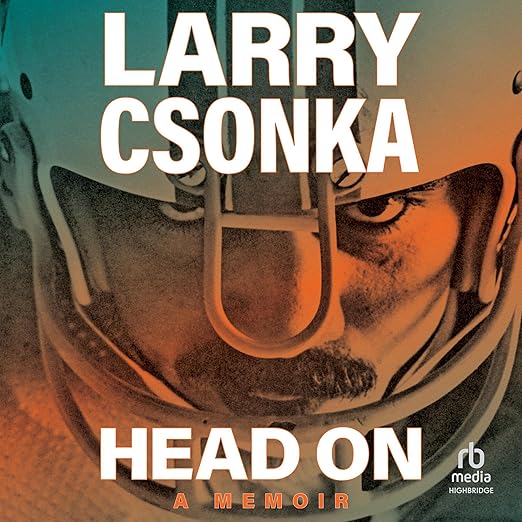
I came to Head On as someone who was not alive for the 1972 Miami Dolphins, which means I had no childhood allegiance to protect. What I found was a memoir that works significantly better than most sports biographies I have covered, not because Csonka’s football career was exceptional (though it was), but because he does not treat the football as the whole story. The Perfect Season is here, but so are the stories that do not fit neatly into any sports narrative: the Ohio dirt farm, the early run-ins with law enforcement, the USO tour of Vietnam where actual sniper fire interrupted the proceedings, and a night adrift on the Bering Sea that belongs in a different genre entirely.
That range is the book’s main virtue. Csonka was named by his 1972 teammates as part of the best team in NFL history, a designation that came as part of the NFL’s 100th Anniversary celebrations, which gives him a clear hook and genuine credibility. But he does not lean on that status as a substitute for storytelling. The account of his complicated relationship with Coach Don Shula, in particular, is more honest than you might expect from a memoir by someone who owes his legacy in part to that relationship. Csonka does not perform gratitude he does not feel.
Our Take on Head On
The title is accurate in a specific way. Csonka ran into things rather than around them, and that is more or less how he tells his life story too. The memoir moves chronologically from his formative years in Stow, Ohio, where a reviewer who graduated from his high school recalled him as an incredible football player even then, overshadowed by the quarterback who got the press, through Syracuse University, the NFL, his years of celebrity adjacency with Burt Reynolds, Dick Butkus, Lee Majors, Joe Namath, and Elvis Presley, and into a life that continued generating material well after his playing days ended. One reader described the account of Csonka confronting thieves with a sawed-off shotgun as something that required no embellishment. That tracks.
Why Listen to Head On
Phil Thron’s narration is a good match for the material. He has a conversational quality that suits memoir more than many audiobook readers, and Csonka’s voice, as established on the page, is accessible and direct. Multiple reviewers noted being surprised by how eloquent Csonka is as a writer given his playing-days persona. Thron carries that quality through without adding flourishes that would undercut the authenticity. For fans who grew up watching the Dolphins in their 1971 and 1972 glory, the audiobook delivers the context and backstory they wanted, one reviewer described the material about Don Shula building the team as riveting, and the emotional texture around the famous Sea of Hands game is rendered with care. But the book also holds up for listeners who come to it without that personal history.
What to Watch For in Head On
The football content, while present and engaging, is not the majority of the book, which is a strength in terms of range but may disappoint readers who specifically want deep tactical analysis or extended locker room narrative. One reviewer explicitly wished for more detailed NFL reminiscing. The memoir is broad rather than deep in any single area, which means some of the more interesting episodes, the Vietnam USO tour, the Alaska adventures, get less development than you might want. This is a feature of Csonka’s storytelling instinct more than a structural flaw, but it is worth knowing. The book moves like its subject ran the football: always forward, not much lingering.
Who Should Listen to Head On
Obviously the right listen for Miami Dolphins fans of a certain era, who will find it repays the time with context they have wanted for decades. But Head On is also genuinely accessible for listeners who simply want a sports memoir with more life in it than the standard highlights-and-heartwarming-lessons formula. Csonka is a specific kind of American character, the farm-raised, physically fearless, socially incautious kind, and his story illuminates that type with more clarity and less sentimentality than you usually get from athletes turned authors. If you need the memoir to stick close to game footage and postgame speeches, this is not your book. If you want to know what it was like to be young and invincible and then figure out what comes next, it delivers.
Frequently Asked Questions
Do I need to know Miami Dolphins football history to enjoy Head On?
No. Csonka provides enough context that the football history reads clearly for newcomers, and the memoir’s range, covering his Ohio farm upbringing, Vietnam, Alaska, and celebrity friendships, gives non-football listeners plenty to engage with. That said, Dolphins fans from the 1970s will find additional layers of personal resonance throughout.
How much of the book covers the 1972 Perfect Season specifically?
It is present but not dominant. The Perfect Season provides a structural anchor and Csonka gives the period real attention, but the memoir spans his entire life rather than zooming in on that single season. Readers who want granular game-by-game analysis of 1972 will need to supplement Head On with more specialized histories.
Phil Thron narrates rather than Csonka himself, does that distance work for a memoir this personal?
Reviewers seem to find it works. Thron has a conversational directness that aligns with Csonka’s prose style, and the self-deprecating humor in the writing comes through clearly in audio. First-person narration by the subject himself would have added another layer of authenticity, but Thron does not lose the voice.
Is the memoir honest about Csonka’s flaws and mistakes, or is it a standard legacy-protection exercise?
More honest than most. The early run-ins with the law, the combative relationship with Shula, and the general portrait of someone who made decisions by leading with his chin are present without being whitewashed. Csonka does not use the memoir to settle scores, but he also does not pretend he was easy to coach or manage.