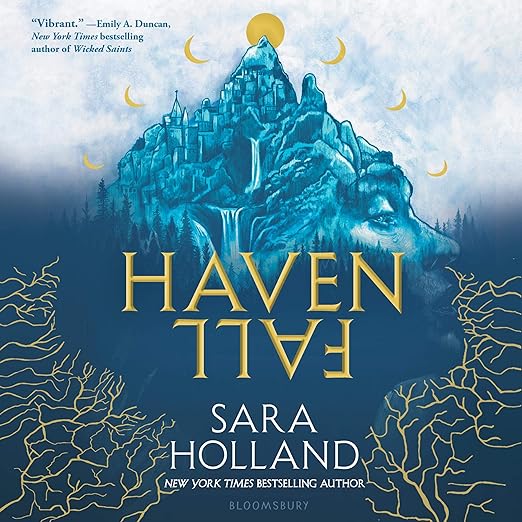
Quick Take
- Narration: Kate Handford brings a clear, composed presence to Maddie’s first-person narration, listeners praised the audio version specifically as easy and natural listening, which matters for a complex multi-realm setup.
- Themes: found family versus biological family, the burden of an idealized safe haven, identity and belonging in liminal spaces
- Mood: Cozy-atmospheric with genuine suspense undercurrents
- Verdict: A YA fantasy that builds a genuinely intriguing world around the Inn at Havenfall, though Maddie’s self-doubt can slow the momentum in the middle sections.
There is a specific kind of fantasy setup I find impossible to resist: the hidden inn, the crossroads between worlds, the sanctuary that is also a trap. Sara Holland’s Havenfall hits that premise squarely. I listened to the first three chapters on a gray September afternoon and felt the exact atmospheric pull the novel is going for, a mountain inn in Colorado that connects to ancient realms, summers that are more real than ordinary life, a protagonist with a painful family history who has built her entire sense of self around a place that may not be what she believed.
Holland is the author of the Everless duology, and Havenfall is her first book that grounds fantasy in the contemporary world rather than a secondary one. That choice changes the stakes in interesting ways, Maddie’s mother sitting on death row accused of murdering her brother is not background noise. It is load-bearing to the story’s emotional architecture.
Our Take on Havenfall
The Inn at Havenfall is a sanctuary connecting four realms, each with its own magic, governed by rules of hospitality that have held for generations. When a dead body is found at the inn, an impossibility given those rules, Maddie Morrow suddenly finds herself holding together a situation she was not supposed to inherit for years. Her uncle is gravely injured, her soldier boyfriend Brekken is missing, and an unknown creature is loose in the building. The plot’s engine runs on mystery and escalating threat, but Holland keeps the emotional center on what the inn means to Maddie: it is the one place where her shattered family history doesn’t define her.
The worldbuilding is one of Havenfall’s genuine strengths. Multiple reviewers noted the intricacy of the different realms and their peoples, the Fiorden soldiers, the other delegations, the particular social dynamics of a summit space. Holland does not dump this information. It accumulates through Maddie’s familiarity with the inn, which is the right approach for a protagonist who grew up there.
Why Listen to Havenfall
Kate Handford’s narration was singled out by at least one reviewer as a specific draw. For a book with this much atmospheric texture, mountain setting, ancient architecture, the specific mood of a space that is neither fully human nor fully other, a narrator who can sustain a composed, slightly wonder-touched register matters. Handford does not overdramatize the revelations, which keeps the mystery feeling grounded rather than overwrought.
The LGBTQ+ thread, involving Maddie’s growing trust and connection with the new staffer Taya, is handled with enough restraint to feel like actual character development rather than a narrative checkbox. Taya’s presence complicates Maddie’s certainties in ways that serve the mystery as well as the romance, which is the more interesting construction.
What to Watch For in Havenfall
The criticism that appears across multiple reviews is consistent: Maddie’s self-deprecation and repeated feelings of inadequacy slow the pacing. One reviewer specifically noted that if those passages were trimmed, the story would move considerably faster. This is a structural choice Holland makes consciously, Maddie’s doubt is connected to her family trauma, but listeners who prefer propulsive YA fantasy may find it frustrating. The middle section, between the initial crisis and the final revelations, is where this drag is most noticeable.
Fans of Holland’s Everless books should also note that Havenfall is tonally different, more grounded, more contemporary, and without the secondary-world immersion that defined that series. It is neither better nor worse, but it is a different reading experience.
Who Should Listen to Havenfall
Recommended for: YA fantasy listeners who enjoy atmospheric inn-and-portal setups, readers who appreciated Holly Black or Melissa Albert’s grounded fantasy work (the comparable names the publisher invokes are appropriate), and anyone interested in a mystery-fantasy hybrid where the emotional stakes are as high as the supernatural ones. Less suited to listeners who want fast-paced action from the opening, or who found Holland’s Everless books compelling specifically for their secondary-world immersion.
Frequently Asked Questions
Does Havenfall work as a standalone, or does it require reading the Everless books first?
Havenfall is a completely separate series with no connection to Everless. It stands fully on its own. The Everless mention in marketing is about Sara Holland’s reputation as an author, not narrative continuity.
How prominent is the LGBTQ+ storyline involving Maddie and Taya?
It develops gradually and is woven into the central mystery rather than treated as a separate subplot. Taya is a character who matters to the plot independent of her relationship with Maddie, and the romantic development is slow and understated rather than foregrounded.
Is the pacing issue reviewers mention with Maddie’s self-doubt significant enough to derail the experience?
It depends on your tolerance for introspective YA narrators. The plot is genuinely compelling, and the worldbuilding is strong enough to sustain engagement. But several reviewers noted that Maddie’s repeated self-recrimination slows the middle section noticeably.
What age range is Havenfall most appropriate for in audio format?
The publisher markets it as YA, and the content is appropriate from around 13 upward. Adult fantasy listeners who enjoy YA-paced worldbuilding and atmospheric mystery will find it equally accessible.