Quick Take
- Narration: Patrick Lawlor delivers Paulsen’s essays with the warmth and candor the material demands, making two-plus hours feel genuinely lived-in.
- Themes: Wilderness survival, the truth behind fiction, boyhood and nature
- Mood: Warm, funny, and occasionally startling in its honesty
- Verdict: An ideal companion piece to the Hatchet series that earns its short runtime by trading in real experience rather than embellishment.
I came to Gary Paulsen late, well past the age at which most people first encounter Brian Robeson stumbling through the Canadian wilderness with nothing but a hatchet and the will to live. I’d heard about Hatchet for years, mostly from parents who pressed it on reluctant readers and teachers who swore it was the book that turned certain kids around. When I finally listened to Guts, I understood the loyalty. Paulsen is one of those writers who makes you feel like he’s talking to you directly, without any of the performance that usually separates an author from a reader.
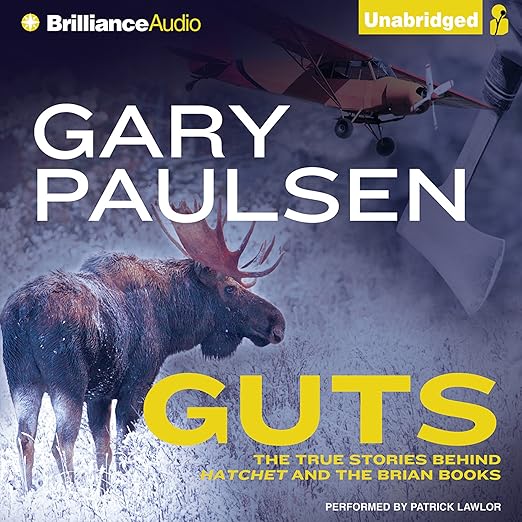
Guts is a companion memoir to the Hatchet series, gathering the real experiences that fed into Brian Robeson’s fictional survival story. It runs just over two hours, which is either a limitation or a feature depending on what you want from an audiobook. I’d argue it’s a feature, since Paulsen’s tone is anecdotal rather than exhaustive, and stretching these essays into a longer format would have diluted the intimacy that makes them work.
Our Take on Guts
What Paulsen does here is something relatively rare in companion nonfiction: he doesn’t just explain where plot points came from, he gives you the texture of actual experience in a way that makes the fictional versions feel more real rather than less. The pilot’s death in Hatchet, which readers always found hauntingly precise, came from real death. Paulsen writes about it with the matter-of-fact openness of someone who processed it long ago and understands that honesty serves readers better than distance.
The mosquito story is the other end of that spectrum, comic and self-deprecating in a way that reveals genuine affection for the wilderness even at its most hostile. Paulsen is not romanticizing the outdoors; he’s reporting on it, including the parts that are embarrassing or frightening or deeply unpleasant. That combination of reverence and realism is what makes his writing work for young readers who are often served sanitized versions of nature.
Why Listen to Guts
Patrick Lawlor’s narration is well-suited to this material. He doesn’t impose drama onto prose that doesn’t need it, which is the right instinct. Paulsen’s voice on the page is already immediate and slightly rough around the edges, and an overwrought performance would undercut it. Lawlor keeps it grounded, and the result feels appropriately conversational, like someone telling you these stories over a campfire rather than performing them on a stage.
Multiple reviewers noted this works for adults as well as younger listeners, and I’d confirm that without hesitation. The Hatchet series was officially YA, but Guts reads older, partly because Paulsen reflects on his experiences from the vantage point of an adult who has survived them and processed them into story. The hunting sections are specific and occasionally graphic in the way that real hunting is, which means parents should listen first if they’re putting very young children on it, but which also means it doesn’t condescend to the teenagers and adults who make up most of its audience.
What to Watch For in Guts
The book is structured as discrete essays rather than a linear memoir, and Paulsen moves between topics with a casualness that can occasionally feel like a lack of architecture. If you’re expecting a traditional beginning-middle-end narrative, you won’t find it here. What you’ll find instead is a series of windows into the experiences that shaped the Hatchet universe, and each one is worth your attention on its own terms.
Pay particular attention to the section about Paulsen’s first hunting experiences and the way he describes learning to be present in the natural world. This is where the book’s emotional core lives, distinct from the survival-manual elements and the incident recollections. There’s a philosopher somewhere under the adventure writer, and he occasionally surfaces here with unexpected clarity.
One fair note for listeners new to Paulsen: this works best if you’ve read or listened to at least Hatchet before coming to Guts. The resonance between real event and fictional version is genuinely illuminating, but it requires the fictional baseline. Without it, Guts is still engaging, but you’re missing a layer.
Who Should Listen to Guts
Essential listening for anyone who grew up with the Hatchet series and wants to understand where Brian Robeson’s world actually came from. Equally good for educators looking for short, honest nonfiction to pair with the novels. Adults who discovered Paulsen late, like me, will find it surprisingly affecting. Less recommended as a standalone entry point into Paulsen’s work, since the companion-piece framing assumes some prior investment in the fiction.
Frequently Asked Questions
Do I need to read Hatchet before listening to Guts?
The book works as standalone memoir, but it functions best as a companion piece. Guts explains the real events behind specific moments in the Hatchet series, including the pilot’s death and various survival scenarios, so knowing the fiction first gives you an additional layer of understanding.
Is Guts appropriate for the same age range as Hatchet?
The hunting and wilderness content is frank and occasionally graphic in the way real outdoor experience is. It’s appropriate for most middle-grade and up readers, but parents of younger children should listen first. Several reviewers noted it works well for adults too, which is an accurate assessment.
How does the two-hour runtime affect the listening experience?
It suits the format. Guts is structured as personal essays rather than a sustained narrative, and the short runtime keeps the anecdotal tone from wearing thin. At four or five hours, the intimacy would likely dilute. Think of it as a conversation rather than a lecture.
Is Paulsen himself the narrator?
No. Patrick Lawlor narrates. The choice works well because Lawlor keeps the tone conversational and unpretentious, which suits Paulsen’s plain-spoken style. Paulsen’s own voice might have added a layer of authenticity, but Lawlor’s performance doesn’t suffer for the distinction.