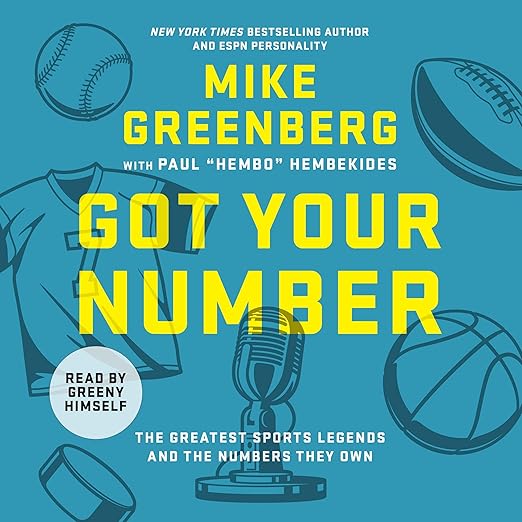
Quick Take
- Narration: Mike Greenberg narrating his own book is a genuine advantage here, his ESPN personality and natural conversational cadence make the short essay format feel like sitting across from him at the desk.
- Themes: Sports legend and numerical identity, cross-generational athletic comparison, the intersection of statistics and mythology
- Mood: Breezy and argumentative, designed to be disagreed with as much as enjoyed
- Verdict: Ideal listening for sports fans who want light, enthusiastic coverage of athletic greatness across eras, not for those seeking deep analytical rigor.
Got Your Number arrived in my queue during a week when I needed something that would not demand sustained concentration. I had just finished a dense historical biography and was craving something that felt more like a good sports argument than a reading experience. Mike Greenberg’s short-essay audiobook about which athletes definitively own each number from one to a hundred delivered exactly that, and I mean that without condescension. There is a real skill in writing about sports in a way that is simultaneously authoritative enough to hold its positions and playful enough to invite dispute, and Greenberg, with producer Hembo, executes that balance more often than not.
The concept is deceptively simple. For each number between one and one hundred, Greenberg selects the athlete whose identity is most thoroughly defined by that number, then makes the case in a short essay. Jordan and 23. Jeter and 2. Brady and 12. Gretzky and 99. Some selections are, as one reviewer notes, obvious. Others will provoke genuine irritation in fans who feel their preferred legend was overlooked or wrongly placed. That provocation is the point. Greenberg is building an argument engine, not a reference work.
The Short Essay Format and Audio Listening
This book is unusually well-suited to audio precisely because of its structure. Each entry is a page or two of concentrated enthusiasm, which means the listen moves at a pace that suits commutes, workouts, or any context where you want engagement without commitment. One reviewer described using it as a gift for sports fans who appreciated the ability to read out of order and in short sessions, and that flexibility translates directly to audio. You can dip in for ten minutes, get three or four entries, and stop without losing any thread.
Greenberg narrating his own material is the right choice. He is a radio and television personality, comfortable with his own voice and practiced at projecting warmth without manufactured excitement. His cadence on the page is already conversational, and hearing it in his own voice rather than a hired narrator’s lends the project an authenticity it might otherwise lack. When he is making a case for a particular athlete, you believe he actually believes it, which is exactly what this kind of argument sports writing requires.
The Question of Rigor
I want to be transparent about what this audiobook does not attempt. It is not a rigorous statistical analysis. One reviewer described it as very informative, and in the sense that it covers a lot of athletes across a lot of eras, that is accurate. But Greenberg’s method is more impressionistic than analytical. He is drawing on a lifetime of sports consumption and emotional attachment rather than building arguments from data. This means the selections and their justifications carry the particular quality of well-informed opinion rather than defensible conclusion.
For some listeners that will be a relief. Sports statistics have become a subject of considerable technical sophistication in recent years, and there is genuine appeal in a book that talks about greatness in terms of mythology and feeling rather than win shares and VORP. For listeners who prefer their sports arguments grounded in numbers rather than narratives, Got Your Number will feel too soft, a collection of confident assertions where a more rigorous author would have shown their work. That tension is real, and worth naming honestly: this is entertainment that wears the clothes of analysis, and you have to be comfortable with that distinction to enjoy it.
What Greenberg does exceptionally well, and what the audio format amplifies, is generate the specific pleasure of disagreement. You will hit entries where his choice strikes you as obvious, others where you feel he has been egregiously wrong, and a handful where he selects someone you had not considered and makes you genuinely reconsider. That arc of reaction, agreement, irritation, surprise, is the book’s real structural design, and it works because Greenberg commits fully to each position. He does not hedge. He argues, and the listener’s instinct is to argue back.
Cross-Sport Coverage and Its Limits
Greenberg’s strongest domain is basketball and American football, where his enthusiasm is most evident and his arguments most assured. The baseball entries are solid, the hockey coverage lighter, and sports with smaller American popular audiences receive the kind of treatment that suggests passing familiarity rather than deep knowledge. This is a book written from a particular American sports media perspective, which means it reflects the hierarchies and blind spots of that perspective. International readers or fans of sports outside the American mainstream will find notable gaps.
That said, the format accommodates this limitation reasonably well. Because each entry is brief and self-contained, weak entries are over quickly and strong entries arrive regularly enough to sustain engagement. One reviewer who specifically noted buying this as a gift for sports fans appreciated the ability to read in any order and in short bursts, which translates directly to audio: you can listen to three entries, pause, and return without having lost any thread. At just under six hours, the audiobook does not overstay its welcome.
The production also benefits from Greenberg’s status as a broadcasting professional. He knows how to talk through a subject without excessive verbal tics or the kind of pacing problems that can afflict author-narrators unaccustomed to long-form audio recording. The sessions feel like a good radio conversation, and that ease of delivery is not accidental, it is a genuine professional skill being applied to material he clearly finds personally enjoyable.
Choosing Your Moment for This Listen
Come to Got Your Number if you want to spend a few hours in an argument with a knowledgeable, enthusiastic sports fan who has strong opinions and is not afraid to defend them. It is genuine sports entertainment in audio form, intelligently assembled and delivered with charm. The format lends itself to commutes, workouts, and any context where you want engagement without needing to follow a continuous narrative. Skip it if you want analytical depth, comprehensive statistical coverage, or anything approaching a definitive record. As argument-sport writing, it succeeds on its own terms. As scholarship, it makes no claim to be anything of the sort, and the honesty of that is part of what makes it easy company.
Frequently Asked Questions
Does Got Your Number cover all major American sports equally, or is there a clear bias toward certain sports?
Basketball and American football receive the most confident treatment, with baseball also well-covered. Hockey and other sports get lighter attention, and international sports or athletes outside the American mainstream are largely absent. The book reflects Greenberg’s specific sports media background.
Can you listen to Got Your Number out of order, or does it need to be heard from number one to one hundred?
The format is perfectly suited to non-linear listening. Each entry stands completely alone, and there is no narrative or argument that builds across chapters. You can dip into specific numbers that interest you or listen in random order without missing anything.
How much do you need to know about sports history to appreciate the book, is it accessible for casual fans?
Casual fans with a general awareness of the names Greenberg references will get plenty from it. Deep sports knowledge will enhance the arguments and help you push back more specifically on the selections you disagree with, but it is not a prerequisite. The writing assumes enthusiasm more than expertise.
Is this the kind of audiobook that works as background listening, or does it require active attention?
It works extremely well as semi-active listening. The short entries and conversational tone make it easy to follow while doing something else, and missing a sentence or two does not derail your understanding of any entry. It is genuinely designed for exactly that kind of flexible engagement.