Quick Take
- Narration: Alex Picard handles Piper’s first-person perspective with credible teenage voice and escalating anxiety; the pacing suits the thriller structure without overdramatizing.
- Themes: Revenge and justice in high school social systems, moral complicity, the danger of anonymous power
- Mood: Tense and claustrophobic, propulsive in its later chapters
- Verdict: A well-constructed YA psychological thriller that uses its notebook-and-text-messages premise to build genuine pressure; better than its familiar-sounding setup suggests.
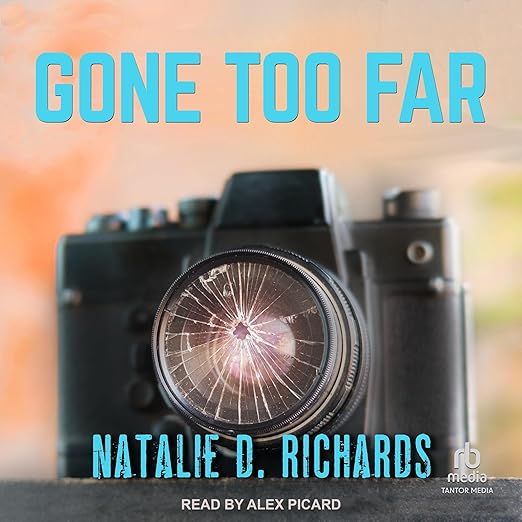
I started Gone Too Far on a Saturday afternoon thinking I would dip in for an hour and decide whether to continue. I finished it that evening. Natalie D. Richards has been writing YA psychological thrillers for long enough that her structural instincts are sharp, and this one, which has been around in various editions since at least 2014, holds up with an urgency that suggests the premise tapped into something that has not aged out of relevance.
Piper Woods is weeks from graduation and has spent four years navigating Thorny’s Mill High School by staying below the radar. She did not see herself as a bystander exactly, but she was not intervening in the social cruelties she witnessed either. Then she finds a notebook filled with other students’ secrets. Then she receives an anonymous text inviting her to choose who gets punished. And then the punishments start happening.
Our Take on Gone Too Far
The novel’s central mechanism, the notebook as repository of secrets and the anonymous texter as judge-executioner-inviter, is doing something that reviewers have correctly identified as similar to other well-known YA thrillers in its territory. One reviewer compared it to the dynamics of a popular streaming series about high school secrets and consequences. Richards is working in a recognizable tradition, but she makes specific choices that distinguish her version.
The most important of those choices is Piper herself. She is not the typically virtuous protagonist who stumbles into danger while being entirely good. She was a bystander to things she should not have been a bystander to, and Gone Too Far is partly about what responsibility that creates. The anonymous texter is offering her a form of justice she failed to pursue through ordinary channels. The question the novel poses is whether the form of justice being offered is justice at all, or whether accepting it makes her complicit in something worse than what she failed to stop earlier.
Why Listen to Alex Picard’s Narration
Picard’s performance makes the most of what Richards’s first-person present-tense narration demands. This is a protagonist in continuous crisis, trying to think clearly while being actively manipulated and threatened, and Picard conveys Piper’s attempts to reason her way through the pressure without tipping into flat anxiety. The scenes where Piper is composing and receiving the anonymous texts, which are necessarily conveyed through her responses to what she reads rather than the texts themselves in audio format, are handled with enough variation to track who has the power in each exchange.
One reviewer noted that in the print version, Piper’s own texts to the unknown number were missing from some e-reader formats, creating comprehension problems. That issue does not apply in audio, where Picard handles both sides of the exchange within Piper’s narration. The audio format may actually be the cleaner version of this particular book because of how that text-message structure is handled.
What to Watch For in the Escalation Structure
Richards builds the novel’s pressure in careful increments. The punishments Piper is invited to enable start plausibly connected to genuine wrongdoing: a cheater, a bully, a shoplifter. That they feel almost justified initially is the novel’s most effective move. The escalation of what is asked of Piper, and the simultaneous narrowing of her options for getting out, follows a logic that feels internally consistent. The anonymous texter is not irrational; the menace comes from how rational the escalating demands are, within the texter’s own framework.
Reviewers have praised the novel for exploring themes of suicide, bullying, peer pressure, prejudice, justice, revenge, and the balance between light and darkness within each person without treating any of them as simple. Richards does not resolve Piper’s moral situation cleanly, and the resolution, while structurally satisfying, does not retroactively make the choices she faced easier. That is harder to do in YA than it sounds.
Who Should Listen to Gone Too Far
Readers who enjoy Karen McManus or Natasha Preston will find this a satisfying addition to the same shelf. The novel’s marketing comparison to those authors is accurate in tone and ambition. Listeners who want YA that takes its moral questions seriously rather than using them as decoration for a plot that has already decided all the answers will find Richards is doing more than the premise suggests.
At just over eight hours, Gone Too Far is a single-sitting audiobook for listeners with that kind of Saturday free. It does not overstay its welcome, and the thriller structure earns its pace in the final third. For the target audience of teen and young adult readers who have wondered what they would do with someone else’s secrets, this is the book that takes that question seriously.
Frequently Asked Questions
Is Gone Too Far part of a series or does it stand alone?
Gone Too Far is a standalone novel. No prior knowledge of other Natalie D. Richards titles is required, though her fans will recognize her characteristic approach to first-person YA thriller construction.
How does the audio format handle the text-message-based plot mechanics?
Better than some print editions, according to reader feedback. Print readers on certain e-reader formats reported missing text because Piper’s own messages were not displayed, creating comprehension gaps. In the audiobook, Picard handles both sides of the exchange within Piper’s first-person narration, making the text-thread dynamics clear throughout.
Is Gone Too Far appropriate for younger YA readers, or is it aimed at older teens?
The novel deals with suicide, bullying, peer pressure, and escalating danger. It is written for teen readers and handles these subjects with appropriate seriousness rather than gratuitousness, but parents of younger readers may want to preview the content before recommending it.
Does the novel’s resolution feel earned, or does it wrap up too neatly?
Reviewers are divided on this. The thriller plot resolves its central mystery and threat cleanly. The moral resolution, the question of whether Piper becomes complicit in something worse, is handled with more ambiguity. Readers who wanted a fully tidy ending occasionally find it unsatisfying; readers who appreciated the moral complexity generally find the conclusion appropriately complicated.