Quick Take
- Narration: Julia Whelan brings Nick’s evasiveness and Amy’s precision into distinct, unsettling relief, making a book already famous for unreliable narrators even more disorienting in audio.
- Themes: Marriage as performance, unreliable narration, the violence of reputation
- Mood: Cold and compulsive, impossible to step away from once the second act begins
- Verdict: The dual-narrator audio format is genuinely the ideal way to experience this novel, and Whelan’s performance is a significant reason why.
I listened to Gone Girl during a particularly grim January, which is probably the right environment for it. Gillian Flynn’s novel is not comfortable company, but it is riveting company, and there is something about the audio format that makes the discomfort sharper and more immediate than reading the page. When you are listening to Julia Whelan deliver Amy Dunne’s diary entries, there is nowhere to look away. You are in Amy’s voice, and what her voice reveals about itself, gradually and then all at once, is one of the most unsettling experiences I have had with an audiobook in the past several years.
Gone Girl needs no long introduction at this point. Published in 2012, it became one of those novels that restructured what readers expected from domestic thrillers. The story of Nick and Amy Dunne, their fifth wedding anniversary, Amy’s disappearance, and the investigation that follows is told in alternating narrations: Nick’s increasingly desperate present-tense account and Amy’s diary, which spans the arc of their relationship from courtship to crisis. The genius of Flynn’s construction is that both narrators are unreliable in ways the reader cannot fully diagnose until the novel forces the reveal, at which point everything has to be re-evaluated in light of what you now know.
Whelan and the Dual Voice Problem
Casting a single narrator for a novel with two primary voices is a genuine challenge, and Whelan handles it with unusual skill. Her Nick is recognizably male in affect without resorting to caricature, and she modulates between his evasiveness and occasional genuine anguish in ways that keep the character ambiguous without tipping the reader’s hand prematurely. Her Amy is where the performance becomes genuinely impressive. Amy’s diary voice has to function simultaneously as an authentic emotional record and as something that, in retrospect, reads as performance. Whelan threads that needle. The diary entries feel real on first listening and calculated on second, which is precisely the effect Flynn intended and the effect that makes the novel’s structural conceit work.
One reviewer described the book as captivating mystery and cleverly conceived thriller while noting that what really works is how beautifully Flynn dissects the disintegration of a marriage. That framing is accurate for the audio experience as well. This is not primarily a whodunit, though the mystery architecture is solid. It is a study of how people perform identity within and outside intimate relationships, and the audio format makes that performance theme more literal and more visceral.
A Novel That Made Its Genre Over
Flynn’s influence on domestic suspense is difficult to overstate. The wave of psychological thrillers featuring unreliable women narrators that followed Gone Girl across the 2010s is a direct response to what she demonstrated was possible within the form. Listening now, more than a decade after publication, it is interesting to notice which elements still feel singular and which have been so thoroughly imitated that they now read as genre conventions rather than innovations. The Amy Dunne character, her specific variety of calculation and intelligence and performance, still feels singular. The structural device of the dual unreliable narrator has been done to death in the years since, but Flynn’s execution remains cleaner than most of what followed.
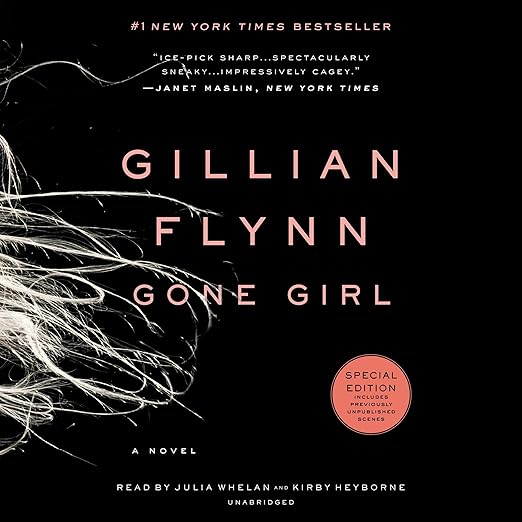
The Audible version reviewed here includes never-before-published deleted scenes, which are a genuine addition for readers who have encountered the novel before. They provide context for some of the backstory elements without changing the essential structure of what makes the novel work.
The Discomfort Is the Point
I want to be direct about what kind of experience this is. Gone Girl is not pleasant. Nick and Amy are both deeply unpleasant people in different registers, the novel asks you to spend extended time in their company, and the conclusion is not cathartic in any conventional sense. One reviewer described it as dark, disturbing, and powerful and noted that it is not easy reading or listening. That is accurate. The audio format intensifies all of this because Whelan’s narration removes the buffer of the page. If you listen in headphones, Nick and Amy are speaking directly into your head, which is both the audiobook’s greatest strength and the most compelling argument for its suitability to this particular material.
The deleted scenes in this edition are worth a note to returning listeners specifically. They flesh out some of the backstory elements that the published novel handled elliptically, and hearing them after you know what Amy is and what the diary represents adds another layer to the re-reading experience. For first-time listeners they are best saved for a second listen after the reveal lands.
First Listen or Revisit, Both Work
Recommended for listeners who have not yet encountered the novel and want the optimal format for a first reading. Also worthwhile as a revisit for those who read it in print, since Whelan’s dual narration adds a layer the silent reading experience does not fully provide. Available as a free audiobook through Audible membership. Skip it if you require likable protagonists or resolution that provides genuine moral comfort.
Frequently Asked Questions
Does knowing the famous twist before listening significantly diminish the Gone Girl experience?
Less than you might expect. The novel’s second reading, knowing what Amy is and what the diary represents, is genuinely interesting as an exercise in noticing what Flynn embedded throughout the text. Whelan’s narration takes on different qualities with foreknowledge.
Is Julia Whelan’s narration the standard dual-narrator format with separate voice actors for Nick and Amy?
Whelan performs both voices herself rather than using two narrators, which is an interesting production choice. She differentiates them clearly enough that the distinction works, and her Amy in particular is an accomplished performance.
What are the never-before-published deleted scenes included in this edition?
The deleted scenes are additional backstory material that did not make the final cut of the novel. They provide texture for some of the relationship history without altering the core narrative or the structural reveal. For repeat readers they are a genuine bonus.
How does Gone Girl hold up compared to Flynn’s other novels, particularly Sharp Objects?
All three Flynn novels share thematic preoccupations with damaged women and the violence embedded in domestic life. Gone Girl is the most structurally ambitious. Sharp Objects is arguably the more disturbing character study. They reward reading in any order, but Gone Girl remains the best entry point.