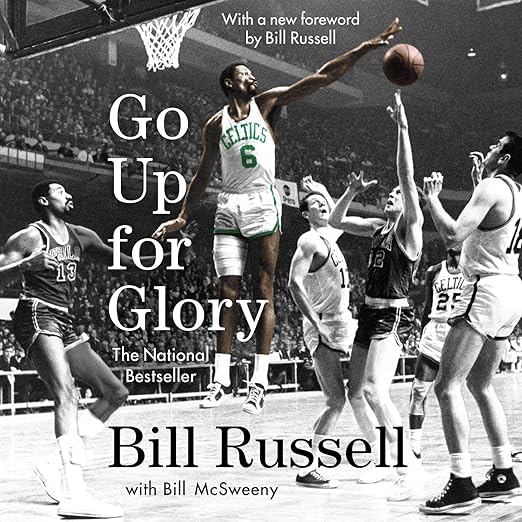
Quick Take
- Narration: JD Jackson brings authority and warmth to Russell’s voice, honoring the memoir’s dual register of sporting pride and civil rights testimony without sentimentalizing either.
- Themes: Race and dignity in mid-century America, excellence under systemic hostility, what it means to be a man by a personal code
- Mood: Proud and unflinching, historically resonant
- Verdict: A foundational sports memoir that reads as urgently now as it did in 1965, with JD Jackson’s narration making it essential in audio.
I came to Go Up for Glory through a roundabout path: a conversation about the most honest athlete memoirs ever written, the ones where the subject is willing to tell you things that make their sport look complicated rather than simply heroic. Bill Russell’s name came up immediately. The book was originally published in 1965, went out of print, and returned in 2020 with a new foreword from Russell himself, narrated here by JD Jackson for Penguin Audio. The timing of that reissue was not accidental, and the book’s central argument, that excellence in sport does not exempt a Black man from the full weight of American racism, reads with an immediacy that nearly sixty years have not blunted.
Russell was eleven-time NBA champion with the Boston Celtics, two-time NCAA champion, Olympic gold medalist, and the most dominant defensive player in basketball history. He was also a Black man navigating a segregated country that celebrated his athletic gifts while treating him as a second-class citizen in nearly every other context. Go Up for Glory is his account of both those realities, and it does not separate them into different books. The championship years and the indignities occur in the same chapters because they occurred in the same life.
Our Take on Go Up for Glory
What strikes you first about Russell’s voice, even mediated through Jackson’s narration, is the combination of dignity and directness. He does not perform resentment, but he does not soften the record either. The childhood in segregated America, the specific humiliations of being a celebrated athlete who still could not eat at certain restaurants or stay at certain hotels, the complex experience of being revered by a city that did not fully accept him as a person: all of this is in the book, stated plainly and without self-pity.
The basketball writing is also genuinely good. Russell understands the game at a level of tactical and physical detail that does not translate to every player memoir, and his descriptions of how he thought about defense, about positioning, about what it meant to own the glass, have a precision that makes the basketball sections worth reading for anyone interested in the sport’s history.
Why Listen to Go Up for Glory
JD Jackson is among the best narrators working in nonfiction audio, and his interpretation of Russell is one of his stronger performances. He captures the memoir’s dual register: the sporting authority of a man who knew exactly how good he was and was not going to pretend otherwise, and the civil rights witness of someone who understood that what was happening to him was not personal but structural. Those are different emotional registers, and Jackson navigates the transition between them with a skill that elevates the material.
One reviewer, who read the book decades ago and bought this edition as a gift for a basketball-fan grandson, described Russell as his all-time sports hero and the memoir as amazing. That combination of basketball achievement and moral seriousness is what makes Russell singular, and this memoir is the clearest statement of both.
What to Watch For in Go Up for Glory
The book was written in 1965 and reflects the language and frame of that moment. Some readers may need to calibrate for historical context in a few passages. The sports writing is also primarily about basketball strategy and team dynamics rather than anecdote-driven behind-the-scenes storytelling, which means readers expecting insider gossip will find something more substantive but also more demanding.
The book is relatively short at six hours and fifty-four minutes, which means it moves quickly through a life that could fill considerably more time. Some periods of Russell’s career receive less attention than a dedicated basketball historian might wish.
Who Should Listen to Go Up for Glory
Sports memoir readers who want their athlete narratives to engage seriously with the social context of athletic achievement will find this one of the essential texts in the genre. NBA history enthusiasts who want Russell’s own account of his dynasty years with the Celtics will find it here, unfiltered. Anyone interested in mid-century civil rights history through the specific lens of a Black athlete navigating a country that both celebrated and diminished him should consider this essential listening.
Frequently Asked Questions
How does Go Up for Glory treat the civil rights context of Russell’s career?
The civil rights experience is not separated from the basketball narrative. Russell describes the specific humiliations of being a celebrated athlete who still faced segregation and racism in daily life, and he does so plainly and without performance. The 2020 reissue foreword from Russell himself addresses how far things have and have not progressed since 1965.
Is JD Jackson’s narration a good match for Bill Russell’s voice and subject matter?
Yes. Jackson captures both the athletic authority and the civil rights testimony register of the memoir, and the transition between the two never feels jarring. For a book that requires honoring both dimensions with equal seriousness, his performance is a strong match.
Do I need to be a basketball fan to find this book worthwhile?
Basketball context helps, but the memoir’s central concerns, race, dignity, the complexity of being celebrated and diminished by the same society, extend well beyond sport. Readers with no particular interest in basketball will find Russell’s account of navigating mid-century America historically significant on its own terms.
How does the 2020 reissue differ from the original 1965 publication?
The core text of the memoir is the same. The 2020 reissue includes a new foreword written by Russell himself, which reflects on the years since original publication and gives the book an additional contemporary dimension. The audio production is new, with JD Jackson narrating for Penguin Audio.