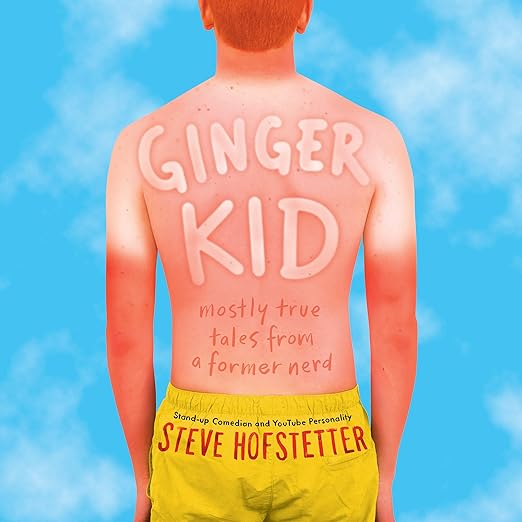
I started Ginger Kid on a whim, pulled in by a description that compared it to Diary of a Wimpy Kid for readers who had grown up alongside that series and were now ready for something more directly autobiographical. My younger sister had been that kid, the slightly awkward, socially misfit seventh grader who organized her social survival around books and humor, and I was curious whether Steve Hofstetter's account would resonate with someone one generation removed from his experience. I listened to about an hour before realizing I had missed my train stop.
The book is narrated by Hofstetter himself, and that fact matters more here than it does for most author-read memoirs. Hofstetter is a working stand-up comedian with a large YouTube following, and the skills that make his live performances work, the rhythm, the precision of setup and payoff, the specific timing of the self-deprecating beat, are fully present in the narration. The essay format, which could easily feel flat or disconnected, instead sounds like a set of linked performances. The audio version is not a supplement to the reading experience. It is the primary experience.
First, the Big Picture
The book covers the territory its subtitle suggests: life after seventh grade, when Hofstetter's world fell apart in the way adolescent worlds do, suddenly and completely. He writes about early dating attempts that went wrong with precision and without embellishment. He writes about family turbulence that ran underneath the social difficulties. And he writes about the particular experience of being a bullied nerd in a way that is neither sentimentalized nor purely played for laughs.
One reviewer described the book as illustrating a lesson many of us do not learn until well after high school: that it is okay to not be popular, or beautiful, or whatever the prevailing standard of your particular hallway required. That is a fair summary of what Hofstetter is reaching for, and he reaches it without the false comfort of a redemption narrative that resolves too cleanly. The comedy is there, but so is the actual sting of what adolescent social exclusion feels like from the inside.
A high school English teacher who reviewed the book described it as a must-read for every student, a genuinely down-to-earth picture of being a high school student. That may slightly overstate the universality, since the book draws specifically from Hofstetter's experience as a Jewish, red-haired kid in Queens in the 1990s, but the emotional terrain it covers, awkwardness, not fitting in, family complexity, finding a version of yourself that works despite all of the above, is broad enough to transcend those specifics.
For listeners who already know Hofstetter's YouTube work or stand-up, the book will feel like an extended backstory, a way of understanding how the voice and sensibility developed. For those encountering him for the first time, it is a self-contained introduction that works entirely on its own terms. At just under six hours, it is a complete listen in a single day if the day allows for it.
What to Watch For in Ginger Kid
The essay structure means the book does not build toward a single dramatic climax. It is cumulative rather than propulsive, adding context and texture across a series of linked incidents rather than moving toward one turning point. Readers who prefer continuous narrative over episodic memoir may find the structure slightly diffuse. The comedy can also create a slight tension with the more genuinely painful passages, since Hofstetter's instinct is to reach for a joke even in proximity to the material that actually hurt, which is both honest and occasionally deflecting.
The book is categorized as YA, and the age of intended audience matters. Adult listeners who were once that misfit kid will find it resonant. Adult listeners who were not will find it engaging but perhaps less urgent. Younger listeners currently in or recently through the experiences Hofstetter describes will likely find it the most immediately useful.
Is This One for You?
The primary audience is teens and young adults who recognize the experience of social marginality from their own school years. Adult listeners who came up as the odd, bookish, socially peripheral kid will find unexpected resonance. Parents looking for a memoir to share with a struggling adolescent will find it more useful than the usual self-help offerings. Listeners looking for sustained narrative momentum rather than essay-format reflection may want something differently structured. Fans of Hofstetter's comedy work will find this the most direct access to the biography behind the persona.
Questions Listeners Ask
Does Steve Hofstetter narrating his own book add significantly to the experience?
Yes, substantially. Hofstetter is a professional comedian and his timing, delivery, and instinct for the self-deprecating beat make the narration feel like a performance rather than a reading. Several reviewers specifically noted the comedian's wit as present from page one - that quality is even more apparent in audio than in print.
Is Ginger Kid primarily funny, or does it deal seriously with difficult adolescent experiences?
Both. Hofstetter is a comedian and the book is genuinely funny throughout, but reviewers consistently note that it does not avoid the actual pain of bullying, family turbulence, and social exclusion. The humor is present alongside the difficulty, not instead of it.
Do you need to know Steve Hofstetter's YouTube or stand-up work to get full value from this book?
No. Multiple reviewers who came to the book without prior familiarity found it a complete, satisfying experience on its own terms. For existing fans it adds backstory and context, but it is fully accessible as a standalone memoir.
Is the book appropriate for younger teens, or is the content best suited to older YA readers?
It is categorized as YA and deals with seventh grade onward. The content includes early dating, family conflict, and social dynamics appropriate for middle-school and high-school readers. There is no explicit content. One high school English teacher described it as a must-read for every student.