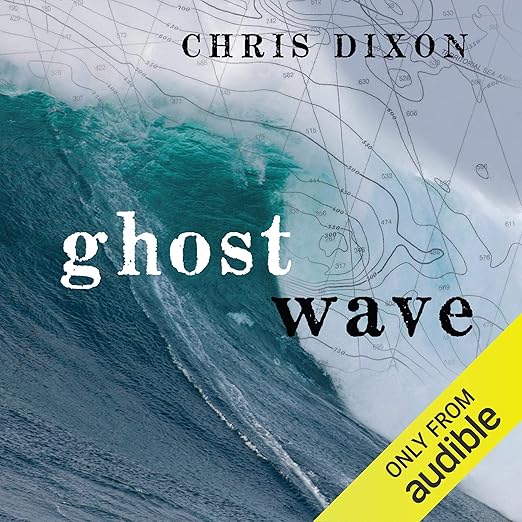
Cortes Bank is a mountain that almost breaks the surface, a fabled island submerged fifteen feet under the North Pacific, and among big wave surfers it is famous for exactly one reason: it is the home of the biggest rideable wave on earth. That is the pitch, and it undersells the audiobook badly. Chris Dixon is a journalist, and what he built out of Cortes Bank is a work of narrative nonfiction that keeps wandering off the wave into shipwrecks, fishing grounds, deep ocean geology and the sort of American scheming nobody could invent. Eleven hours and twenty-three minutes, and the surfing is not all of it by some distance.
What people came for is the most telling thing in this pool. One reader arrived because of a story about a ship called the Jalisco, deliberately sunk on Cortes Bank in the 1960s, and stayed for the scheme behind it: an attempt to build an island called Abalonia on top of a submerged channel island a hundred miles off San Diego. That notice's verdict on the men who tried it is the best line on the page, a mix of boldness, eccentricity and downright craziness. A separate reader, writing about offshore banks as fishing grounds, describes the book as far more than an account of big-wave riding at Cortes Bank.
Surf readers are served as well, and served by people who know the literature. The longest response comes from a self-described lifelong student of surf culture who has picked up every book on the subject and calls this one, without a doubt, the best big wave book, the sentence breaking off before the comparison finishes. That writer is landlocked in West Virginia, cheerfully self-deprecating about a longboard career that went nowhere, which is a useful reminder of who actually reads big-wave writing. Mostly people who will never paddle out. A four-star account traces its own route to the Bank through a clip from Dana Brown's film Step Into Liquid, showing Mike Parsons dropping endlessly into a ridiculously large wave, and credits Dixon with pulling the wave and its history into clear relief. Both notices describe a gap that had been sitting open.
The Best Parts of Ghost Wave
Byline and narrator credit carry the same name. Chris Dixon reads his own book, and on a work of reported nonfiction that is a production decision with consequences rather than a courtesy. Dixon did the reporting and wrote the sentences, and a journalist reading his own investigation carries a particular kind of authority through the material, because every name in it belongs to somebody he actually spoke to. What a self-narrated nonfiction title trades away, in general terms, is the trained delivery of a career reader. On a book this personally reported, that is the defensible side of the trade.
Publisher's copy makes a revealing slip in the same direction. It says the book pulls listeners into the harrowing world of big wave surfing and high seas adventure, using the word for an audience that hears rather than reads, on a page whose written responses come from print readers. Four of the five were filed before the December 2012 recording existed, running back as far as November 2011. Nobody is at fault for that. It does mean the enthusiasm here was earned in print, which is worth weighing before you commit the better part of a working day to it.
Third, the range is the actual reason to spend the time. A book that opens on the biggest rideable wave in the world and then detours into island-building schemes from the 1960s, the geology of a drowned peak and the commercial fishing that goes on above it has more than one hook in it. The description calls Cortes Bank the Everest of the sea and promises the story will reach anyone with a curiosity about and respect for the ocean, and the pool bears that out. One reader finished the book convinced the place was a genuinely mystical spot on the planet. The Abalonia chapters are the ones I would hand to somebody who insists they have no interest in surfing.
Before You Commit to Ghost Wave
Age is the obvious caution. This recording dates to December 2012 and the written responses run from November 2011 to December 2014, which makes the whole page a snapshot of a single moment. Nothing in the book has been updated since. Treat it as the history of a place and the value holds completely, because a drowned mountain does not change its mind. Treat it as a current account of who is riding what and where, and you will be listening to a leaderboard that stopped being maintained more than a decade ago.
Expectation management is the second thing, and it cuts both ways. The listing is tagged Water Sports, which badly undersells a book containing shipwrecks, deliberate scuttlings, ocean-floor geology and an attempted act of private island-building. A listener who wants pure surf writing will meet long stretches that are not about surfing at all, and two of the five reviewers mention that approvingly rather than as a complaint. A listener who came for ocean history will sit through detailed accounts of what it takes to ride waves this size. Both audiences get more than they bargained for, which is usually a compliment and occasionally not.
Should You Listen to Ghost Wave?
Ocean people, broadly defined. Anyone drawn to parts of the sea that behave like landscape, to places that have acquired reputations, or to the specific human category that looks at a hundred-mile crossing toward a submerged rock and thinks yes, will find their subject here. Surfers get the fullest account of a break most of them will never see, on the pool's own evidence. Readers of adventure nonfiction get a well-reported story with real peril in it, and the 4.5 across two hundred and ninety-nine ratings is a settled, long-standing number rather than a fresh spike.
Instruction and technique are not on the menu. This is reporting rather than a manual, and Dixon is interested in why people go rather than in how they get up. A decade-old snapshot is the other caveat, since nothing here has been refreshed. What remains is a journalist reading his own long investigation into a mountain that never quite reaches the surface and into the people who cross open water to meet it. The wave is why you will open it. The Abalonia scheme is what you will still be telling people about.