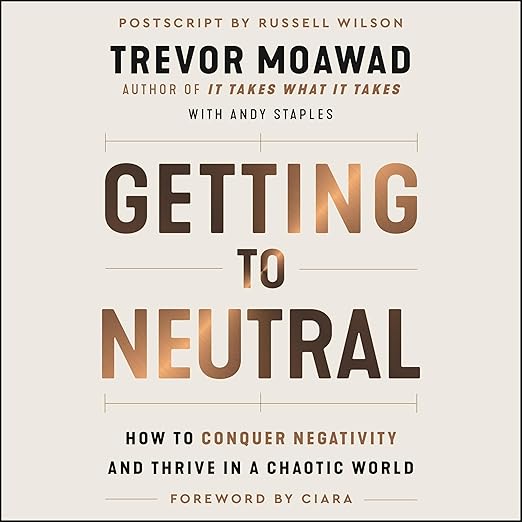
Quick Take
- Narration: Russell Wilson reading this is either a feature or a problem depending on your relationship to Wilson’s public persona, one reviewer warned against it specifically, and that warning is honest.
- Themes: Neutral thinking vs. positive thinking, behavioral approaches to adversity, mental conditioning under pressure
- Mood: Motivational but measured, grounded in specific sports psychology rather than generic inspiration
- Verdict: The concept is genuinely useful and distinguishable from standard positive-thinking content, listeners who can tolerate Wilson’s narration will find practical tools worth keeping.
I want to address the narration situation first because one reviewer did so bluntly and honestly and I think it deserves to be front-loaded here: listening to Russell Wilson read a six-hour audiobook is, for some people, an actively unpleasant experience. The reviewer in question put it plainly: just avoid the audio book unless you like to listen to Russell Wilson for hours. That is not a small caveat when Wilson’s delivery tends toward the earnest and motivational in a way that, across six hours, can become its own kind of pressure.
That said, Getting to Neutral is the work of Trevor Moawad, a mental conditioning coach who worked with some of the most consistently high-performing athletes and teams in American professional sports, and Wilson narrating it makes biographical sense, he was Moawad’s long-time friend and business partner, and the book includes Moawad’s own story of facing serious health challenges with the system he developed. There is a reason Wilson is reading it, and that reason is not arbitrary.
Our Take on Getting to Neutral
The concept at the center of the book is the most useful thing here, and it is worth understanding clearly. Neutral thinking is not positive thinking with a different name. Moawad distinguishes it explicitly: positive thinking requires you to believe things are good when they may not be; neutral thinking asks you to assess situations accurately, without the emotional loading that comes from either optimism or pessimism. It is process-oriented and judgment-free, designed for high-pressure moments when the temptation to spiral, in either direction, is strongest.
This distinction lands because it maps onto real failure modes. The listener who described himself as Type A with ADHD, constantly projecting into a future he cannot control, found the neutral framework specifically useful for that tendency. That kind of resonance, where the framework names something the reader was experiencing but had not articulated, is the marker of useful self-help writing. Moawad is not recycling familiar productivity wisdom.
Why Listen to Getting to Neutral
The book draws on Moawad’s experience working with elite athletes and coaches, and the case studies ground the abstract framework in specific high-stakes situations. His personal story about navigating serious illness with neutral thinking is the emotional core of the audiobook, and it earns its place there, it is not motivational decoration. One listener bought the book for a college sports coach, which suggests the framework is being used as a practical professional resource, not just personal development reading.
For listeners who can make peace with Wilson’s narration, the structural logic of the book is clear and practical. Moawad gives you a framework, shows it working in specific contexts, and then gives you the behavioral steps to practice it. The chapter on surrounding yourself with people who help you stay neutral is one of the more original sections, the relational dimension of mental conditioning is often ignored in sports psychology writing.
What to Watch For in This Audiobook
The narration is the main practical concern. Wilson reads with conviction and care, but his delivery is recognizably that of a professional athlete who has done a lot of media training, polished, sincere, slightly more formal than conversational. Over six hours, that quality becomes load-bearing. Listeners who find it grating in the first twenty minutes should probably read the print edition instead.
The book also has a quietly spiritual undertone. Moawad does not write from an overtly religious framework, but several reviewers noted, with appreciation, that the neutral framework left room for faith without requiring it. For listeners who want strictly secular sports psychology, that dimension is present but not dominant.
Who Should Listen to Getting to Neutral
Athletes, coaches, and anyone in high-performance environments where managing adversity is a professional skill will find this practically useful. Listeners who are already fans of Wilson and Moawad’s public work will appreciate the narration. Those who want mental performance tools but cannot engage with Wilson’s delivery should seek out the print or e-book version instead. General readers curious about behavioral approaches to negative thinking spirals, not just athletes, will find the framework applicable beyond sports contexts.
Frequently Asked Questions
Is neutral thinking the same as positive thinking with different branding?
Moawad is explicit that it is not. Positive thinking requires believing circumstances are good when they may not be. Neutral thinking asks for accurate assessment without emotional loading, neither optimism nor pessimism, specifically designed for high-pressure moments when a spiral in either direction is costly.
Does the audiobook require being a sports fan to get value from it?
No. The case studies are drawn from sports contexts and Moawad’s work with elite athletes, but the framework is behavioral and applicable to any high-pressure environment. One reviewer describes applying it to work, sport, and family life simultaneously.
Why does Russell Wilson narrate this audiobook rather than the author?
Trevor Moawad, who died in 2021, was Wilson’s long-time friend, mental conditioning coach, and business partner. Wilson co-wrote portions of the foreword with Ciara and narrates the audiobook as a tribute to their relationship and shared work. The book was completed and published posthumously.
Is the audiobook appropriate for coaches as well as athletes and individual performers?
Yes. At least one reviewer specifically purchased it for a college sports coach, and the section on building a team environment that supports neutral thinking is directly applicable to coaching contexts. The framework is designed for high-performance environments broadly.