Quick Take
- Narration: Christopher Gebauer delivers a clean, unhurried read that never condescends to its young audience, keeping the pacing accessible without dumbing anything down.
- Themes: Productivity and self-management, overcoming overwhelm, building autonomy in adolescence
- Mood: Practical and encouraging, like a patient mentor who takes teenagers seriously
- Verdict: A smart adaptation of a proven system, best suited to motivated teens and any parent who has tried and failed to explain adult GTD to their kids.
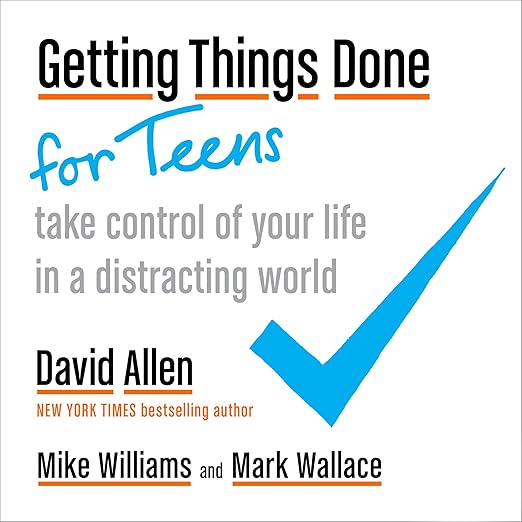
I came to this one on a Tuesday afternoon when I was helping my neighbor’s fifteen-year-old daughter set up some kind of system for managing her coursework, her part-time job, and what she described as ‘approximately forty-seven group chats that all need immediate replies.’ She had tried adult productivity apps. She had tried paper planners. She had tried nothing, which she said was ‘basically the same.’ I pulled up Getting Things Done for Teens that evening, mostly out of professional curiosity, and by the time I finished it the next morning I understood both why it needed to exist and what it does well.
The original Getting Things Done by David Allen has been a touchstone for knowledge workers since 2001. It is useful, occasionally brilliant, and written for someone who has a desk, an inbox, a calendar, and a relatively stable professional life. Adapting it for teenagers who are navigating social media notifications, homework deadlines, extracurriculars, family obligations, and a developing prefrontal cortex is not a trivial task. This version, narrated by Christopher Gebauer, takes on that challenge with more care than I expected.
Our Take on Getting Things Done for Teens
The central reframe the authors use is to treat life as a game and GTD as the strategy set that lets you play it well. That is not a revolutionary metaphor, but it is a tactically smart one for an audience that has grown up with gamified learning apps and achievement systems baked into almost every digital interaction. The book does not talk down to its listeners. It acknowledges that teens today are managing a volume of competing demands that most adults would find genuinely stressful, and it treats that reality as the starting condition rather than a complaint.
The core GTD concepts are all here: the capture habit, the clarifying of open loops, the idea of next actions rather than vague goals, and the weekly review. Each is translated into the language and context of adolescent life, which mostly works. One reviewer noted that their thirteen-year-old picked up the jargon of ‘open loops’ and next actions almost immediately after finishing it, which tells you something about how accessibly the concepts land when you’re hearing them for the first time without years of adult productivity baggage attached.
Why Listen to Getting Things Done for Teens
The audiobook format suits this material reasonably well. At four hours and thirty-three minutes it is short enough that a motivated teenager could finish it over a weekend. Gebauer’s narration is measured and clear, without the performative enthusiasm that can make how-to audio for young people feel patronizing. He reads it like a knowledgeable older friend rather than a teacher who has been told to ‘connect with youth.’
There is also something worth noting about the parent-and-child use case. Multiple reviewers describe reading or listening to this alongside their teenagers, and finding it clarified their own GTD practice in the process. One parent called it ‘a win-win for both parent and child,’ having used it to finally make sense of a methodology they had known about for years but never implemented cleanly. The visual elements referenced in the text are available in a companion PDF, which is a thoughtful inclusion for an audio product built around a system that benefits from diagrams.
What to Watch For in Getting Things Done for Teens
The book has real limits. One reviewer who was preparing their adult children for college found it useful but noted that it runs on the long side for most teenagers, and the structure can feel like it repeats itself in the later chapters. That observation aligns with a broader critique of the GTD methodology itself: the front half of the framework, the capture and clarify stages, tends to be immediately useful, while the later organizational scaffolding requires more sustained commitment to see the payoff.
There is also the question of what happens after the listen. GTD is a system that requires ongoing practice, not a one-time insight. The audiobook can introduce the mindset and the vocabulary, but the real work is in building the weekly review habit and maintaining the organizational structure over months. Teens who are already somewhat self-motivated will get more from this than those who are hoping the system will create motivation from scratch.
Who Should Listen to Getting Things Done for Teens
This one is genuinely suited to teenagers who feel overwhelmed by competing demands but want a real solution rather than a pep talk. It will also work for homeschooling families looking for a structured approach to self-directed learning, and for parents who want a shared vocabulary for talking about productivity with their kids without it feeling like a lecture. If your teenager is not already curious about organization and productivity, no amount of good narration will change that, and this audiobook will not be the thing that sparks that curiosity. But for the ones who are already asking ‘how do other people manage all this stuff,’ it delivers a thoughtful answer.
Frequently Asked Questions
Do you need to have read the original adult Getting Things Done to get value from this version?
No. Getting Things Done for Teens is written as a standalone introduction to the GTD methodology. You do not need any prior familiarity with the original book. Listeners who already know the adult version will find some of the content familiar, but the reframing and teen-specific examples still offer value.
Does the audiobook include the visual elements and PDF companion mentioned in the description?
The PDF companion with the visual summary, lab experiments, and glossary is available in your Audible library when you purchase this title. The narration references these visuals at points where diagrams would be helpful, so it is worth having the PDF accessible while listening.
Is this appropriate for a thirteen-year-old, or is it aimed at older teenagers?
The material is accessible to motivated thirteen-year-olds, as several reviewers confirm. One parent specifically notes their thirteen-year-old read it quickly and immediately began applying the concepts. The language and examples skew toward high school rather than middle school, but the core ideas are not age-gated.
What does Christopher Gebauer’s narration add to the experience compared to just reading the print version?
Gebauer keeps the pacing unhurried, which suits a book asking listeners to internalize a system rather than simply absorb information. His delivery is calm and clear without being flat. For teenagers who find reading how-to books tedious, the audio format lowers the friction considerably.