Quick Take
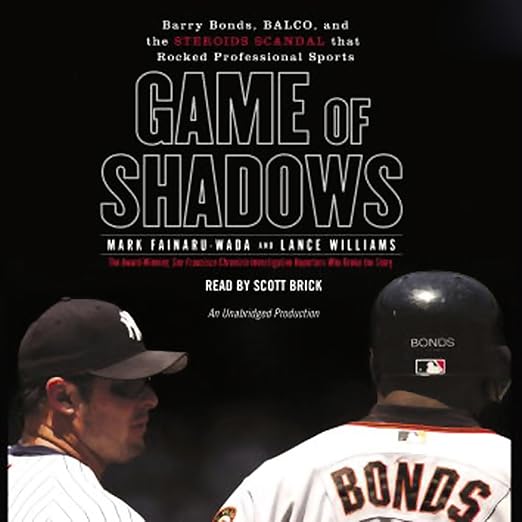
- Narration: Scott Brick brings urgency and authority to a story built on leaked grand jury testimony and relentless reporting, his measured pace suits the weight of the material.
- Themes: Institutional complicity in doping, the mythology of athletic heroism, investigative journalism under legal fire
- Mood: Investigative and unrelenting, with mounting dread
- Verdict: Listeners who want the full BALCO picture, not just Barry Bonds but the track-and-field network beneath him, will find this essential sports journalism.
I picked this one up on a long drive through the Central Valley, which felt appropriately Californian for a story rooted in the Bay Area sports scene. About an hour in, somewhere between Fresno and Merced, I pulled into a rest stop just to sit with what I had been hearing. Fainaru-Wada and Williams were not writing a book about a cheater. They were writing a book about how a culture decides what it wants to see.
Game of Shadows was first published in 2006, not long after the San Francisco Chronicle reporters broke the BALCO story that would eventually lead to congressional hearings, federal indictments, and the forced reckoning of professional sports with its own permissiveness. Twenty years on, the audiobook holds up as one of the cleaner examples of long-form investigative journalism adapted for listening.
Our Take on Game of Shadows
What Fainaru-Wada and Williams accomplished here was unusual: they built a portrait of institutional failure without turning it into a polemic. The book’s structure follows the rise of Victor Conte and the Bay Area Laboratory Co-Operative with the patience of good narrative nonfiction, letting the accumulation of detail do the persuading rather than leaning on moral outrage. Barry Bonds is the central figure, but the authors spend real time with the track-and-field side of BALCO’s operation, which several reviewers noted as an unexpected but welcome emphasis. One listener put it plainly: the book filled gaps in his knowledge about athletes well beyond baseball. That breadth is part of what makes this work.
Why Listen to Game of Shadows
Scott Brick narrates with the composure the material demands. There is no sensationalism in his delivery; he treats the testimony, the named sources, and the documented timelines with the gravity they require. For a story that could easily tip into tabloid register, his restraint is exactly right. Brick is a narrator who understands when the writing is doing the work and knows to stay out of its way. The 10-hour-and-36-minute runtime feels earned rather than padded, the material is genuinely dense with named individuals, timelines, and legal proceedings that benefit from Brick’s clear, authoritative read.
One reviewer who came in expecting a focused Bonds biography found himself surprised by how much territory the book covers: Conte’s background, Greg Anderson’s role, the athletes from track and field who orbited the whole enterprise. That broadened scope is both the book’s strength and, occasionally, its test of patience. If you want Bonds and only Bonds, you may occasionally wish the camera would narrow. If you want the full picture of how an underground performance-enhancement network operated at the highest levels of American sports, this is one of the few books that provides it.
What to Watch For in Game of Shadows
One reviewer with obvious investment as a Giants fan described the book as a little too preachy in places, and I think that is a fair note. When the authors step back from reporting into editorializing, the narrative momentum softens. That said, the preachiness is minor and occasional, not structural. The far larger issue some listeners may have is the question of where the story goes after the facts are laid out. The book ends where the journalism ends, not where the moral accounting ends. That is probably right for this kind of work, but it means the conclusion feels more like a pause than a resolution. The legal proceedings that followed the book’s initial publication continued for years after, and the audiobook offers no update on those threads.
Who Should Listen to Game of Shadows
This is for listeners drawn to narrative investigative journalism in the tradition of long-form magazine work, the kind of patient, evidence-first storytelling that builds its case over hours rather than chapters. It rewards listeners who already follow baseball or track and field but does not require that background to be compelling. Those looking for sports entertainment or fan biography will be less satisfied; the prose is journalistic, not novelistic. But for anyone who wants to understand the BALCO scandal in full, with all its legal, political, and athletic dimensions intact, this audiobook delivers exactly what its reputation promises.
Frequently Asked Questions
Do I need to know a lot about baseball to follow Game of Shadows?
No. The book spends significant time on track-and-field athletes connected to BALCO and builds its case methodically enough that general listeners can follow without deep sports knowledge. Baseball context helps but is not required.
Does Scott Brick’s narration handle the legal and technical material well?
Yes. Brick maintains a measured, authoritative pace that suits the book’s dense timelines and sourced testimony without making the legal material feel dry or inaccessible.
Is this primarily a book about Barry Bonds or about the broader BALCO scandal?
Both, though Bonds is the most prominent figure. Multiple reviewers noted that the track-and-field dimension of the story receives substantial attention, making this a fuller account of BALCO than the title’s baseball associations might suggest.
Has the book aged well given everything that has happened with the Bonds home run record since publication?
The core reporting remains solid as a historical document of the scandal’s early period. The audiobook does not include updates on subsequent legal proceedings or the broader steroid era reckonings, so it reads best as the investigative record it was at the time of original publication.