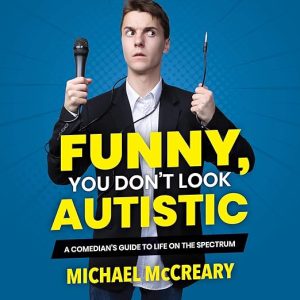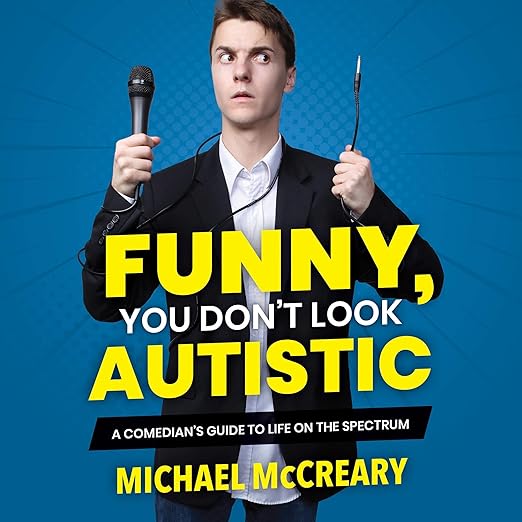
I had this one in my queue for a long time before finally getting to it during a long drive up the coast. Within the first twenty minutes I was laughing out loud in the car, which was not what I had expected from a memoir about autism spectrum disorder. Michael McCreary is, before anything else, a comedian, and that fact shapes every page of Funny, You Don't Look Autistic in ways that make it substantially different from the earnest awareness literature the genre usually produces. This is not a book that explains autism to you from a clinical distance. It is a book about what it felt like to be a specific person growing up with a specific brain, written by someone who learned to make his pain funny before he learned much else about how to navigate the world.
McCreary was diagnosed with ASD at age five. He started journaling during what sounds like a genuinely difficult stretch of junior high, and he turned those journals into material. By fourteen he had his first stand-up gig, and the book describes him as not looking back since. The trajectory from pain to punchline is the book's real subject, and he is smart enough not to oversimplify it into straightforward triumph narrative. There are sections of this memoir that are genuinely uncomfortable in ways that do not resolve neatly, and that honesty is what distinguishes it from the inspirational memoir category it might otherwise get filed into.
What McCreary does with structure is worth noting for anyone who comes in expecting a conventional chronological memoir. The book doesn't move in strict biographical order. It moves more the way a comedy set does, with thematic threads, callbacks, and moments where the personal becomes the universal by way of the specific and slightly absurd. He's writing about what it means to not look autistic when you are, about the way that disconnect plays out in social situations, job interviews, friendships, and on stage in front of an audience. The title is doing real work. It captures the exhausting experience of having an invisible condition that others constantly interrogate and debate as though their assessment overrides your diagnosis.
At just under three and a half hours, this is a compact audiobook, and there is no bloat. McCreary makes the brevity feel intentional, as though he understood that the subject does not require a marathon runtime to be taken seriously. He covers what it means to live with ASD in practical terms: the way social scripts fail when you cannot intuit them, what performing stand-up actually gave him as a means of creating structured and therefore manageable human connection, and why the frequently offered advice to just try harder is not only useless but actively misunderstands what the difficulty is.
What Stands Out
The book markets itself as an OwnVoices memoir, and that designation matters in ways that go well beyond representation. McCreary writing about ASD from the inside means he is not explaining symptoms to you. He is describing experience. The difference is enormous and determines nearly everything about how the book functions. He knows what it is like to be told you do not look autistic by someone who means it as a compliment. He knows what it is like to rehearse social interactions as scripts and have them fail when the other person goes off-script. He knows what it is like to discover that your coping mechanism, in his case journaling that became comedy, is more sustainable than most of the alternatives well-meaning people suggested.
Listeners who are parents of children with ASD, or who are on the spectrum themselves, have responded to this memoir in ways that speak to that interior specificity. One reviewer described it as the best book on Asperger's she had ever read, having read most of the available literature. Another wrote that he bought it for his adult son with autism, who found it funny and relatable, recognizing his own experience in McCreary's. That cross-generational resonance, the book functioning equally well for a young person who wants to feel less alone and for the adults trying to understand that young person, is a genuine achievement in a genre where those audiences typically require entirely separate titles.
Before You Commit to Funny, You Don't Look Autistic
The author reading his own work is always a gamble. Sometimes the absence of distance flattens what a trained narrator would elevate. Here the opposite is true. McCreary has spent years performing, and he knows exactly how to pace material for a listening audience. His delivery captures the comic timing in ways a hired narrator could not reproduce, and crucially, it also captures the moments where the humor is not meant to deflect but to ground something real. When the book enters harder territory, his voice does not become performatively emotional. It stays wry, which is its own form of honesty and probably the most effective choice available.
One reviewer offered a mild reservation, calling the book good rather than great and noting that certain passages lean more toward structured overview than memoir. That is a fair observation. There are sections where the explanatory content feels more like a primer on ASD presentations than a personal story. But McCreary is twenty-something when he writes this, and the book reflects both the clarity and the limitations of that vantage point. It is the work of someone still in the process of understanding the shape of his own experience, and that quality gives it an authenticity that more polished retrospective memoirs sometimes lose.
Best Suited For
This one is genuinely useful across multiple audiences: people on the spectrum looking for a voice that reflects their experience, parents of children with ASD who want something that is neither clinical nor condescending, and anyone whose understanding of autism comes primarily from what is visible rather than what is felt. Listeners expecting a conventional linear memoir may find the structure slightly loose. Anyone who wants the experience without the comedy should probably look elsewhere. But if you are open to both, Funny, You Don't Look Autistic is exactly as valuable as its reviews suggest, and substantially funnier than you will expect.
Is this audiobook appropriate for a teenager with ASD, or is it primarily written for adults?
McCreary addresses both teen and adult experiences, and multiple listeners have shared it with teenage children on the spectrum who found it relatable and funny. It works genuinely well for both age groups.
How much of the audiobook is stand-up comedy versus memoir?
It is primarily memoir with a comic voice running throughout, rather than comedy segments with memoir interludes. Think comedian writing a personal book, not a comedy special with occasional vulnerability.
Does McCreary address the frustration of appearing neurotypical when you are not?
Yes, extensively. The title is the central argument: the assumption that autism must look a certain way causes specific and recurring harm to people whose presentation does not match expectations. This thread runs through the entire audiobook and never loses its urgency.