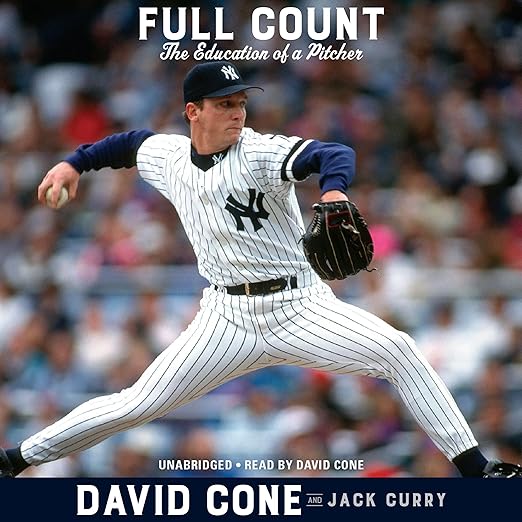
Quick Take
- Narration: David Cone narrates his own memoir with the same analytical composure he brought to the mound, natural and unperformed, though not always riveting as a pure vocal performance.
- Themes: Pitching craft, mental toughness, the Yankee dynasty of the 1990s
- Mood: Reflective and technically immersive, warm toward the end
- Verdict: For serious baseball listeners who want to understand the mind of a pitcher, this goes deeper than almost any other memoir in the genre.
I came to Full Count on a Tuesday night in late October, the kind of evening when the World Series is on in the background and you find yourself wondering, for the hundredth time, what is actually happening inside a pitcher’s head. I had been putting this one off because author-narrated memoirs can be awkward, particularly when the author is famous for something physical and communicative rather than for the spoken word. I was wrong to hesitate.
David Cone narrates his own book and it works, largely because Cone has spent years talking about baseball on television in ways that reveal a genuine analytical mind. The same quality that made him such an interesting broadcaster, a willingness to dwell on the mechanics and psychology of pitching rather than just the highlight moments, is exactly what makes Full Count a different kind of sports memoir. Andy Pettitte’s opening quote says it best: even when Cone was in trouble, he carried himself like a pitcher who believed he was the man out there. What this book does is show you the discipline underneath that bearing.
Inside the Mechanics of a Craft
The central promise of this book is that Cone is going to take you inside the thinking of a major league pitcher, and he delivers on it in ways that can feel almost uncomfortably intimate. He talks through specific counts, specific batters, specific series of decisions made in real time on the mound. He covers the pitchers he studied, how he developed his splitter, how he processed the psychological humiliation of blowing a lead, and what composure actually means as a practice rather than as a personality trait. The reviewer who called this a thinking man’s guide to pitching is accurate. This is not a book for casual fans who want anecdotes and gossip. It is a book for people who want to understand the craft at a level that most athletes never bother to articulate. Cone bothers, with patience and specificity, across every chapter.
What is unusual about Full Count is how little Cone is interested in flattering himself. He describes mistakes he made as a young pitcher, the naivety he carried from Kansas City to New York, and the ways his early confidence was as much ignorance as it was talent. The self-assessment is genuine rather than performed humility. A reviewer named The Professor described finding himself neglecting the evening’s games to keep reading, and noted that Full Count does not feel like the tired greatest-hits collection that most sports autobiographies become. That observation points to the structural choice Cone makes throughout: he connects specific moments to larger principles about craft rather than letting the moments stand alone as highlights.
The Teams That Shaped Him
Full Count moves chronologically through Cone’s career, from the late-eighties Mets with their notorious energy and Keith Hernandez-era personality, through Toronto and Kansas City, and eventually to the Yankee dynasty of the nineties that most fans will know him for. The contrast between the chaotic late-eighties Mets and the more professional Yankee clubhouse is drawn with care. Cone is honest about what he absorbed from each environment and about the immaturity he carried into his early career. He is not interested in settling scores. He is interested in describing how each context shaped the pitcher he eventually became.
The book does not linger on scandal for its own sake. The reviewer from Canada who called it boring was not wrong that the pitching analysis dominates. If you came expecting a tell-all about the cocaine-era Mets, you will be disappointed. What you get instead is a pitcher reflecting on what those years taught him about preparation, professionalism, and how to fail constructively. That is a more valuable record than the gossip would have been, even if it is a less immediately sensational one.
Where the Narration Earns Its Place
Hearing Cone read his own lines matters in specific ways. When he describes a pitch sequence or reconstructs what he was thinking in the seventh inning of a close game, there is authority in the voice that no hired narrator could replicate. You hear him remember in real time. He pauses in places that suggest genuine recollection rather than performance. The vocal production is less polished than a professional studio narrator, but that roughness serves the memoir’s texture in the same way that a slightly worn field recording serves documentary footage better than a cleaned-up studio version would.
The audiobook runs to over twelve hours, which is substantial, and there are stretches where technical detail accumulates faster than it resolves into narrative momentum. Listeners who want emotional peaks at regular intervals may find the middle sections demanding. For those willing to stay with it, the payoff is considerable. His perfect game against the Expos in 1999 is handled with exactly the understated grace it deserves, and the later chapters, where Cone reflects on aging, transition, and the end of elite athletic performance, carry genuine weight.
Who Should Listen and Who Should Skip This
Full Count is for the baseball listener who reads box scores with genuine curiosity, who has opinions about pitch sequencing, and who wants a memoir that respects their intelligence enough to go technical. If you are a Yankee fan from the nineties dynasty era this is close to required listening. If baseball is background entertainment for you rather than a subject you actively think about, this will feel like too much work. Cone is not performing for the casual fan. He is talking, at length and in depth, to people who love the game the way he does, and that specificity is exactly what makes this memoir worth twelve hours of your time.
Frequently Asked Questions
Does David Cone cover his perfect game against the Expos in 1999?
Yes, it is addressed in the memoir with the reflective detail the book is known for. Cone does not sensationalize it, but the account carries real emotional weight precisely because of how quietly and thoughtfully he approaches it.
Is Full Count only for Yankees fans or does it cover his full career?
The book covers his entire seventeen-year career including his time with the Mets, Toronto, and Kansas City before his Yankee years. The Mets chapters are particularly interesting for the contrast they draw with the more professional Yankee environment of the nineties.
How technical does the pitching analysis get? Is it accessible to non-pitchers?
Quite technical in places, but Cone explains his reasoning clearly enough that engaged general listeners can follow. You will learn about pitch sequencing, grip mechanics, and in-game psychology. No prior pitching experience is required, though understanding basic baseball counts helps.
Does Cone narrating his own audiobook work, or would a professional narrator have been better?
It works. Cone’s television background gives him comfort with the spoken word, and the authority in his voice when reconstructing specific pitching decisions adds something no professional narrator could replicate. The production is less polished than a studio narrator but more authentic in feel.