Quick Take
- Narration: Joey Evans self-narrates with raw, unpolished sincerity that makes the harrowing recovery chapters feel genuinely personal rather than performed.
- Themes: Spinal injury recovery, dream pursuit against medical odds, friendship and family as lifelines
- Mood: Bruising then triumphant, with long honest stretches in the dark before the light
- Verdict: A genuinely hard-won memoir about what it costs to keep a dream alive after your body has been taken apart.
I put this one on during a long Saturday drive through the countryside, somewhere around the second hour of motorway, and I did not turn it off. Joey Evans tells his own story, in his own voice, and there is something about the South African cadence of it that keeps you grounded in the specifics of place and person rather than letting the narrative drift into generic inspirational territory. This is not a polished studio performance. It is a man sitting across a table from you, telling you the worst thing that happened to him and then telling you what he did about it.
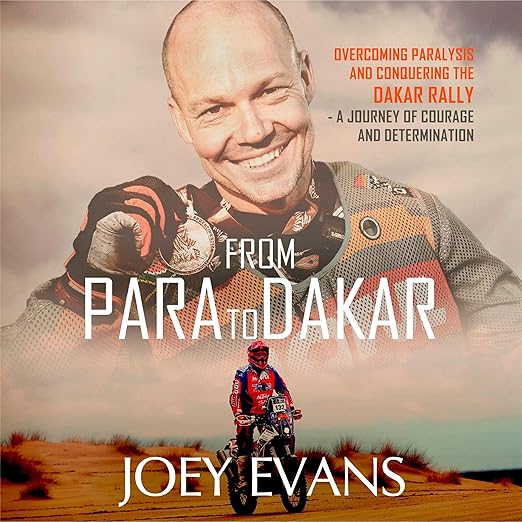
Evans broke his back in a 2007 racing accident. His spinal cord was crushed. Doctors gave him a ten percent chance of ever walking again. The Dakar Rally, all 9000 kilometres of it, was the dream he had been building toward. The accident did not end that dream. It just moved the start line much, much further back.
Our Take on From Para to Dakar
What makes this memoir unusual is how methodically Evans refuses to skip the hard parts. He does not rush from accident to triumph. He stays in the hospital. He stays in the rehabilitation ward. He describes what paralysis actually does to a body, to a marriage, to a household, and to a man’s sense of himself. One reviewer called this book a how-to guide on positive thinking, and that is not entirely wrong, but it undersells how much of the instruction comes from watching Evans fail before he succeeds. The philosophy here is earned, not declared.
Why Listen to From Para to Dakar
Evans self-narrating is both this audiobook’s greatest strength and a mild practical challenge. His voice carries emotional weight that a professional reader simply could not replicate. The moments where he talks about his wife, his children, and the friends who drove hours to sit with him in the dark of early recovery land with a force that only first-person intimacy can produce. The South African idioms and phrases that one reviewer flags as occasionally opaque are a small price for that authenticity. You pick up the meaning from context, and the texture they add to the storytelling is worth it.
At ten hours and forty minutes, the book gives the Dakar Rally itself room to breathe. The race is not summarized. You ride through it with him, sector by sector, and Evans is specific enough about the terrain, the mechanical failures, and the physical punishment that you understand what finishing actually cost. He was the only South African to complete the race in 2017. By the time you reach that fact again in the final chapters, it lands differently than it does in the synopsis.
What to Watch For in From Para to Dakar
The book occasionally reads as a tribute to the community around Evans rather than a tightly controlled personal narrative. He is generous to a fault with credit, which means the chapters covering his rehabilitation support network can feel more documentary than memoir. Some listeners expecting a propulsive racing narrative may find the early recovery sections slower going than they anticipated. That said, those same sections contain the book’s most honest writing, and skipping them would hollow out the finish.
The audiobook is priced at zero on Audible, which means it is accessible to anyone with an account. For a memoir at this level of personal exposure and a rating of 4.8 from 270 listeners, that is a significant value proposition.
Who Should Listen to From Para to Dakar
Listeners who respond to memoir built around physical extremity and genuine consequence will find this rewarding. Motorsport fans will get the Dakar detail they want. Readers who enjoyed books about recovery from catastrophic injury, or who have followed events like the Dakar Rally on television and wanted the inside view, are the natural audience. Those looking for a conventional racing narrative with clean structure and polished prose should know this is something rougher and more personal than that, and that the roughness is the point.
Frequently Asked Questions
Do I need to know anything about the Dakar Rally before listening?
No prior knowledge required. Evans explains the race’s structure, terrain, and culture as part of the storytelling, so first-time listeners get enough context to understand what the achievement means.
How graphic is the description of Evans’s spinal injury and paralysis?
Evans is honest and specific about the physical realities of his condition, including bodily functions, rehabilitation setbacks, and the emotional weight of dependency. It is not gratuitous, but it is unflinching, and listeners sensitive to medical detail should know this going in.
Is this audiobook suitable for non-motorsport fans?
Several reviewers explicitly say yes. The racing content is present throughout, but the core of the book is about recovery, family, and determination, which resonates well beyond the motorsport audience.
Does Joey Evans’s self-narration work technically, or are there production quality issues?
The production is clean and audible throughout. The narration lacks the polish of a professional studio reader, but the trade-off is a quality of personal intimacy that Evans’s own voice delivers in a way no hired narrator could have managed.