Quick Take
- Narration: Bailey Carr handles Lyric’s emotional range with conviction, she distinguishes the Obscurite and Lumiere factions clearly and keeps the multi-character dynamics from blurring together.
- Themes: Prophecy and agency, navigating divided loyalties, the cost of a chosen destiny
- Mood: Propulsive and emotionally invested, with a cliffhanger that will frustrate listeners who need immediate resolution
- Verdict: A strong second installment for readers already committed to the Elements of Five series, though new listeners must start with book one.
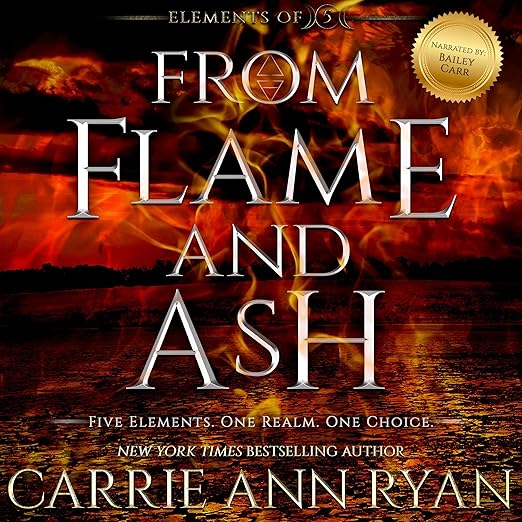
I came to From Flame and Ash already knowing Lyric from the first book, which made the opening stretch, a year of training in the human realm, college classes she knows are pointless, nightmares bleeding into her waking life, land with a particular kind of melancholy. Carrie Ann Ryan understands that the weight of a prophecy is not just about the big moments. It is about all the ordinary Tuesday mornings you spend knowing those ordinary Tuesday mornings are numbered.
Bailey Carr’s narration is doing consistent, careful work across this series. She keeps Lyric sounding young without making her sound naive, which is a harder distinction to maintain than it looks, especially as Lyric moves from the familiar territory of Book One into the Obscurite Kingdom with Easton and a new set of allies who complicate everything she thought she understood about the war.
Our Take on From Flame and Ash
This is fundamentally a transitional installment in the best sense, it earns its middle-book status rather than simply marking time. Lyric’s journey through the Water and Air territories gives Ryan room to expand the elemental magic system with genuine specificity. The Obscurite warriors are no longer abstractions; they become people with histories. And Easton, who in book one could have read as a standard brooding YA love interest, develops enough texture here to feel like an actual character in his own right.
The decision to keep Lyric navigating between both sides of the Lumiere-Obscurite war is the novel’s structural strength. She cannot afford clean allegiances, and Ryan does not let her off the hook by resolving that ambiguity prematurely. The Seer’s wish that arrives late in the novel is genuinely destabilizing in a satisfying way, it reframes some of what came before without invalidating it.
Why Listen to From Flame and Ash
Readers who flagged the worldbuilding as a highlight of the first book will find this installment even richer. The elemental territories have distinct characters, Water presents differently from Air, and Ryan establishes those differences through sensory detail rather than summary. Multiple reviewers praised the expansion of the Obscurite Kingdom specifically, noting that the explanations of new territories feel extraordinary rather than like an info-dump obligation.
The pacing complaint that surfaces occasionally is real: the book is slow to launch, spending its opening chapters in the human realm before Lyric’s return to Maison. If you found the human-realm sequences in Book One necessary but not thrilling, budget some patience for those early chapters here. Once Lyric is back in the Maison realm, the book accelerates and does not really stop.
What to Watch For in From Flame and Ash
The cliffhanger ending is the point where listener responses sharpen. One reviewer’s note that the end was handled with a reassuring afterword is worth knowing in advance: Ryan acknowledges where the series is going, which softens the abrupt stop without eliminating the urgency. It is a cliffhanger of the kind that rewards rather than punishes, you are left wanting Book Three rather than feeling abandoned. But listeners who genuinely need closed endings should be warned.
The series has four books confirmed as of this installment, and From Flame and Ash functions as the bridge between Lyric’s formation and her full deployment as a force in the war. That middle-series position means some resolutions are deferred, and the book is best understood as one extended chapter of a larger story rather than a complete arc.
Who Should Listen to From Flame and Ash
Do not start here. This is book two of a series that builds on specific character relationships and world details from book one, and beginning mid-series will leave you disoriented. For listeners already in the Elements of Five world, this is exactly what a sequel should be, more complex, more costly, more invested in its characters. YA fantasy readers who like their magic systems detailed and their heroines carrying genuine narrative weight will find Ryan’s series consistently rewarding.
Frequently Asked Questions
Can From Flame and Ash be listened to without reading From Breath and Ruin first?
Not comfortably. The character relationships, the political structure of the Maison realm, and Lyric’s emotional arc all depend heavily on the first book. Starting here would mean missing the context that makes the Obscurite-Lumiere conflict meaningful.
Does Bailey Carr differentiate between the large cast of characters clearly enough to follow in audio?
Yes, this is one of Carr’s strengths in this series. The Obscurite warriors in particular have distinct vocal signatures, and the emotional dynamics between characters come through cleanly even during the busier action sequences.
How explicit is the romance content, is this strictly YA or does it edge toward adult fantasy romance?
The romance in From Flame and Ash stays firmly in YA territory. Emotional tension and connection are central, but the content is appropriate for teen listeners and adults who prefer romance without explicit scenes.
Does the book end on a cliffhanger, and if so, is Book Three readily available?
Yes, the ending is a cliffhanger, though Ryan includes an afterword that provides some reassurance about the series direction. Books Three and Four in the Elements of Five series are available, so listeners will not be left waiting indefinitely.