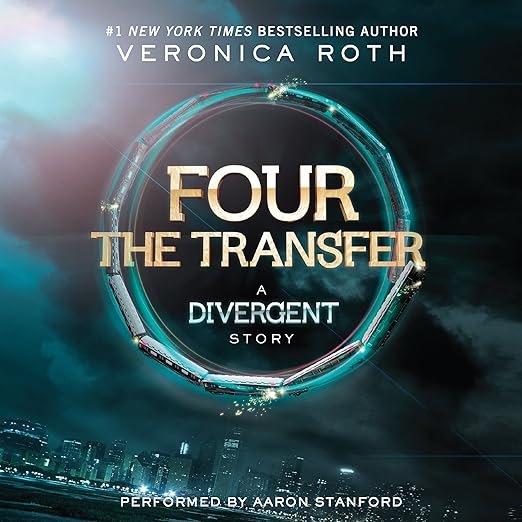
Quick Take
- Narration: Aaron Stanford delivers Tobias’s interiority with controlled intensity, handling the abuse scenes with a restraint that makes them more affecting than a more dramatic reading would.
- Themes: Escaping parental violence, the psychology of faction choice, identity under pressure
- Mood: Tense and quietly revealing, a companion piece rather than a standalone experience
- Verdict: Rewarding for Divergent fans who want to understand Tobias more fully, but too brief and context-dependent to work as an entry point to the series.
At one hour and sixteen minutes, this is not a book in the conventional sense. It is the first of four short companion pieces that Veronica Roth wrote for the Divergent universe, each between fifty and seventy-five pages, retelling pivotal moments from the series through Tobias’s perspective. This particular entry covers his aptitude test, the moment of Choosing Day, and the sequence that earns him the nickname Four. I listened on a Sunday afternoon between other things, which is roughly the temporal scale the content demands.
The question worth asking about any companion piece is whether it earns its existence or merely extends a franchise’s commercial footprint. For The Transfer, the honest answer is: it earns it, conditionally. The condition is that you have read Divergent already, or at minimum listened to it. Without that foundation, the moments Roth is revealing here have no weight because the weight comes entirely from dramatic irony. You know who Tobias becomes. Watching how he got there is meaningful precisely because of that knowledge.
Our Take on Four
What the companion format allows Roth to do that the main series cannot is to show the father. Marcus Eaton appears in Divergent as a public figure and a private threat, but from Tris’s perspective you see only the external consequences of what he is. From Tobias’s perspective, you get the interior of it: how Marcus presents one face to Dauntless leadership and another entirely to his son, and how a person can be invisible in their own home even when they are known publicly. One reviewer highlighted exactly this, noting that Tobias’s observation that no one knew his father, not even him, is the kind of line that opens up rather than closes down a character.
The aptitude test sequence is one of the better uses of the format. Readers of Divergent already know that Tris’s test result is unusual and threatening. Seeing Tobias’s test result through his own eyes, with the specific knowledge of what the administrators do with results like his, adds a layer to both characters. Roth uses the parallel structure of the Choosing Ceremony particularly well, showing the moment of faction selection as experienced from a completely different emotional position than the one the main series presents.
Why Listen to Four
Aaron Stanford is the right choice for this material. Tobias is defined by restraint, by the effort required to not become his father while carrying everything his father gave him. Stanford’s reading keeps that lid on throughout, which means the moments where emotion does surface carry genuine impact. The scene with Marcus requires a specific kind of vocal control, and Stanford delivers it by underplaying rather than dramatizing, which is the correct instinct. An overemotional reading would have made the scenes feel exploitative; the measured approach makes them feel honest.
For listeners who have always found Tobias slightly opaque in the main series, this short piece is genuinely clarifying. The nickname Four is not just a faction quirk; it is a kind of armor he builds for himself, and hearing how it was constructed and chosen makes it more meaningful when it resurfaces in the full novels.
What to Watch For in Four
The length is the main caveat, and it is a real one. At 76 minutes, this is priced and packaged as a full audiobook, which created friction with listeners who felt the value exchange was off. That is a legitimate concern about format rather than content quality. The writing itself is tight and purposeful precisely because it is short, but the expectation management question remains. Roth wrote four of these pieces, and they were subsequently compiled into a single volume. If you are considering this as a first purchase, the compiled Four collection may offer better value than buying the individual pieces separately.
The synopsis also mentions The Fates Divide, Roth’s sequel to Carve the Mark, in a way that feels like marketing appended to the product description rather than content relevant to this story. That kind of cross-promotional inclusion does not affect the quality of what you are actually listening to, but it is worth noting as a packaging choice that feels slightly cluttered.
Who Should Listen to Four
This is for Divergent readers who want more Tobias and are comfortable with the companion novella format. It is not the place to start the series, and it is not a self-contained story. Listeners who found Tobias compelling in the main trilogy will find this a satisfying deepening of his backstory. Anyone who has not read Divergent should start there first, as the emotional resonance here depends entirely on knowledge imported from the main series.
Frequently Asked Questions
Can I listen to Four without having read or listened to Divergent first?
It is possible but not advisable. The emotional and narrative weight of The Transfer depends on knowing who Tobias becomes and what the Divergent universe looks like after Choosing Day. Without that context, the scenes will feel like setup without a payoff.
This is listed as a single story but the Divergent universe has four Four stories total, does this collection include all of them?
This audiobook appears to be the first of four companion pieces, The Transfer, rather than the complete Four compilation. The four short stories were published individually and then collected. If you want all four perspectives, look for the compiled Four audiobook rather than the individual pieces.
Does Aaron Stanford’s narration match the tone of the Divergent main series narrator?
Emma Galvin narrates Tris’s perspective in the main series; Aaron Stanford narrates Tobias here. Both are strong choices for their respective characters. Stanford’s controlled delivery suits Tobias’s restrained emotional register, and listeners who move between the two narrators generally find the contrast adds to rather than disrupts the experience.
The abuse scenes involving Marcus are described as affecting, how intense are they in the audio format?
The scenes are psychologically intense but not graphic in an exploitative way. Stanford’s understated reading keeps them grounded rather than dramatized, which makes them feel honest rather than sensational. Listeners with sensitivity to parental abuse content should know these scenes are present and central to Tobias’s character.