Quick Take
- Narration: Kirby Heyborne brings warmth and steady authority to Yuki Nakahara’s story, lending the combat scenes weight without losing the YA accessibility.
- Themes: Japanese American internment, loyalty under injustice, brotherhood in wartime
- Mood: Earnest and sobering, with moments of genuine uplift
- Verdict: A historically grounded YA novel that handles wartime injustice with care, told through a protagonist whose quiet dignity makes the larger history land harder than any lecture could.
I first heard about the 442nd Regimental Combat Team years ago, buried in a footnote about World War II unit casualties. The 442nd became the most decorated unit in US Army history for its size and length of service, and a large portion of the men fighting in it had family members being held in internment camps back home. That irony is so sharp it almost defies fiction, which is probably why it took a novelist of Dean Hughes’s patience to render it at a YA level without either softening it or making it unbearable.
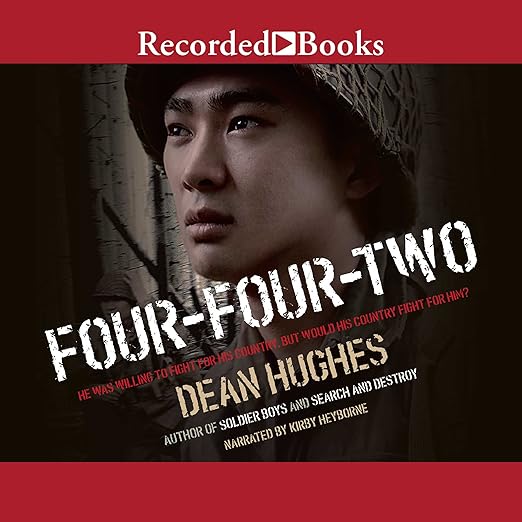
Four-Four-Two follows Yuki Nakahara, a young Japanese American from the Utah internment camps who enlists partly out of genuine patriotism and partly out of a desire to prove something that should not have to be proven. His friendship with Shig grounds the book emotionally, and the novel earns its combat sequences precisely because Hughes spends enough time on the two of them before shipping them overseas. The first-person emotional register is not sentimental; it is specific and restrained, which turns out to be more affecting.
Our Take on Four-Four-Two
Hughes has written about war for young adult readers before, with Soldier Boys and Search and Destroy in his bibliography, and that experience shows in how he calibrates violence. The combat here is vivid enough to feel real, brutal enough to carry consequences, and restrained enough that the focus stays on what these men are fighting through emotionally rather than just physically. The review from one reader who called it touching and perhaps a bit preachy is fair: there are moments when the book leans into its moral explicitly rather than trusting the reader to draw the conclusion. But given the audience, that choice is defensible, and it never tips into harangue.
Why Listen to Four-Four-Two
Kirby Heyborne is an excellent narrator for this material. He brings an understated gravity to Yuki that respects the character’s dignity without making him seem older than he is. The audiobook format works particularly well for the combat sequences, where Heyborne’s pacing creates a rhythm that heightens urgency without melodrama. At just under seven hours, it is a tight, focused listen. One reader called it a little piece of hidden history, and that captures the audiobook’s pace: it moves with the efficiency of something that knows exactly what it wants to say and is not interested in padding.
What to Watch For in Four-Four-Two
The novel does occasionally slip into a rhythm where the injustice being depicted speaks for itself but the prose feels the need to underline it. Younger listeners who are encountering this history for the first time will likely not notice; more experienced readers of WWII fiction may find it slightly familiar in structure. More substantively, the book is better at depicting the experiences of men within the regiment than at exploring what was happening to the families left behind in the camps. That is partly a scope choice, but it means the internment context, while present, is not fully inhabited.
Who Should Listen to Four-Four-Two
This is genuinely strong listening for readers thirteen and up, and for adults who want an accessible entry point into 442nd history before moving to non-fiction accounts. If you have a teenager interested in WWII or in American civil rights history, this is a more dimensional introduction than a textbook provides. Skip it only if you are coming looking for the kind of moral complexity that questions the protagonists’ choices rather than honouring them.
There is one more thing worth naming: this story arrives at a moment when the history it depicts feels newly urgent. The 442nd’s soldiers were accused of insufficient loyalty to a country that had locked their families up. They responded by fighting harder than almost any unit in the war. Dean Hughes does not editorialize about what that says about citizenship, belonging, or the definitions of patriotism. He lets the story speak. That restraint is itself a kind of respect, and it makes Four-Four-Two linger longer than most YA historical fiction manages.
Frequently Asked Questions
Is Four-Four-Two based on real events or is it fully fictional?
The novel is historical fiction. The 442nd Regimental Combat Team was a real unit with a documented history, and the broad historical circumstances are accurate. Yuki Nakahara and his specific story are fictional composites created by Dean Hughes.
Is the content appropriate for middle school readers, or is it primarily a high school book?
The publisher and most reader reviews suggest a 13-and-up audience. The combat scenes are realistic and some deaths are emotionally weighted, but there is no graphic gore or adult content. One reader specifically praised it as a perfect read for a mature 13-year-old.
How does Kirby Heyborne handle the Japanese American characters and cultural elements?
Heyborne narrates with respect and restraint. He does not attempt exaggerated accents and delivers the emotional register of the characters cleanly. His performance has been praised across his YA audiobook catalog for this kind of sensitive handling.
Does Four-Four-Two connect to other books by Dean Hughes about WWII?
Hughes has written other war novels including Soldier Boys and Search and Destroy, but Four-Four-Two stands alone and does not require knowledge of those books. It can be read in any order.