Quick Take
- Narration: Bradford Hastings delivers a serviceable performance that keeps the thriller moving, he handles the LA atmosphere and legal drama competently without adding much interpretive color.
- Themes: Criminal defense, organized crime, the line between loyalty and complicity
- Mood: Fast and twisty, though the courtroom scenes carry a noted accuracy problem
- Verdict: A quick, entertaining legal thriller opener that works best for listeners who prioritize plot momentum over procedural fidelity, the Brad Madison series shows enough promise to earn a second installment.
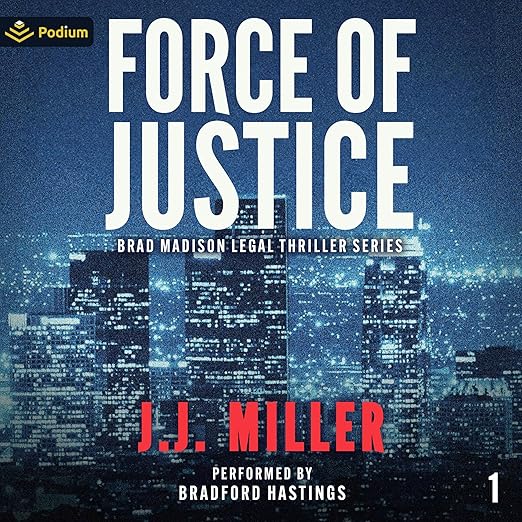
I came to Force of Justice on a Tuesday afternoon when I wanted something that would carry me along without asking too much, and J.J. Miller’s debut Brad Madison legal thriller delivered exactly that, for most of its seven and a half hours. This is a series opener that knows what it is trying to do and does it with enough competence to make you curious about where Brad Madison goes next, even if it does not entirely earn the comparison to the genre’s heavier hitters.
Brad Madison is a Los Angeles criminal attorney called to defend Patrick Strickland, one of the city’s most powerful men, against a murder charge. What makes this more than a standard courtroom drama is the organized crime dimension: Strickland claims to have no criminal connections, but the evidence tells a different story, and as Madison digs deeper, the distinction between defending a client and becoming entangled in something far larger starts to blur in ways that put Madison himself at risk. When the case attracts national media attention, the underbelly of LA power gets a public airing no one involved actually wants.
Our Take on Force of Justice
The book’s strongest quality is its pace. Miller does not waste time on scenes that do not advance either the case or the threat to Madison personally, and the seven hours move with the kind of forward momentum that makes legal thrillers satisfying as audio. The organized crime elements give the story a physical danger dimension that pure courtroom dramas sometimes lack, Madison is not just trying to win an argument, he is trying to stay alive while doing it, and the two pressures play against each other in ways that keep the tension from deflating after each courtroom scene.
The ending, which multiple reviewers note is unexpected, delivers on its promise. One reviewer described not having any idea how it was going to end as the mark of a good mystery, and that reader’s experience seems to be the common one. Miller plants the relevant information without telegraphing where it leads, which is a harder craft problem than it sounds in a genre where experienced readers have absorbed every available twist template.
Why Listen to Force of Justice
Bradford Hastings keeps the energy moving across seven hours without the narration becoming a drag on the pace. He is particularly effective in the scenes where Madison is under direct threat, his reading of those sequences has a physical tension that the courtroom scenes, which require a more measured delivery, do not quite match. The LA setting is evoked efficiently rather than elaborately, which suits a fast plot, you get enough atmosphere to locate the story without scene-setting that halts the momentum.
As a series opener, Force of Justice establishes Madison as a protagonist with a clear professional identity and enough personal dimension to carry subsequent books. Reviewers who are first-time Miller readers note the characters are interesting and rich, which is an important box for a series starter to check. The Strickland case is resolved, but Madison’s world is left open enough that a second installment is a natural next step.
What to Watch For in Force of Justice
The book’s most honest caveat comes from a reviewer with direct legal knowledge, who found the courtroom procedures, evidence handling, judicial behavior, attorney questioning, significantly inaccurate. This is not unusual in legal thrillers, where procedural fidelity and narrative entertainment frequently trade off against each other, but it is worth knowing in advance. Readers who consume legal thrillers primarily for the procedural accuracy of the courtroom scenes will find Force of Justice frustrating in those passages. Readers who treat the courtroom as a dramatic setting rather than a technical framework will not be bothered.
The organized crime plotting is also handled at a level of generality that keeps the thriller engine running but does not develop the Los Angeles power structures with much specificity. Strickland’s connections are credible as narrative scaffolding without being detailed enough to feel grounded in how organized crime actually functions. For a debut novel this is understandable, but readers who want their criminal conspiracies architecturally solid will want to calibrate expectations.
Who Should Listen to Force of Justice
Legal thriller fans who prioritize plot momentum and a satisfying twist ending over courtroom procedural accuracy will find this a solid seven-hour investment. Listeners looking for a series with a clear LA criminal defense attorney protagonist and room to develop across multiple books will find this opener establishes the premise efficiently. Anyone who has strong feelings about accurate legal procedure in fiction should either approach with lowered expectations or choose a different series. John Grisham readers who want something shorter and faster-paced without the elaborate political architecture will find Miller’s approach accessible and direct.
Frequently Asked Questions
How accurate are the courtroom scenes in Force of Justice compared to actual legal procedure?
A reviewer with legal knowledge flagged the courtroom procedures, evidence handling, judge’s demeanor, attorney questioning, as significantly inaccurate. Miller prioritizes entertainment over procedural fidelity in these scenes, which is a common thriller trade-off but worth knowing if legal accuracy matters to you.
Is Force of Justice a complete story, or does it end on a cliffhanger requiring the next Brad Madison book?
The main case resolves completely, including an unexpected ending that reviewers consistently praise. The series is left open for continuation but does not rely on a cliffhanger, this functions as a satisfying standalone while establishing the character for future installments.
How does the organized crime element distinguish this from a standard courtroom drama?
The organized crime dimension creates physical danger for Madison beyond the professional stakes of losing a case. Madison himself becomes a target as he investigates, which adds a thriller dimension to the legal procedural framework and keeps the tension from being purely intellectual.
Bradford Hastings narrates, is his style appropriate for the LA legal thriller setting?
Hastings is competent and keeps the pace moving. He handles the physical danger sequences with more energy than the courtroom scenes, which suits the book’s priorities. He does not add strong interpretive color but also does not create friction with the material.