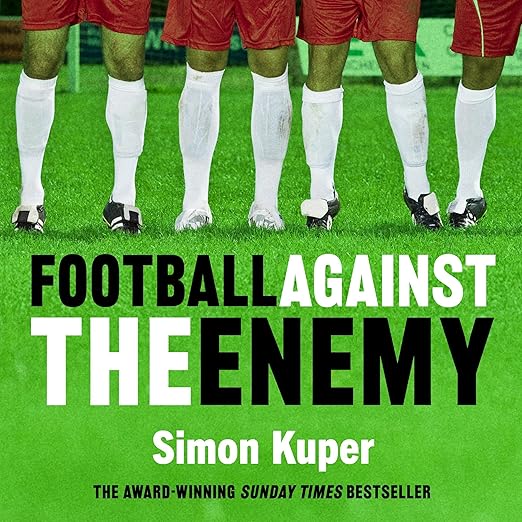
Quick Take
- Narration: Mark Meadows delivers Kuper’s globe-trotting prose with a measured, journalist-like neutrality that suits the book’s outsider-observer stance.
- Themes: Football as political identity, national culture and sport, the sociology of fandom
- Mood: Curious and wide-ranging, like a long dispatch from a smart foreign correspondent
- Verdict: For readers who want to understand why football means something different in every country, Kuper’s twenty-two-nation journey remains one of the sharpest starting points in sports literature.
I came to Football Against the Enemy sideways, through a recommendation from a colleague who covers sports media. He handed me his copy years ago with the comment that it was the book that explained why football worked differently everywhere. I read it then in print; listening to the audiobook version narrated by Mark Meadows brought a different experience, the journalistic rhythms of Kuper’s prose come through more clearly when someone is reading them aloud, especially the passages where Kuper is describing himself as a twenty-something traveling through post-apartheid South Africa or negotiating access in Ceausescu’s Romania.
The book was originally published in the early 1990s, the product of Kuper traveling to twenty-two countries to ask a single compound question: what does football actually do to the societies that love it? He is not primarily interested in tactics or transfer fees. He is interested in the relationship between what happens on the pitch and what is happening in the streets, in the parliament, in the psychology of a nation that has just won or just lost.
Our Take on Football Against the Enemy
The book holds up remarkably well considering its age, which is a sign of how carefully Kuper chose his subject matter. He is not reporting on specific tournaments or specific squads, he is identifying structural patterns in how football intersects with political violence, with racism, with nationalism, with corruption. Those structures have not disappeared. The Old Firm chapter, which one Celtic-supporting reviewer described as both amusing and illuminating, remains one of the most precise accounts of a sectarian football rivalry written for an outside audience.
Kuper is honest about his limitations in a way that early-career journalists rarely are. He knows he is a young outsider dependent on interpreters, incomplete access, and his own cultural preconceptions. That honesty produces some of the book’s most interesting passages, where you can watch him working out what he can and cannot verify. The Peru and Argentina material, involving allegations of match-fixing and performance-enhancing drugs in the 1978 World Cup, is presented with appropriate uncertainty, and one reviewer who questioned those claims raises a fair point. Kuper is reporting what sources told him, not delivering established fact.
Why Listen to Football Against the Enemy
Mark Meadows brings a clean, competent delivery to the narration. He does not try to characterize the voices of the people Kuper interviews, which is the right call for this kind of reportage, the book is Kuper’s observations, not a drama, and a straight read suits it. At ten hours, the pacing is comfortable. The chapters are short enough that you can take the book in segments, one country at a time, which is also how Kuper wrote it.
The descriptions of individual football cultures retain their specificity in audio form. The Brazil chapter on the aesthetics of jogo bonito, the Russia chapter on the relationship between clubs and the state, the South Africa chapter written just as apartheid was ending, each section has its own texture and its own preoccupations, which is what distinguishes this from a generic survey.
What to Watch For in Football Against the Enemy
The political context around certain chapters has shifted significantly since Kuper wrote the book. He is careful to anchor his observations in specific historical moments, but a listener in 2025 will need to do some mental updating in places. The Eastern European chapters in particular describe a post-communist landscape that has changed considerably. This is not a flaw in the book; it is just the nature of journalism about a rapidly changing world.
Some reviewers also noted that Kuper occasionally allows himself to become the story in a way that feels self-serving. The passages describing the difficulty and danger of certain journeys can read as self-congratulatory to a contemporary eye trained on more self-aware travel writing. It is a minor irritant in what is otherwise an unusually selfless piece of sports journalism.
Who Should Listen to Football Against the Enemy
This is for listeners who follow football but want more than match analysis, and for readers of political travel writing who do not necessarily follow football at all. Kuper writes clearly enough that non-fans can follow the argument; the football itself is always the vehicle, never the destination. Listeners expecting a straightforward sports book will need to recalibrate their expectations. This is sociology with a football in it.
Frequently Asked Questions
Does the book’s age, originally published in the early 1990s, make it feel outdated?
Less than you might expect. Kuper is writing about structural relationships between football and politics, not specific tournaments, so the core arguments have retained their relevance. Some political contexts have obviously shifted and listeners should factor that in.
Is this book accessible to readers who do not follow football closely?
Yes. Kuper uses football as a lens for examining politics, identity, and culture. The chapters work as political travel writing even if you have no strong attachment to the sport itself.
How does Mark Meadows handle the multi-country, multi-language context of the book?
Meadows maintains a consistent journalistic tone throughout, which suits the book’s outsider-correspondent framing. He does not attempt accents or vocal characterization, which is appropriate for this style of reportage.
Does the book cover women’s football or is it focused entirely on the men’s game?
The book focuses on men’s football, which reflects both the era in which it was written and the political contexts Kuper was examining. Women’s football features only marginally in the early 1990s material.