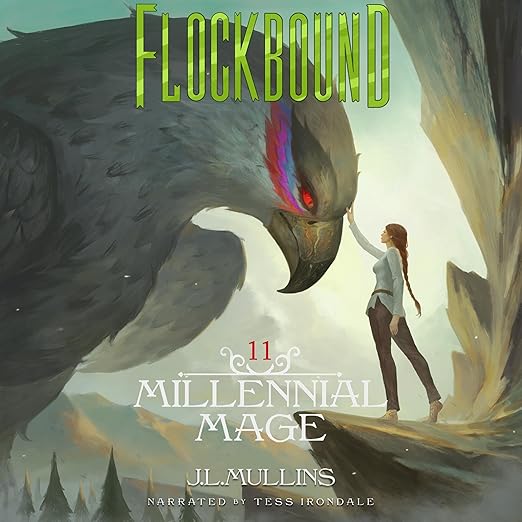
Quick Take
- Narration: Tess Irondale brings warmth and quiet authority to Tala’s ongoing journey, handling the series’ slower, introspective eleventh installment with steady composure.
- Themes: Immortality and longevity, the weight of chosen bonds, slice-of-life progression magic
- Mood: Measured and world-rich, with flashes of emotional depth
- Verdict: Rewarding for Millennial Mage devotees, but entry-level listeners should start at book one before attempting this layered installment.
I finished Flockbound on a rainy Thursday evening, deep into book eleven of J. L. Mullins’ Millennial Mage series, and I noticed something that I find genuinely rare in long-running fantasy audio: I was not bored, but I was also not rushing. That tension between patience and investment is exactly what this installment traffics in, and it is worth understanding before you queue it up.
By this point in the series, Tala has shed mortality entirely. She has bound herself to Terry the terror bird, built out a city inside her magical storage space, and is now navigating something much harder to plot-map than a dungeon or a battle: the slow accumulation of a life that will outlast nearly everyone she loves. Flockbound is about what immortality actually costs once the initial exhilaration of power has worn off.
Our Take on Flockbound
Mullins earns the pacing here, even if it tests patience. The eleventh book in any series is a structural challenge: the author must simultaneously reward returning readers with meaningful progress while laying groundwork for whatever comes next. Flockbound does the second job more visibly than the first. Reviewer Andy Zach noted that entire scenes were added in this edited version compared to the RoyalRoad arc, and the result is a book that feels more complete, more internally logical, and slower to ignite. The automaton subplot that several reviewers flagged as dragging does persist, and I found myself in agreement that it has not yet earned the space it occupies. But the romance arc with Rane, long simmering, finally gets real momentum, and that payoff lands.
What Mullins does exceptionally well is the texture of time. Because Tala is now truly immortal, even mundane sequences carry weight: the sense that this morning, this courtship, this small argument with a companion will be one of thousands. The emotional stakes are not explosive, but they are persistent and real.
Why Listen to Flockbound
The audiobook format suits this installment particularly well. Tess Irondale has grown with the series, and her narration in Flockbound is noticeably more confident than in earlier entries. She navigates the introspective passages without letting them go slack, and she differentiates the ensemble cast clearly, which matters when Tala’s circle has expanded to include family members who have not featured prominently before. Irondale’s reading of the scenes where Tala confronts the emotional inheritance of her past is the emotional highlight of the production. She does not push for drama where the text is understated, and that restraint pays off.
At twenty-three and a half hours, this is a substantial listen, and it rewards the kind of attention you give it on long walks or extended commutes rather than fragmented ten-minute sessions. The worldbuilding is dense enough that you want continuity between sittings.
What to Watch For in Flockbound
The biggest adjustment required here is calibrating expectations around action. Earlier Millennial Mage entries balanced combat and progression with quieter character beats. Flockbound shifts that ratio significantly toward the latter. Reviewer Libri described it well: a lot of what happens in this book feels like Tala getting ready for things in future volumes. If that kind of deliberate preparation frustrates you in long-running fantasy series, this particular installment will test you. If you find satisfaction in seeing a fictional world breathe and a character settle into a changed identity, it will hold you.
The romance subplot also deserves a mention: some readers will find its pace frustrating given how long it has been building, but others will appreciate that Mullins does not rush a relationship that carries significant narrative weight. The payoff, when it comes, feels earned rather than convenient.
Who Should Listen to Flockbound
Readers who have invested through ten previous books will find enough here to justify the listen, particularly for the romance resolution and the expanded family scenes. The edited version is meaningfully better than the RoyalRoad original, and that improvement is audible in the logical flow of events. Skip this one if you have not read the series from the beginning: the world of Zeme requires significant prior context, and Flockbound makes no concessions to the uninitiated. If you are a newcomer drawn by the premise of immortality-era fantasy progression, start with book one and work your way here.
Frequently Asked Questions
Do I need to have read all ten previous Millennial Mage books to follow Flockbound?
Yes, this is a deeply serialized series and Flockbound assumes complete familiarity with Tala’s history, the world of Zeme, and the supporting cast. There is no recapping for newcomers.
Is the edited version noticeably different from the RoyalRoad release?
Several listeners who read the original web serial report that the edited audiobook version adds entire scenes, improves logical flow, and fills in details that were missing. If you followed the story on RoyalRoad, the audiobook is the more complete version.
How does Tess Irondale’s narration hold up over a 23-hour runtime?
Irondale handles the long runtime well, maintaining consistent character voices and finding the right emotional register for introspective passages without letting them drag. She is a good fit for this installment’s quieter tone.
Is there significant action in Flockbound, or is it mostly character and world development?
This entry leans heavily toward character development and world-building. Multiple reviewers note it is slower than previous books and functions partly as setup for future volumes. Action is present but not the dominant mode.