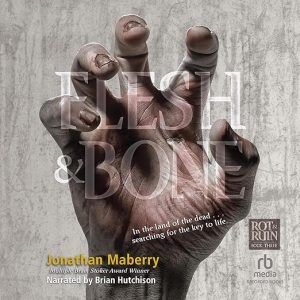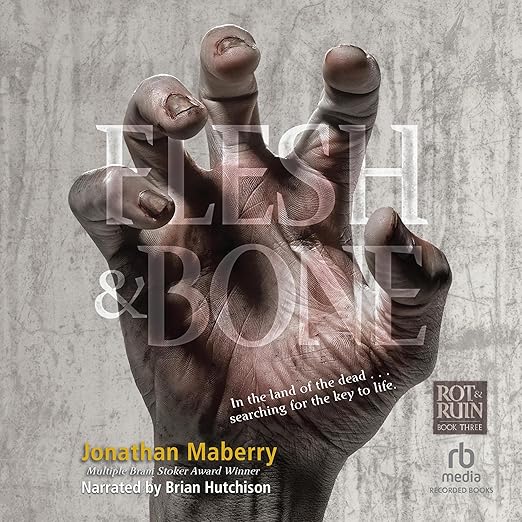
I came to Flesh and Bone already familiar with Jonathan Maberry's adult fiction, which made returning to his Rot and Ruin series as an adult listener a genuinely interesting experience. These books are marketed as YA, and they are, Benny Imura and his friends are teenagers navigating a world fifteen years after a zombie apocalypse has swallowed civilization. But Maberry does not soften the stakes for his young audience. He trusts them with real loss, real moral complexity, and real horror. Listening to the third book in the series, I kept thinking about how different this is from the flattened, consequence-free version of danger that a lot of YA genre fiction offers.
Flesh and Bone opens in the immediate aftermath of the second book's devastation. Benny, Nix, Lilah, and Chong are still processing what they lost, particularly Tom Imura, whose death in the previous installment was apparently the kind of ending that required readers to sit with it for weeks before picking up this volume. The grief is present here without being paralyzing, which is the right call: these characters have to keep moving because the world does not pause for mourning. Their destination is the jet they glimpsed months ago, a sign that human civilization may have survived somewhere. The search for it gives the book its momentum and Maberry enough narrative space to introduce the complications that make this installment worth reading.
How Flesh & Bone Holds Up
The most interesting narrative element in Flesh and Bone is not the zombies. It is the death cult that Benny's group encounters, human beings who have decided that the zombies represent an evolutionary endpoint, that the living are the anomaly, and that accelerating the spread of infection is a form of theological duty. Maberry uses this premise to ask a question that is darker than anything the zombies raise: what does survival mean when some humans actively oppose it? The cult members are not cartoonish villains. Their logic, however deranged, follows from real despair about what the world has become. One reviewer described this installment as getting to the real heart of humanity, or lack thereof, and that assessment is accurate. The book uses genre mechanics to explore genuine philosophical territory about what we owe each other in conditions of catastrophe.
Why Flesh & Bone Works as an Audiobook
The central horror complication of this book is that the zombies Benny's group encounters are different from those they have faced before. Faster. More organized in their movement. Potentially more intelligent. The mutation question, whether the plague has evolved or something more sinister is behind this new behavior, drives the narrative tension of the final act. Maberry is smart about escalation: he does not simply increase zombie numbers for shock effect but introduces qualitative changes that raise new questions about the nature of the outbreak. The cost is that the third book in a series can start to feel like a delivery mechanism for the final act, and some readers found this installment the weakest of the three for exactly that reason. The complaint has some merit in the middle section, where momentum dips to accommodate worldbuilding, but the opening and closing chapters are as strong as anything in the series.
Maberry's decision to use the wastelands of what was once America as his setting, rather than a confined location like a city or a compound, gives Flesh and Bone a geographic scale that distinguishes it from most zombie fiction. The group is always moving, always in transit, always discovering new and worse things about what the country has become. This structural restlessness keeps the pacing high and prevents the claustrophobia that can set into apocalyptic fiction when a single location becomes the entire world. It also means Maberry can introduce new characters and factions without it feeling contrived, the wastelands are genuinely vast and genuinely strange, and new threats feel like discoveries rather than plot devices.
Weak Spots in Flesh & Bone
Managing four protagonists with distinct voices and emotional registers is a significant challenge for a narrator, and Hutchison meets it well. Lilah, the feral, nearly wordless fighter, is the hardest character to render in audio, her interiority has to be communicated through what she does not say, and Hutchison understands that. Nix's grief and Chong's more cerebral, sometimes darkly funny perspective are differentiated without caricature. The action sequences, and there are many, particularly as the story accelerates toward its confrontation with both the cult and the mutated zombie swarms, stay clear enough to follow aurally, which is harder to achieve than it sounds when you are managing multiple characters in chaotic terrain.
The Right Listener for Flesh & Bone
Listen if you have completed the first two Rot and Ruin books and are invested in Benny's world. The series rewards continuity, and the emotional stakes of Flesh and Bone depend on what came before. Also recommended for adult listeners of horror and speculative fiction who underestimate YA, Maberry does not write down to his audience, and the moral and philosophical territory here is legitimate. Teachers who reviewed the series generally recommend it for readers twelve and up, noting mature themes and violence without sexual content or profanity. Skip it if you are new to the series, and skip it entirely if your tolerance for death cults and escalating zombie horror is limited, this is not a comfortable listen, which is precisely the point.
Key Details
- Narration: Brian Hutchison brings the right kind of controlled urgency to the Rot and Ruin world, he differentiates the ensemble cast clearly and keeps the propulsive momentum of the action sequences intact.
- Themes: The persistence of hope in a collapsed civilization, the nature of humanity versus monstrosity, cult psychology
- Mood: Relentlessly kinetic with genuine philosophical undercurrent
- Verdict: A strong third installment in a YA zombie series that earns its darkness by taking its teenage characters seriously as moral agents.
Do I need to have read the first two Rot and Ruin books before listening to Flesh and Bone?
Yes. The emotional architecture of this book depends on events from the previous two installments, particularly the loss that occurs at the end of Dust and Decay. Starting here would rob the story of most of its impact.
Is the death cult element handled with nuance or is it purely a villain device?
With more nuance than most genre fiction would attempt. Maberry gives the cult members a coherent, if horrifying, internal logic rooted in real despair about human survival. They are not comic-book antagonists.
Is Flesh and Bone appropriate for younger readers within the YA age range, given the content?
Teachers and parents who reviewed the series generally recommend it for readers twelve and up. The book contains mature themes and violence but no sexual content or profanity. The zombie content is graphic but purposeful rather than gratuitous.
How does Brian Hutchison handle Lilah's character, who communicates primarily through action rather than dialogue?
Thoughtfully. Hutchison conveys Lilah's interiority through tone and restraint rather than overperformance, which suits a character whose power lies in what she does not say. It is one of the more technically interesting narrator choices in the audiobook.