Quick Take
- Narration: Vanessa Moyen gives Nova a voice that reads as genuinely young and sharp, capturing the snarky-as-armor quality the character requires without making her grating across 10 hours.
- Themes: Villain redemption, enemies-to-lovers, angel-born mythology
- Mood: Urgent and emotionally charged, with a slow-burn romance that earns its heat
- Verdict: A YA fantasy finale that rewards series readers with a character pairing that finally gets the space it deserves.
I came to this one having read several YA fantasy series over the past few months, and what struck me immediately about the Fallen Legacies world was how seriously it takes its villain. Thorne is not a misunderstood hero waiting to be unlocked by the right girl. He is, as the synopsis directly states, a ruthless killer who almost brought upon the apocalypse. Julie Hall doesn’t soften that record, which gives the redemption arc a tension that most enemies-to-lovers stories in this genre never quite achieve. I was somewhere on my morning walk when the island-stranding setup clicked into place, and I realized this was going to be a more interesting book than I had expected.
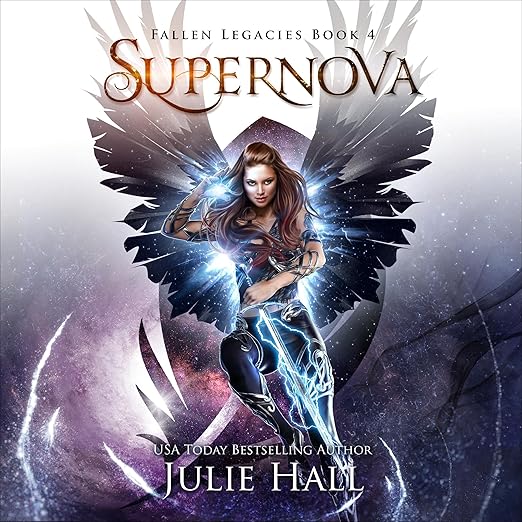
Supernova is listed as book 4 in the Fallen Legacies series, and the note that it should be listened to after Unleashing Fire is worth heeding. This is not a friendly entry point. The weight of Thorne’s backstory, the decisions he made, the people he hurt, the mother he helped defeat, all of that is assumed knowledge. Listeners arriving here cold will understand the plot but miss the emotional resonance that makes it work. For those who have followed the series, though, this is the payoff they’ve been circling.
The Stranded Island Setup and What It Actually Does
Forced proximity is one of the most reliable engines in romance-adjacent fiction, and Hall uses it with more sophistication than the premise suggests. Stranding Nova and Thorne on a deserted island strips away the social armor that both characters use to keep distance between themselves and everything they feel. For Nova, that armor is the snarky comeback and the cultivated indifference. For Thorne, it’s the deliberate menace, the refusal to explain himself, the identity built on being unreachable. Cut off from the war with the spirit realm monsters, from the other Nephilim warriors, from the social hierarchy that defines who they are allowed to be to each other, they are just two people who have to figure out whether the hatred they’ve built is actually what they feel.
Hall is patient here in ways that paid off for me. The romance doesn’t accelerate past believability. The physical attraction is present from early on, acknowledged honestly by Nova’s point of view, but she doesn’t act on it in ways that undercut her intelligence. That careful management of pacing is what separates this from the more formulaic entries in the genre.
Nova as a Narrator, Thorne as a Mystery
The decision to tell this story entirely from Nova’s perspective is the book’s defining structural choice, and it’s the right one. We don’t get inside Thorne’s head, which means his darkness remains genuinely opaque. We see his reactions. We see the moments where his control slips. We see what he does when he thinks Nova isn’t watching. But we never get the reassuring interior monologue that explains him and makes him safe. That opacity is what makes the romance feel dangerous in the best sense, and dangerous romance is the genre’s entire point.
Vanessa Moyen handles the first-person narration with real skill. Nova’s voice has a dry quality that keeps the emotional peaks from feeling overwrought, which matters a great deal across a 10-hour listen. The snarky comebacks land as comic timing rather than defensive noise. The moments of genuine fear or longing, which would curdle into melodrama under a less controlled performance, come across as earned feeling instead. Reviewers consistently single out Thorne’s sad upbringing as emotionally devastating, and Moyen’s restraint during those revelations is what makes them hit.
What the Series Setup Demands of This Entry
The note in the metadata that this is a standalone within a series is accurate but requires context. Standalone means the romance between Nova and Thorne reaches its resolution here. The larger world, including the subplots involving Sterling, Greyson, and Ash that several reviewers mention hoping to see continued, remains open. Hall is clearly leaving doors ajar rather than sealing the world shut. Whether that reads as satisfying or frustrating will depend entirely on how invested you’ve become in the secondary cast.
The angel-born mythology is dense enough to reward series followers but not so obscure that it becomes alienating. The spirit realm monsters, the Nephilim warrior structure, the aftermath of Thorne’s mother’s defeat, all of this functions as a well-built world rather than a tangle of invented terminology. Hall has clearly thought through the internal logic, which means the rules feel like rules rather than conveniences.
Who Should Follow Nova and Thorne to the Island
The 4.7 rating across 858 reviews is the kind of score that reflects genuine affection from a devoted readership rather than casual listeners stumbling in. This is a series book in the truest sense: it rewards investment and offers diminishing returns to anyone who skips the preceding entries. For established series readers, it functions as exactly the kind of conclusion a well-constructed enemies-to-lovers arc deserves, specific in its emotional logic, patient in its pacing, and honest about who Thorne is rather than who the romance genre usually needs its heroes to be.
Listeners new to YA fantasy who enjoy the genre’s redemption arc tradition would do better to start at book one and work toward this one. Those who want an accessible, action-packed fantasy romance without series baggage should look elsewhere. Those who have been following Hall’s world and have been waiting for Thorne to get his reckoning: this is the book for you.
Frequently Asked Questions
Can I listen to Supernova without reading the earlier Fallen Legacies books?
Technically yes, but the emotional weight of Thorne’s backstory and his role in stopping his mother’s apocalyptic plan requires context from earlier entries. The note in the synopsis is genuine: listen after Unleashing Fire at minimum.
How does the enemies-to-lovers dynamic develop across the 10-hour runtime?
Slowly and deliberately. Julie Hall doesn’t rush the romance past believability. The forced proximity on the island strips away both characters’ defenses gradually, and the romantic tension develops over the full runtime before resolving.
Is Vanessa Moyen’s narration well-suited to Nova’s first-person voice?
Very much so. Moyen captures Nova’s snarky-as-armor quality without making it grating, and her restraint during the emotionally heavier moments involving Thorne’s past keeps those scenes from tipping into melodrama.
Does the book wrap up the series completely, or does it leave threads open?
The Nova and Thorne romance reaches a full resolution. Secondary character subplots, particularly involving Sterling, Greyson, and Ash, remain open, suggesting Hall may return to this world. The main arc closes satisfyingly.