Quick Take
- Narration: Graham Halstead delivers a steady, grounded performance that suits the series’ ensemble-driven post-apocalyptic tone, he handles action and character moments with equal assurance.
- Themes: survival and loyalty in a collapsed world, the cost of stepping back into the fight, found family under pressure
- Mood: Tense and propulsive with an underlying warmth between characters who have survived much together
- Verdict: A reliable thirteenth entry in a zombie series that has maintained quality over a long run, series devotees will find exactly what they came for.
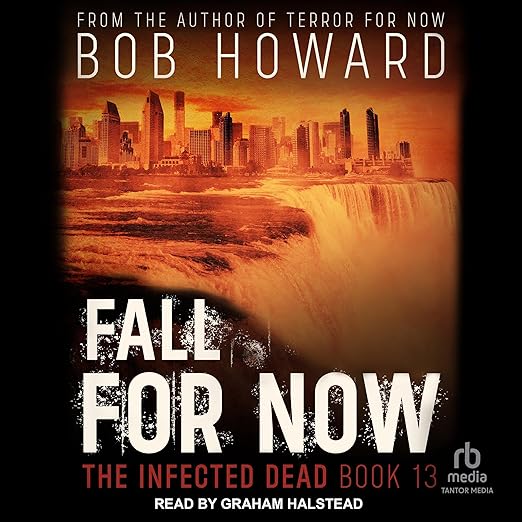
Thirteen books into any series, an author faces a particular challenge: the readers who are still with you have deep investment in the characters, but the very familiarity that keeps them engaged makes it harder to surprise them. Bob Howard has been writing The Infected Dead series long enough that the community around it has its own shorthand, its own favorite characters, its own expectations. Fall for Now meets those expectations and, in a few places, exceeds them.
I came to this one without the prior twelve volumes in my ear, which is not the recommended approach and I will be honest about that limitation. Howard does not extensively recap prior events, which is the right authorial decision for a series with this much accumulated history. What it means for newcomers is that the emotional weight of Ed and Jean Jackson’s return to the action, they chose years ago to step back and remain in the safety of Green Cavern, is felt primarily through the reactions of other characters rather than through direct experience of what they gave up. I understood the stakes intellectually. Long-term readers will feel them viscerally, in the way that only a dozen books of accumulated attachment can produce.
Our Take on Fall for Now
Howard’s setup is clean and purposeful. A group of survivors near Niagara Falls and the Finger Lakes needs rescue, and Ed and Jean are the ones who go. What sounds like a straightforward survival mission becomes a character study of two people returning to a way of life they thought they had left behind. Graham Halstead’s narration suits this material well, he plays Ed with the kind of wearied competence that is more interesting than the performative heroism that zombie fiction sometimes defaults to. The action is rendered with clarity, but Halstead is most effective in the quieter scenes where characters reckon with what they have agreed to do.
Reviewers who have followed the entire series repeatedly note Howard’s skill with plot and characters, and his ability to introduce new people without disrupting the existing ensemble. Fall for Now brings in fresh faces at Niagara who earn their place in the story without displacing the long-term favorites. One reviewer who describes themselves as not a fan of the genre credits Howard with keeping them hooked across the entire series, that is the kind of testimony that speaks to genuine character investment, not just genre satisfaction.
Why Listen to Fall for Now
The Infected Dead series is one of those rare zombie franchises that has maintained consistent quality over an extended run, which is genuinely not easy. Howard writes with real affection for his characters, and that affection is audible in how carefully he protects their established relationships while still putting them in danger. The Niagara Falls setting gives the book a distinct visual and geographical identity. The landscape functions almost as a character, with the falls themselves creating both natural barriers and a symbolic weight about the unstoppable progression of time, which in a post-apocalyptic series carries particular resonance. Howard uses the setting rather than merely describing it.
What to Watch For in Fall for Now
This is emphatically not an entry point. Listeners who start here will understand the mechanics of what is happening but will miss the accumulated emotional weight that makes character moments land with full force. The new characters introduced at Niagara take time to establish themselves, which means the opening hours of the nearly 14-hour runtime are building toward payoffs that require investment in people you have just met. That balance works better for existing fans than for newcomers. Howard is more interested in human dynamics than in horror set-pieces, which is a characteristic of the series worth knowing before you begin.
Who Should Listen to Fall for Now
Exclusively for readers who have followed The Infected Dead from the beginning or at least through the majority of the series. The emotional payoffs here are built on twelve books of accumulated history, and they simply do not land with full force without that foundation. If you are new to Howard’s work, begin at the beginning, one reviewer described having read the entire series multiple times, which is testimony to how well the whole holds together when consumed in proper sequence. For those who are already invested, Fall for Now is a confident continuation that respects what has been built.
Frequently Asked Questions
Is Fall for Now accessible as a first book in The Infected Dead series or must I start from the beginning?
Start from the beginning. This is a thirteenth-book entry that assumes deep familiarity with the ensemble, their history, and their choices. Howard does not recap extensively, and the emotional payoffs require prior investment.
How does Graham Halstead handle the long runtime and ensemble cast?
Halstead maintains consistent character voices across the nearly 14-hour runtime and distinguishes clearly between the existing ensemble and the new Niagara characters. His performance is patient rather than showy, which suits Howard’s character-driven approach.
Does Fall for Now focus primarily on Ed and Jean or does it develop the wider ensemble?
Ed is the central character returning to action, which makes fans of his arc happy. Jean is present but less centrally developed in this volume. The new Niagara survivors get meaningful attention and are written as genuine additions rather than functional walk-ons.
How does the Niagara Falls setting affect the story compared to earlier locations in the series?
Howard uses the geography specifically, the falls and the Finger Lakes region create both tactical challenges and a distinct atmosphere that differentiates this book from earlier entries. The location earns its narrative role rather than serving as mere backdrop.