At a Glance
- Voice: Leslie Odom, Jr., reads his own short memoir with the breath control and pacing of a trained stage performer.
- Big ideas: ambition versus safety, creative risk, delayed success, self-belief
- Atmosphere: Sincere and brisk, more extended pep talk than sprawling memoir
- Worth it?: A strong pick for anyone stalled on a big decision, as long as three and a half focused hours is what you want rather than Broadway detail.
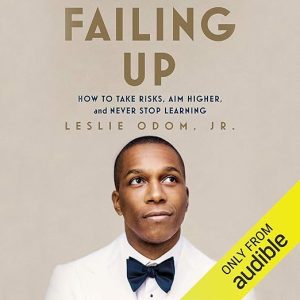
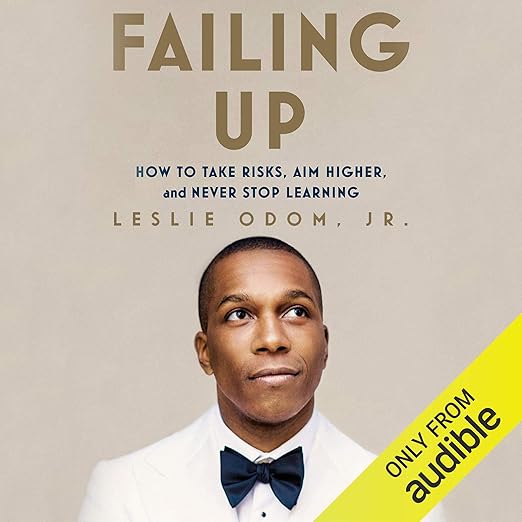
Leslie Odom, Jr., won his Tony for playing the man who killed Alexander Hamilton, so why does this audiobook spend so much more time on childhood daydreams than on Broadway? Failing Up, running a brisk three hours and thirty-five minutes, turns out to be less a backstage memoir than a distilled talk on ambition, and Odom narrates it himself with the same controlled, intimate delivery he brought to originating Aaron Burr in Hamilton.
How Failing Up Holds Up
The synopsis frames the book around a blunt question, what does it actually mean to be realistic when your own ambitions keep getting shelved, and Odom answers it by working backward from his own stalled years rather than forward from his eventual success. He treats the gap between dreaming something and doing it as the real subject of the book, with the Tony Award functioning more as proof the approach worked than as the story's center of gravity.
Reviewer Chris Moss admits going in expecting 'a myopic story of his celebrity self' and instead found something that drew them in 'from the very first chapter,' a reaction that lines up with how the book is actually structured: less name-dropping showbiz anecdote, more extended reflection on the specific choices, the ones nobody applauds for, that have to happen before any applause is possible.
Odom is direct about the mechanics of ambition rather than just the feeling of it: the synopsis specifically promises 'concrete actions' listeners can apply immediately, not just an inspiring story to admire from a distance. That practical thread keeps the book from drifting into pure celebrity uplift, and it explains why reviewers keep calling it useful rather than merely enjoyable.
The title itself reframes failure as directional rather than terminal, 'failing up' implies motion, not collapse, and that reframe is the book's real argument in miniature: setbacks aren't erased by eventual success, they're the mechanism that produces it. Odom doesn't just assert this once as a thesis statement; he returns to specific stalled auditions and shelved plans throughout, treating each one as evidence rather than as a detour from the real story.
The synopsis's opening line, addressed directly to the listener as a fellow dreamer, sets a conversational, second-person tone that carries through the whole book; Odom isn't writing a distanced retrospective, he's talking to the listener the way he'd talk to a younger version of himself, which suits the audio format specifically well.
The book also sidesteps the two most common traps of the celebrity-memoir genre, score-settling and humble-bragging, by staying tightly focused on process over prestige; no sense of Odom settling scores with directors or castmates ever creeps in, and the concrete-actions framing keeps the emphasis on what a listener can use rather than on cataloging his own accomplishments.
A three-and-a-half-hour audiobook narrated by its own author, trained as a stage performer and, per the synopsis, bringing 'the depth and poetic power he brought to the stage' directly into the recording booth, is close to an ideal format match. Odom's Broadway background means he already knows how to control breath and pacing across a long monologue, which is functionally what this book is.
None of the three attached reviews specifically discuss the narration itself, most describe reading a print or Kindle copy, which is worth flagging honestly rather than papering over. What they do confirm is that the underlying material connects: Lizabetty calls it so 'captivating' she read it in one sitting, a habit she says she doesn't normally have, and Margo King describes carrying a copy around for two years before finally starting it on a plane ride and finishing it just as fast.
A vocal-craft angle specific to Odom also matters here, one a hired narrator couldn't replicate: he's a trained singer as well as an actor, and that same breath control and phrasing sense shapes how he reads his own sentences aloud, giving even plain declarative lines a rhythm that a page can only imply.
That direct-address quality matters even more in audio than in print, since a memoir built around second-person encouragement lands with more warmth spoken aloud by the person who actually means it than read silently off a page.
Weak Spots in Failing Up
At three hours and thirty-five minutes, this is closer to a long keynote address than a comprehensive memoir, and listeners hoping for extensive detail on the Hamilton production itself, castmates, rehearsals, opening night, will find the show treated as a destination rather than a setting. The book's real interest lies earlier, in the years when none of that success was guaranteed.
The teen-young-adult genre tag undersells how the book actually reads. Real crossover appeal runs through it for any adult navigating a stalled ambition, not just younger listeners weighing a first big risk, and shelving it purely as a YA title risks losing an audience the book is clearly also written for.
Margo King's review notes she bought the book in 2018 and let it sit almost two years before finally reading it, a small but telling data point: this is a book many buyers pick up with intention and then set aside, which suggests the short runtime might actually be a practical advantage for the audio edition specifically, easier to finish in one sitting than a print copy competing with a shelf of half-read books.
At a 4.7 average from 881 ratings, reception has been unusually consistent for a celebrity memoir, a genre where enthusiasm often splits sharply between fans and skeptics. That consistency suggests the book is landing on its stated goal, practical, sincere encouragement, rather than coasting purely on Hamilton-era name recognition.
The Right Listener for Failing Up
This is a strong pick for young adults and recent graduates staring down a gap between ambition and reality, for Hamilton fans curious about Odom's own voice reflecting on the role rather than performing it, and for anyone who responds better to a short, dense dose of encouragement than a sprawling four-hundred-page memoir.
It also rewards performers and creative people specifically, actors, musicians, writers, anyone whose ambitions depend on being chosen by someone else first, since Odom's account of 'playing it safe' before Hamilton speaks directly to that particular kind of risk calculus in a way a more general career-advice book wouldn't.
It's also a natural fit for anyone who prefers a single focused sitting to a multi-week reading commitment; at under four hours, the entire book fits into one long commute or a short flight.
Skip it if extensive Broadway or Hamilton production detail is the draw, this book keeps that material in the background, or if a three-and-a-half-hour runtime feels too slight for what you'd want from a full memoir purchase.
A Few Questions About Failing Up
Does the Failing Up audiobook cover Leslie Odom Jr.'s time playing Aaron Burr in Hamilton?
It touches on it, but the book focuses more heavily on the years of stalled ambition before that role than on backstage detail from the production itself.
How long is the Failing Up audiobook?
Three hours and thirty-five minutes, a brisk, focused listen closer to a long talk than a full-length memoir.
Is Leslie Odom, Jr., narrating this audiobook himself?
Yes, and his stage and vocal training show in the pacing and breath control he brings to reading his own material aloud.