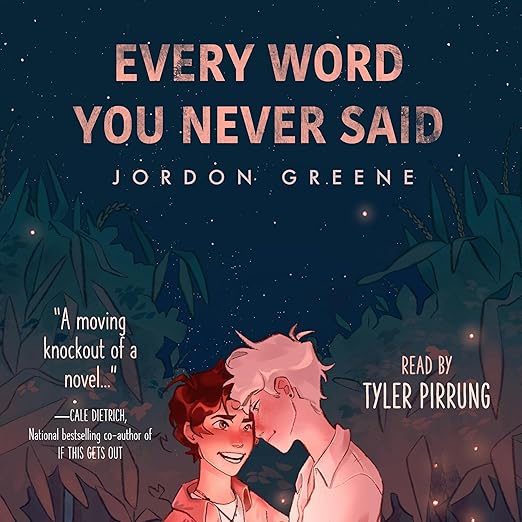
Quick Take
- Narration: Tyler Pirrung navigates two distinct teen voices with care, keeping Skylar’s interiority distinct from Jacob’s outward defiance in a way that serves the dual POV structure well.
- Themes: Nonverbal identity and communication, queer self-expression against family opposition, found family in hostile environments
- Mood: Tender and often funny, with real anger running underneath
- Verdict: An 11-hour YA romance that does more for LGBTQ+ readers who’ve felt erased by their own silences than most of its genre peers.
I finished Every Word You Never Said on a Sunday evening that had started out as purely administrative listening time, the kind where I had podcasts queued up and was half-expecting to switch over to something denser. I did not switch over. I stayed with Skylar and Jacob through the last hour, and when Tyler Pirrung read the final pages I sat in my kitchen for a moment before putting my headphones away. Jordon Greene’s novel, the third in the Noahverse series, is the kind of YA that earns the genre’s most devoted readers rather than just accommodating them.
The setup is easy to summarize and much harder to execute well. Jacob Walters is out, stubborn, and spending most of senior year grounded because his father’s reaction to Jacob’s sexuality has been to make his life a living hell while largely pretending nothing happened. Skylar Gray is adopted, nonverbal, and wears skirts. He’s starting over at a new school with new parents in a new state, and his baseline assumption is that people will leave. These two are going to fall for each other, and the story they build around that certainty is the point.
What Nonverbal Representation Looks Like in Practice
Skylar’s nonverbal identity is not a plot device. This is the thing that separates this novel from a lot of disability-adjacent YA, where a character’s difference exists to generate story mechanics for the neurotypical or fully verbal protagonist. Greene writes Skylar’s interior life with specificity and humor, and his communication, through a phone app, through gesture, through the kinds of expressiveness that don’t require words, is rendered with genuine attention to how relationships actually form for people who navigate the world without speech.
The dress code subplot is where this becomes most political and most resonant. When Skylar wears a skirt to school and the administration responds with a sexist new dress code proposal, Jacob decides to organize against it. The moment crystallizes what both characters are dealing with: Skylar’s gender expression and Jacob’s need to act when people he cares about are targeted. One reviewer described this as a tremendously important story, written while things seem to be rolling further and further backwards for the LGBTQ community, and that context is not incidental to how it lands.
Jacob’s Father and the Quiet Violence of Conditional Love
The parental opposition in this novel is handled with more nuance than most YA manages. Jacob’s father is not a cartoon villain. He is a man who mostly acts as if his son’s coming out never happened, which is in many ways more damaging than direct confrontation. Jacob’s refusal to perform shame, the nail polish, the dyed hair, the guitar riffs, happens against this backdrop of sustained low-level hostility from someone who should be his primary support. Greene writes this dynamic without oversimplifying it or letting Jacob’s bravado fully disguise the cost of maintaining it.
Tyler Pirrung’s narration handles the space between Jacob’s public defiance and private exhaustion carefully. The moments where Jacob is alone, or alone with Skylar, sound different from the moments where he’s performing invulnerability for the rest of the world, and that difference is essential. A narrator who played Jacob at the same register throughout would lose the emotional logic of why Skylar specifically gets to see what Jacob hides from everyone else.
The 80% Problem That Some Readers Encountered
One reviewer who spent nearly three months unable to finish other books because of narrative problems noted that Every Word You Never Said came close to breaking their streak, giving them two well-crafted protagonists for about 80% of the runtime before something in the final stretch didn’t land. This is a data point worth naming honestly. Greene’s characters are genuinely strong, and the emotional architecture is sound for most of the listen. If the last act loses something, it may be a function of how difficult it is to deliver an ending proportionate to the emotional investment a book this tender generates.
At 11 hours and 29 minutes, this is a commitment, and it knows it. The slow accumulation of trust between Skylar and Jacob mirrors in structure what it takes for both characters to trust anyone at all, which is either a feature or a bug depending on your patience with unrushed character work. Readers who responded to F.T. Lukens’s In Deeper Waters, cited specifically by one reviewer as a previous favorite this book displaced, will likely find the DNA familiar and the execution comparable.
For Readers Tired of Being Handed the Bare Minimum
YA listeners who want their queer romance to carry genuine emotional and political weight rather than simply delivering a cute couple will find this exceptional. The nonverbal representation is specific enough to matter to readers who share Skylar’s experience and illuminating for those who don’t. Listeners who enjoyed the earlier Noahverse books will get additional resonance from seeing Noah and Tyler appear here.
If you need your romances to move at pace or your YA to stay light, the deliberate emotional accumulation here will frustrate you. This is not a breezy listen. It’s the kind of story that asks you to sit with discomfort, to feel the cost of being different in environments that prefer you invisible, before it offers you the relief of two people finding each other. The relief, when it comes, is earned.
Greene writes teens who sound like actual teenagers navigating genuine difficulty rather than plot functions delivering conflict. The small moments, the phone app communications, the guitar playing, the particular silence of someone who has learned not to trust, accumulate into something that the YA category doesn’t always have the patience to build.
Frequently Asked Questions
Do you need to have read the previous Noahverse books to follow Every Word You Never Said?
The novel works as a standalone, though it’s the third book in the Noahverse series. Characters Noah and Tyler from earlier books appear, and their presence will carry additional meaning for series readers. The central story of Jacob and Skylar requires no prior knowledge of the series.
How does the book handle Skylar’s nonverbal communication in audio format?
Tyler Pirrung navigates this by rendering Skylar’s interior monologue fully while distinguishing those private thoughts from his external communication, which happens through a phone app, gesture, and expression. The narration treats Skylar’s interiority with the same richness as Jacob’s, making his perspective feel complete rather than constrained by his nonverbal identity.
Is Every Word You Never Said appropriate for younger YA readers given the parental abuse and political content?
The book addresses parental hostility toward LGBTQ+ youth and bullying with honesty, but the violence is emotional rather than graphic. The political context, including the dress code subplot responding to gender expression, is handled with care rather than didacticism. Most YA readers from roughly 14 upward would find the emotional register appropriate.
What does the dress code subplot represent in the broader story?
When Skylar wears a skirt and the school administration responds with a new restrictive dress code, the incident crystallizes both characters’ stakes. For Skylar, it’s his gender expression being targeted in a space that was supposed to be his fresh start. For Jacob, it’s the moment that calls him out of his default individualism into something more collective. The subplot connects the personal romance to the political environment its characters are navigating.