Quick Take
- Narration: Samantha Novak returns from earlier entries in Davis’s series with a reliable, accessible delivery that suits the practical tone of the content.
- Themes: Financial literacy, communication skills, career preparation
- Mood: Organized and encouraging, like a well-run orientation session for adulthood
- Verdict: Broad in scope and genuinely useful as a starting point, though listeners seeking depth on any single skill area will need to look elsewhere.
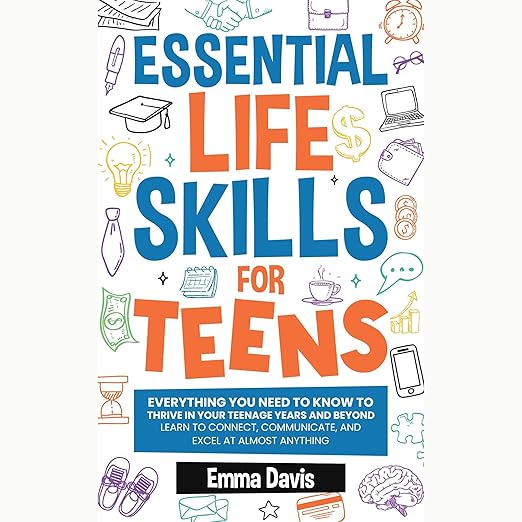
There is a gap in most school curricula that parents notice with mounting anxiety as their kids approach graduation. The gap is not academic. It is the practical kind: how to manage a bank account, how to write an email to a potential employer, how to negotiate a conflict without it becoming a fight. Emma Davis’s fifth entry in the Therapy and Mental Health Books For Teens series takes direct aim at that gap, and at just over five hours it covers considerably more ground than its predecessors in the series.
Essential Life Skills for Teens is a structured survey of the practical competencies that the formal education system tends to either ignore or handle badly. Davis organizes the content around five broad domains: financial literacy, communication, time management, career readiness, and relationship building. Each chapter builds on a consistent structure, explain the skill, demonstrate it with relatable examples, and provide actionable takeaways.
Our Take on Essential Life Skills for Teens
The book’s ambition is its most discussed quality among reviewers, and it cuts both ways. Reviewer Hannah Lindley described it as a cheat sheet for surviving and thriving in life’s most important circumstances, which captures what Davis is going for. The chapter on building and improving relationships was singled out by reviewer Jullan as the most influential, noting that navigating relationships is central to the teenage experience in a way that other practical skills are not.
Davis writes in a voice that respects teen intelligence without assuming prior knowledge. The financial literacy section, which covers budgeting basics, the concept of financial independence, and the early steps toward a job search, is accessible without being condescending. The communication chapter, which addresses both personal and professional contexts, is one of the more practically grounded sections, and Samantha Novak’s narration keeps it from feeling like a workplace training module.
Why Listen to This Rather Than Read It
The audio format works well for content that is organized in discrete, learnable sections. Novak’s pacing across the 5 hour 2 minute runtime makes it easy to absorb the material without feeling overwhelmed by how much ground the book covers. Teens who find themselves zoning out while reading dense nonfiction may find that having the content read to them, with Novak providing consistent energy throughout, keeps them engaged longer.
This is also a book that works well for a parent to pre-listen to before passing it to a teenager. Understanding the structure and content makes it easier to use as a conversation prompt, which is how reviewer Jullan described approaching it. The material lends itself to discussion rather than silent solo consumption.
What to Watch For in Davis’s Life Skills Approach
The breadth that makes this book broadly useful is also its primary limitation. Five major skill domains in five hours means each gets roughly an hour of coverage at most, and several reviewers implicitly acknowledged this by singling out specific chapters as favorites, suggesting the book works better as a broad orientation than as a deep resource in any single area. Teens who have already developed solid financial literacy, for example, may find that section covers territory they know, while others may wish the communication chapter went deeper into conflict resolution.
The promotional framing, common to the series, surfaces here more than it should. Phrases like equipping today’s teens with the knowledge and skills they need to excel in all areas of life set expectations that no five-hour audiobook can fully meet. The actual content is more measured and realistic than the marketing suggests, which is reassuring but means first-time listeners should calibrate expectations accordingly.
Who Should Listen to Essential Life Skills for Teens
Teens aged fourteen to eighteen who are approaching the practical transitions of late adolescence, first jobs, post-secondary decisions, independent living, and who have had limited formal instruction in any of the five skill areas Davis covers. Also worth recommending to parents who want a shared reference point to discuss with a teenager approaching graduation. Not the resource for teens already deep into personal finance or career planning; best suited to those starting from scratch.
Frequently Asked Questions
How does this compare to other books in Emma Davis’s Therapy and Mental Health Books For Teens series?
This is the fifth entry in the series and the broadest in scope. Earlier volumes focus more specifically on emotional regulation and mental health. This one shifts toward practical life competencies, making it the most useful entry for teens preparing for adulthood transitions rather than those dealing with acute emotional challenges.
Is the financial literacy section current and relevant for today’s teens?
Reviewers found the financial content accessible and grounded in practical basics: budgeting, saving, and the early steps of financial independence. It does not cover advanced topics like investing or cryptocurrency, keeping the scope appropriate for teens who are starting from foundational concepts.
Does Samantha Novak’s narration make this easier to absorb than reading the print version?
For teens who struggle with sustained reading of nonfiction, the audio version with Novak’s consistent and engaging delivery is likely the better format. The structured chapter format also means the content is easy to pick up and put down without losing the thread.
Would a school counselor find this useful as a classroom or group resource?
Multiple reviewers, including those in education and counseling contexts, recommended the book for school settings. The chapter structure makes it easy to use selectively, assigning specific sections relevant to a particular group’s needs rather than requiring the entire listen.