Quick Take
- Narration: Katherine Kellgren is one of the finest narrators working in YA and middle-grade fantasy; her ability to differentiate a large cast and give each Woodcutter sister a distinct voice makes the family feel genuinely populated.
- Themes: Fairy tale intertextuality, identity and writing, love that survives transformation
- Mood: Whimsical and layered, with surprising emotional weight
- Verdict: A fairy tale mashup that earns its complexity through craft rather than accumulation, with narration that elevates already strong source material.
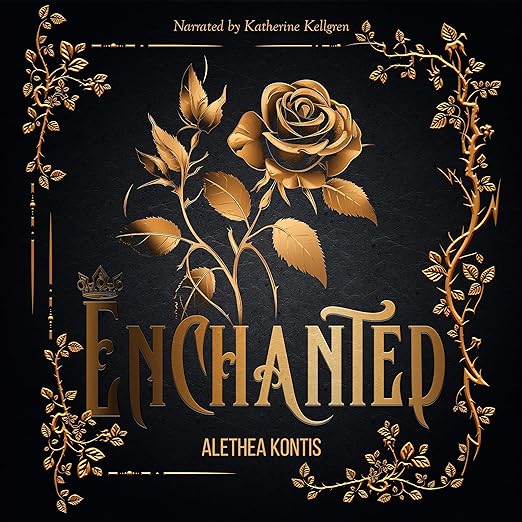
I came to Enchanted because a colleague mentioned Katherine Kellgren’s narration in passing, the way you mention a performance that stays with you long after the story does. Kellgren died in 2018 and left behind a body of audiobook work that is genuinely irreplaceable. Her recording of Alethea Kontis’s debut novel is a good place to start understanding why. I listened to the first two hours on a rainy weekday afternoon when I had a pile of review notes to get through and kept getting pulled back into Sunday Woodcutter’s world instead. That is the particular compliment this kind of book earns: it makes the alternative less appealing.
The setup Kontis establishes is richer than its fairy tale chassis might suggest. Sunday is the seventh daughter of a seventh daughter, which comes with an enormous family and a peculiar creative affliction: the things she writes in her journal have a tendency to come true. This means she can only safely write what has already happened, a constraint that shapes her character more meaningfully than most YA protagonists’ defining traits manage to do. She is a young woman who loves storytelling and has learned to distrust her own creative impulse, and that tension gives the book genuine psychological texture beneath the fairy tale surface.
Sunday Woodcutter and the Problem of Writing What You Know
The frog Sunday meets in the Enchanted Wood is Rumbold, the crown prince under a curse, and the relationship that develops between them before Sunday knows his true identity has the quality of the best fairy tale friendships: it is built on honesty rather than attraction, on her stories and his listening. When Sunday kisses him goodbye and leaves one night, not realizing what her affection has done, and then encounters the prince at his own ball without recognizing him as her frog, Kontis has set up a dramatic irony that runs on its own emotional logic rather than simply on plot mechanics.
The romantic complication works because Kontis earned the emotional stakes in the friendship first. Sunday is not simply waiting to be convinced by a handsome prince. She is trying to figure out whether what she feels for the prince is connected to what she felt for the frog, and whether a relationship begun in concealment, even unintentional concealment, can survive the truth. That is a more interesting problem than the genre typically poses.
A Fairy Tale Library Compressed Into One Story
Several reviewers have noted that Enchanted weaves references to an enormous range of fairy tales beyond the Princess and the Frog at its center. Cinderella, Sleeping Beauty, Bluebeard, and others appear as structural elements, thematic resonances, or outright plot complications involving the seven Woodcutter sisters. The sister who ran off with the Pirate King, the one whose stories are literally cursed, the one who went north and never returned: they are referenced rather than fully explored in this first book, which functions as an invitation into a larger world across a series.
One reviewer flagged some confusion about elements that are not fully explained, and that is fair. Enchanted asks readers to accept a level of fairy tale logic that does not always answer its own questions. That is a feature for readers comfortable with the mode, a genuine problem for readers who want complete narrative accounting. Kontis trusts her readers to hold ambiguity, which is more confidence than most YA debuts extend.
What Katherine Kellgren Does That No Other Narrator Can
The Woodcutter family has seven daughters and two parents with distinct personalities, and Kontis gives them enough individual identity that they need to be voiced rather than simply named. Kellgren distinguishes each sister with vocal choices that feel organic rather than assigned. The sisters who appear briefly are still distinct from one another. The frog has a different register than the prince, which is a characterization choice that makes the central romantic complication more legible in audio than it might be on the page.
The Tonal Ambiguity and Who It Serves
One reviewer noted some confusion about whether Enchanted is properly YA or middle-grade, citing the prince’s age of nineteen alongside the generally younger narrative voice. That tonal ambiguity is real, and listeners who pick it up expecting older YA content may need to recalibrate. But at seven hours and forty-six minutes with Kellgren at the microphone, the listening experience resolves the question practically: this is a fairy tale in the truest sense, which is to say it is for anyone who can hear it without demanding that it be something more contemporary or more categorically neat. Fairy tales have always belonged to readers younger and older than their stated audiences.
Frequently Asked Questions
Is Enchanted the first book in the Woodcutter Sisters series, and do later books follow Sunday specifically?
Yes, it is the first book. The series follows different Woodcutter sisters in subsequent volumes, building out the fairy tale world Kontis introduces here. Sunday’s story continues but later books center on other sisters.
How does Katherine Kellgren’s narration handle the large cast of Woodcutter sisters and other characters?
Kellgren gives each sister a distinct vocal identity without exaggerated differentiation. Even briefly mentioned sisters register as individuals, which makes the family dynamics easier to track across a seven-hour listen.
Is this book appropriate for middle-grade readers, or is it properly YA?
The tone reads as older middle-grade to younger YA. The romantic content is innocent and the fairy tale logic is accessible to younger readers. However, the prince is nineteen, which can feel slightly mismatched. Most readers find it sits comfortably at the boundary.
How much of the fairy tale intertextuality can a listener follow without being familiar with specific tales?
Most of it. Kontis embeds the references with enough narrative context that unfamiliar listeners will not lose the main story. Familiarity with the broader fairy tale canon adds pleasure but is not required to follow Sunday’s central arc.