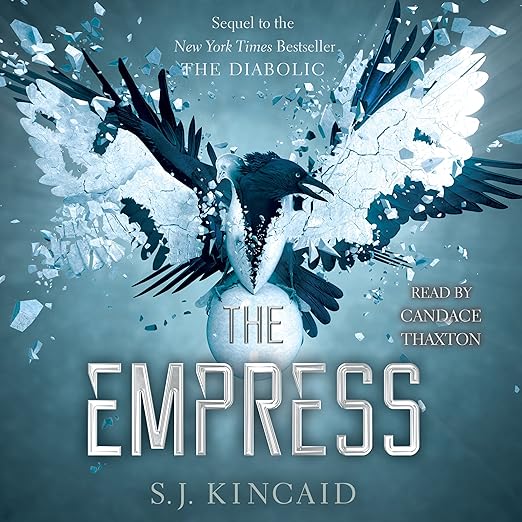
Quick Take
- Narration: Candace Thaxton handles the density of Kincaid’s space-opera politics with clarity and consistent characterization, she differentiates Nemesis’s precise, searching interior voice from the courtly manipulators around her in ways that make the complex cast navigable.
- Themes: humanity as something earned rather than inherited, political power and the cost of revolution, love tested by impossible moral demands
- Mood: Emotionally volatile and politically dense, with a third act that hits harder than the first book prepared you for
- Verdict: A sequel that surpasses its predecessor in ambition and emotional scope, required listening for anyone who finished The Diabolic and felt there was unresolved universe left to explore.
I came to Empress, the second book in S.J. Kincaid’s Diabolic series, having listened to the first novel on a long weekend trip. The Diabolic had impressed me with its premise: Nemesis, a creature engineered to protect a human at any cost, begins to develop genuine interiority, emotional attachment, and eventually something that functions like love. It was a book about what humanity means when it is not assumed but constructed. It left me, as one reviewer notes, feeling “incomplete”, not in the way of a flawed narrative, but in the way of a world that had more story in it than a single volume could hold.
Empress begins where The Diabolic ends, with Tyrus newly crowned Emperor and Nemesis at his side. Their plan is straightforward: change the Empire. Share science. Give creatures like Nemesis worth and recognition. Stop the ruling Grandiloquy from controlling civilization for their own perpetuation. What the synopsis does not fully convey is how quickly Kincaid dismantles this plan, and how much the book is about the corruption of idealism under the pressure of political survival.
Our Take on Empress
The book’s central question is deceptively simple: if proving your humanity requires doing inhuman things, what remains of the proof? Kincaid does not ask this abstractly. She asks it through specific, escalating choices that Nemesis and Tyrus make, choices the reader watches with growing dread because the internal logic is always comprehensible even when the outcomes are devastating. One reviewer described finishing the book and not being able to process thoughts for several weeks afterward. That is a specific kind of success: the kind that comes from a story that does not let you off the hook.
The Grandiloquy, the ruling class plotting against Tyrus’s reforms, are effectively drawn antagonists because Kincaid gives them coherent motivations. They are not evil for its own sake. They are powerful people who have built their power on a specific arrangement of the world and who will do whatever is necessary to preserve it. The political maneuvering is dense, another reviewer notes feeling “befuddled with some of the worldviews, the space, the politics”, but the navigation is worth the effort.
Why Listen to Empress
Candace Thaxton’s narration is a significant reason this complex book works as an audiobook. Nemesis is a challenging character to inhabit in audio: she is precise, analytical, capable of violence, and also genuinely emotionally developing across these books in ways that require the narrator to make the interiority feel continuous rather than episodic. Thaxton manages this consistently. The difference between the Nemesis who enters the Empire’s political arena at the book’s opening and the Nemesis who navigates the third act’s devastation is audible without being overwrought.
The eleven-hour runtime gives Kincaid space to develop the political world more fully than the first book could. Listeners who found The Diabolic rushed in its worldbuilding will find this book’s slower construction of the Empire’s power structures satisfying. The vocabulary that seemed overwhelming in book one has, by now, become a familiar landscape.
What to Watch For in Empress
The third act is where the book makes its most demanding demands on the reader. Kincaid introduces plot developments that some listeners found predictable and others found completely unexpected, both responses are documented in the reviews, which suggests the foreshadowing is present but not heavy-handed. What is universally reported is that the emotional cost is significant. A reviewer described it as “feeling devastated by direction” and unable to get off the emotional roller-coaster until the series ends. If you are someone who needs to manage the emotional intensity of your listening, be prepared to need the third book immediately afterward.
Who Should Listen to Empress
This is a book for readers who have finished The Diabolic and are ready for the story to get harder. Do not start here, the series rewards a linear progression, and the emotional weight of this volume depends entirely on caring about Nemesis and Tyrus in ways that the first book established. Fans of Amie Kaufman and Jay Kristoff’s Illuminae Files, or of Marissa Meyer’s Lunar Chronicles, will recognize the genre blend of science fiction, political intrigue, and high-stakes romance, and will appreciate the way Kincaid uses all three to serve each other rather than compete.
Frequently Asked Questions
Do I need to read The Diabolic first, or can I start with Empress?
The Diabolic is essential prerequisite reading. Empress picks up immediately after the first book’s events, and the emotional investment in Nemesis and Tyrus’s relationship that drives this entire volume is built during The Diabolic. Starting here would be confusing and would deprive you of the setup that makes this sequel’s payoffs land.
Is there a third book in the series, and does Empress end on a cliffhanger?
Yes, the series continues with The Tyrant, and Empress ends in a place that makes the third book feel urgent. It is not a cliffhanger in the sense of an unresolved action sequence, but the emotional and political situation at the close of this book has no easy resolution, and readers will want the next volume quickly.
How does Candace Thaxton differentiate the large cast of political characters vocally?
Thaxton does not rely on exaggerated vocal differences between the Grandiloquy characters, which is the right choice for a cast of courtiers who present polished surfaces regardless of their actual motivations. The differentiation comes through pacing and tone rather than accent or pitch, which keeps the characterizations from tipping into caricature.
The series is shelved as YA, does it feel age-restricted, or does it work for adult listeners?
Kincaid’s series reads comfortably for adult listeners. The protagonist’s age and the romance are the primary YA genre markers, but the political complexity, moral ambiguity, and the demands the series makes on the reader’s emotional tolerance are not moderated for a younger audience. Adult readers who enjoy intelligent science fiction will find nothing here that feels beneath them.