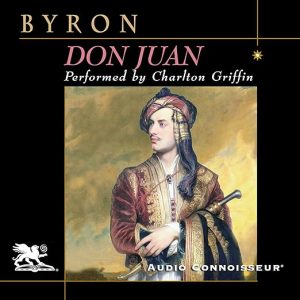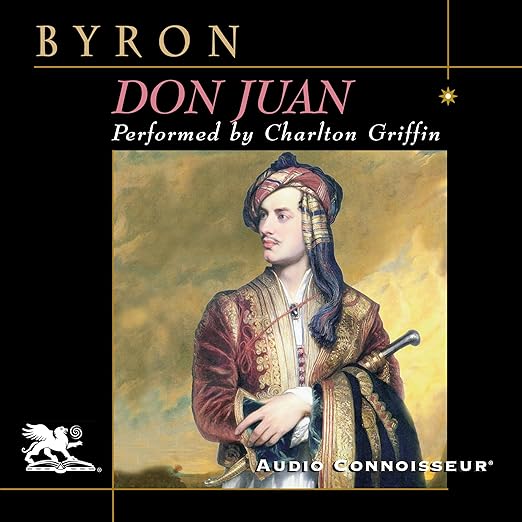
Byron called what he was doing 'epic satire', and the copy attached to this audiobook repeats the label without softening it. Don Juan reverses the legend it borrows: rather than a seducer, Byron hands us a young man 'easily seduced by women instead of seducing them', and then wanders away from him, canto after canto, to talk about everything else on his mind. Charlton Griffin narrates, and Audio Connoisseur issued the recording in January 2014.
Fifteen hours and twenty-eight minutes of rhymed satirical verse is a serious commitment, so let me be straightforward about what the review pool can and cannot tell you. Of the five written responses attached here, three were filed before the recording was published, a fourth calls the thing it read an ebook, and the fifth complains about narrow page margins and missing line numbers. Not one of them describes a recording, and that is unusual enough to say plainly.
Byron Interrupts His Own Plot Constantly
The reversal is the joke that starts the poem, and the digressions are the joke that sustains it. A four-star reviewer names this precisely: 'Byron's authorial intrusions, his narrative digressions, are what keep me coming back to Don Juan'. Juan himself is a passive tourist through shipwreck, harem, siege and salon. Byron is the one doing the talking, and the poem's real subject is the mind of its author refusing to stay on task.
Byron's comedy lives in his rhymes, which is the thing to settle before you choose between formats. His rhymes reach for comic strain rather than elegance, stranding words in positions they were never meant to occupy, and the effect is a sustained wink at the reader. A reviewer who admires the poem called the scheme 'Hudibrastic, deliberately off-kilter', which is a fair description of machinery built to be heard rather than scanned.
What surprised me most is how modern the tone reads. Byron is bored by his own plot, says so, and turns that boredom into a running bit about the impossibility of writing an epic in a corrupt age. One reviewer reaches for the word gonzo to describe those intrusions, noting that Byron was doing it nearly two centuries before the term existed, and the comparison is not as strained as it sounds.
Rhymes Snap Shut Only When Heard Aloud
Verse this deliberately musical belongs in the ear. Silent reading flattens the rhymes into typography, and the punchline of a Byron stanza is usually the sound of the last two lines snapping shut. A recording restores the timing the page only implies, and that alone is a serious argument for choosing this edition over a paperback if you have never made it through the poem before.
Pronunciation is the live question, and the sources disagree in a way that matters. The publisher's description insists the name here is pronounced JOO-AN. A reviewer, explaining the off-kilter rhyme scheme, transcribes it as 'Joo-en'. Both are pointing at the same fact: Byron rhymes the name with English words, so the anglicized pronunciation is structural rather than a mistake. Whichever way a reading goes, a great many of the comic rhymes depend on that one decision.
Fifteen Hours Beats Three Hundred Printed Pages
A word about the poem's reputation, since it puts people off. Don Juan has a name for being difficult and it is not. The stanzas are conversational, the vocabulary is ordinary, and the jokes are broad enough to have survived two centuries without help. What makes it demanding is volume rather than density, and that distinction is worth making before anyone looks at the running time and decides against it. A reader defeated by the length on the page may well find it manageable here, precisely because a recording sets the pace and removes the temptation to count how many stanzas are left.
The length works differently in audio, too. A five-star reader warned that anyone 'thwarted by the length' should take it a stanza or two at a time, and added that this is not a book to be finished in a sitting or two. That advice describes a print problem. Fifteen hours across a month of commutes is a far gentler proposition than three hundred pages of dense verse on a bedside table.
Byron's Political Jokes Need Footnotes Audio Can't Give
What this format costs you is the apparatus. One five-star notice is titled with a plea to bring on the footnotes, which tells you exactly how much this poem rewards annotation: Byron is constantly glancing at contemporaries, political scandals and literary feuds that a modern listener will not catch unaided. Audio strips all of that away. The product details flag no accompanying file, so treat a good annotated text as a separate purchase if the references matter to you.
A caveat on the rating as well. A 4.3 average across 211 ratings looks modest for a work the description calls Byron's masterpiece, and the visible written pool suggests why. The single lowest score, three stars, is entirely a complaint about the physical layout of a printed edition. Ratings on listings like this accumulate across formats and editions, so the number is a blunt instrument here rather than a verdict on any one version.
Then the period itself. Byron's treatment of women is the engine of most of the plot and it will not read as charming to everyone, satire or not. The targets of the political jokes have been dead for two centuries. A listener who wants the poem to behave like a novel will also be frustrated, because the plot exists mainly to be interrupted.
Comic Byron Fans Will Love This Talker
This suits listeners who already enjoy long-form verse and want the comic Byron rather than the brooding one. It suits anyone who studied Romantic poetry and never got past the first canto, people who like digressive first-person narrators of any era, and readers curious about the satirical tradition that runs from Alexander Pope through to modern comic essayists.
It is a poor fit for a listener who wants a straightforward story, for anyone who needs scholarly notes at the point of use, and for a newcomer to poetry looking for an accessible starting point. Byron assumes a reader who knows his world, and audio provides no margin in which to explain it.
Fifteen hours with the most entertaining talker in English Romanticism is a genuine pleasure if you go in for the voice rather than the plot. Start anywhere, expect to lose the thread of Juan's adventures, and let the digressions carry you. The poem was built to be recited, and this format returns it to something close to the condition its author wrote it in. Poetry of this vintage was made for reading aloud as much as for the page, and a recording sits nearer to that than any paperback.
Does the audiobook come with the footnotes that annotated print editions carry?
No companion file appears in the product details, and a recording cannot easily reproduce annotation in any case. One reviewer's headline is a direct plea for footnotes, which tells you how much the poem leans on them. Pair the listening with an annotated text if the historical references matter to you.
How is the name Don Juan pronounced in this poem?
Anglicized, and deliberately so. The publisher's description renders it JOO-AN, while a reviewer accounting for the deliberately skewed rhyme scheme transcribes it as Joo-en. Byron pairs the name with English sounds throughout, so a Spanish pronunciation would collapse the jokes the poem depends on.
Is this audiobook a reasonable first encounter with Byron?
For the comic Byron, yes. Don Juan is described as his masterpiece and it is far more approachable in tone than the brooding early poems. The obstacle is length rather than difficulty, and hearing the rhymes land makes the humor considerably more obvious than reading them silently does.