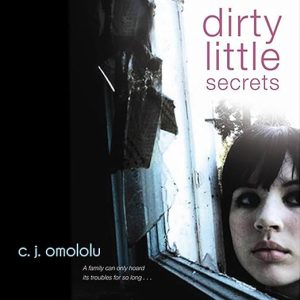
Narration shapes YA fiction in ways it doesn't always shape adult fiction, because the interior lives being depicted are often more undefended, more raw in their shame and desperation, and a narrator who misjudges the register can flatten everything. Jessica Almasy's performance in Dirty Little Secrets avoids that failure. She finds Lucy's voice precisely: a sixteen-year-old carrying an impossible secret, operating under enormous cognitive load, moving through her first unmonitored hours as an orphan with a two-day plan that requires her to be both ruthless and completely alone. The audiobook format makes that interiority visceral in a way the page version may not.
A note on the metadata: this listing carries K.G. Reuss's name as author, but the synopsis and reviewers' descriptions match C.J. Omololu's 2010 YA novel, also titled Dirty Little Secrets. The audiobook being reviewed here is Omololu's work. The central situation is this: Lucy has hidden for years that her mother is a severe hoarder, their home filled with garbage and shame. When her mother dies in that home, Lucy doesn't call 911. Not immediately. Because calling 911 means letting the secret out, and she has calculated that surviving what comes next requires controlling how and when that happens.
Where This One Lands
The book's structure is its boldest choice: it covers approximately two days in real time, hour by hour, as Lucy executes what she calls her plan to set things right before the world finds out. That temporal compression creates a pressure that most YA fiction, which tends to breathe across weeks or months, rarely achieves. The audiobook intensifies this: six hours and fifty-three minutes tracking a teenager's interior monologue as she does increasingly desperate things feels genuinely urgent rather than constructed.
Omololu writes Lucy as fully dimensional without ever explaining her. We understand her situation because we experience it alongside her, not because the narrative steps back to provide context or sympathy-building exposition. That technique is harder than it sounds, and Almasy's performance sustains it. She gives Lucy dignity without idealizing her, fear without melodrama, intelligence without making her implausibly competent.
Hoarding as a YA subject is still relatively rare, and Omololu handles it with specificity and honesty that more comfortable authors often avoid. The physical descriptions of Lucy's home are both precise and disturbing, not for shock value but because understanding exactly what Lucy lives in is what makes her choices comprehensible. When she hesitates to call for help, the reader has already been inside that space long enough to understand why exposure feels catastrophic.
The book also captures the particular social mathematics of adolescence with unusual accuracy. Lucy's fear of what her friends, her crush, and her peers will think if they discover the truth isn't presented as vanity. It's presented as a realistic assessment of how teenagers navigate social survival, and Almasy's narration keeps that calculation present throughout without letting it shade into selfishness.
Reviewers consistently praise Lucy as one of the most fully realized protagonists in YA fiction about family crisis. One noted she is 'an authentic teen, who has a huge burden and few resources' and is 'truly alone in trying to deal with her mother's hoarding.' Another described the writing as 'amazing' while noting the ending requires careful consideration before recommending to teens in similar situations, which is honest critical engagement rather than dismissal.
Before You Commit to Dirty Little Secrets
The ending is divisive. Reviews suggest it takes a direction that some readers found shocking and others found inappropriate for the intended age group. If you're considering this audiobook for a teenager who may be navigating hoarding or parental crisis in their own life, the ending warrants a preview. The story does not resolve in the way most YA fiction reassures us things will resolve.
The narrow temporal scope, while a structural strength, is also a limitation. Listeners who want backstory, resolution, or a broader portrait of Lucy's life before and after the central crisis may find the tight two-day frame frustrating. Omololu is making a deliberate formal choice, not a constraint, but it shapes what the book can and cannot do.
Jessica Almasy's performance also deserves attention for what she does with the secondary characters in Lucy's orbit: the friends who don't know the truth, the neighbors who have their own suspicions, the various figures who appear during Lucy's two-day effort to control her situation. None of these roles are written with great depth, because the book's perspective is relentlessly interior to Lucy and the secondary characters exist primarily as pressures on her decision-making. Almasy differentiates them sufficiently that you never lose track of who Lucy is navigating around, while keeping the focus clearly on Lucy's interior logic rather than on any external character's independent claim to sympathy. That kind of precise performance discipline is what makes the six-hour format land as taut rather than drawn out.
Who Will Get the Most From It
This audiobook is for listeners who respond to YA fiction with genuine psychological density, particularly stories about the specific shame of family secrets and the social cost of difference. Almasy's performance is the right vehicle for material this carefully constructed. The six-hour runtime is exactly right for the scope.
Approach cautiously if you intend to recommend it to teens currently in crisis situations involving parental hoarding or loss. The ending's direction makes it more appropriate for thoughtful older YA readers than for younger or more vulnerable ones. For adult readers and critics interested in how YA handles difficult domestic realities, this is essential listening.