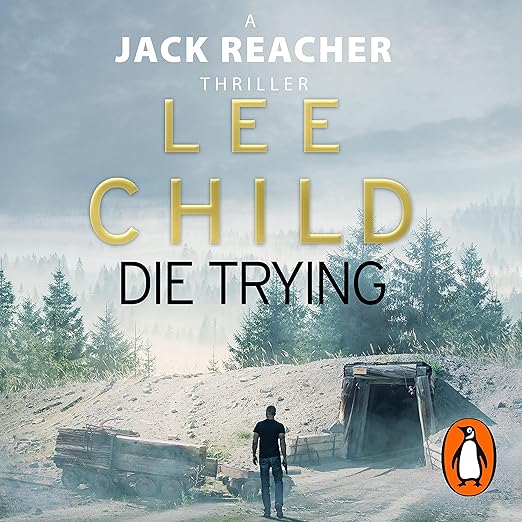
I finished Die Trying during a transatlantic flight, somewhere over the Atlantic, which is the ideal setting for the second Jack Reacher novel. Lee Child writes books that are calibrated to movement, to the experience of being in transit, of covering distance, of not being able to stop. Reacher himself is always in motion, always arriving somewhere he did not intend to be, always leaving as soon as the situation is resolved. You read these books at the same rhythm you travel.
Die Trying opens on a Chicago street in bright daylight. Reacher, alone and unencumbered as always, notices a woman struggling on crutches and offers a steadying arm, a reflex of ordinary decency that immediately costs him his freedom. Within minutes he is chained in a dark van with an FBI agent named Holly Johnson, racing across America toward a destination and a captor he knows nothing about. The setup is stripped to its bones, and Child does not waste a sentence establishing it. This is a writer who trusts pace over atmosphere, and Reacher is a character who rewards that trust because his interiority, the way he catalogs a room, estimates distances, reads people, is more interesting than most novels' external drama.
A Closer Look at Die Trying
Die Trying is the second book in the Reacher series, and it is demonstrably more ambitious than Killing Floor. The antagonist, a rogue militia leader with separatist ideology and a remote compound, allows Child to engage with questions of institutional loyalty and the nature of political extremism that are absent from the first novel. The FBI's role in the investigation running parallel to Reacher's captivity creates a dual-perspective structure that builds genuine tension, because the reader knows what the Bureau does not, and the gap between them keeps narrowing in ways that might or might not align in time.
The rogue militia plot is one that multiple reviewers identify as both compelling and occasionally implausible. One listener described it as a crazy rogue militia intent on rekindling the American Revolution. That reading is accurate, the antagonist's ideology requires a certain degree of suspension of disbelief, but Child makes the internal logic of the group coherent enough that the threat feels organized rather than random. The villain is not merely evil; he is convinced, which is a more interesting and more frightening type.
What Makes Die Trying Worth Hearing
Jeff Harding. The Sunday Times review quoted in the book's own materials, that his narration captures Reacher's character perfectly and forces you to savour every minute, is not promotional hyperbole. Harding has found something in Reacher's voice that purely textual reading cannot achieve: the specific quality of a man who thinks precisely, speaks rarely, and acts with absolute economy. The internal monologue sections, where Reacher calculates odds and assesses threats, are delivered at a pace that gives the listener time to follow the logic without feeling lectured at.
Child's prose style is spare and rhythmic, built on declarative sentences and physical specificity. Those qualities translate directly into audio in a way that ornate literary prose often does not. One reviewer noted some filler at times, which is a fair observation, Child occasionally belabors physical descriptions that audio makes more apparent than print does. But Harding navigates those passages without losing momentum, which is a narrator's skill rather than the text's.
Things to Know Before Starting Die Trying
Holly Johnson is a stronger female lead than readers of this genre might expect from a 1997 novel. She is an FBI agent who is genuinely capable, frustratingly competent even in captivity, and whose relationship with Reacher is developed with more nuance than the setup suggests. Child does not reduce her to a victim or a romantic device, though she functions as both at various moments. Her toughness is established early and maintained throughout, which is the right choice.
The technology and communications references are period-specific, this novel was written in the late 1990s, and the investigative methods and tracking capabilities the FBI employs reflect that era. Listeners who have come to the series through the Amazon Prime adaptation starring Alan Ritchson should prepare for a Reacher who operates without smartphones, GPS, or instant communication. The constraints actually make the tension more interesting rather than less, because Reacher cannot be reached, tracked, or assisted.
Who Lee Child Is Writing For
This is essential listening for anyone who has already heard Killing Floor and wants to continue the series, several reviewers confirm the books improve as they go, and Die Trying represents a meaningful step up in scale and ambition. Newcomers to the Reacher series can start here with only minor confusion, though the first book establishes Reacher's character in ways that give the second more resonance. Jeff Harding's performance is reason enough to choose this edition over any other available version.
Key Details
- Voice: Jeff Harding is the definitive voice for Jack Reacher, his reading of Reacher's internal logic is so precise that The Sunday Times singled it out for special praise.
- Big ideas: Captivity and resistance, institutional power versus the lone individual, moral clarity under duress
- Atmosphere: Relentlessly kinetic, with periodic pauses for Reacher's methodical thinking that make the action more rather than less tense
- Worth it?: A tighter, more ambitious novel than Killing Floor, and the audiobook format suits Lee Child's prose style particularly well, Harding's performance is the reason to choose audio over print.
Questions Listeners Ask
Can Die Trying be listened to without having heard Killing Floor first?
Child himself says the Reacher novels can be read in any order, and Die Trying introduces enough context to stand alone. However, Killing Floor establishes Reacher's character, history, and way of operating in ways that make him more comprehensible, starting from the first book is still the recommended approach for new listeners.
How does Jeff Harding's performance compare to other available narrators for the Reacher series?
Harding is widely considered the definitive audio voice for Reacher, even The Sunday Times noted his narration captures Reacher's character perfectly. Other narrators have recorded some editions, but Harding's interpretation is the reference against which others are measured.
Is the militia in Die Trying based on any real-world organization?
The fictional militia reflects the broader American militia movement of the early-to-mid 1990s, which was a documented social phenomenon following incidents like Ruby Ridge and Waco. Child does not model it on a specific organization, but the ideological profile is recognizable from that period.
At fifteen hours and fifty-five minutes, does Die Trying sustain its pace throughout or sag in the middle?
The pacing is generally strong, though a few reviewers noted filler in the mid-section. Child's alternating perspectives, Reacher in captivity, FBI investigators pursuing, create enough structural variation to prevent the momentum from stalling. The final act is consistently described as delivering on the tension built throughout.