- Narrator: A single reader carries both halves of a slow burn whose most praised passages are also its most explicit ones.
- Subjects: Enemies to lovers across a bratva and mafia divide, forced proximity, found family, criminal apprenticeship
- Tone: Hot, hostile, and occasionally very unpleasant
- Bottom line: Confident, well-built genre romance, undermined by a page that will not say whether it is a standalone or book one.
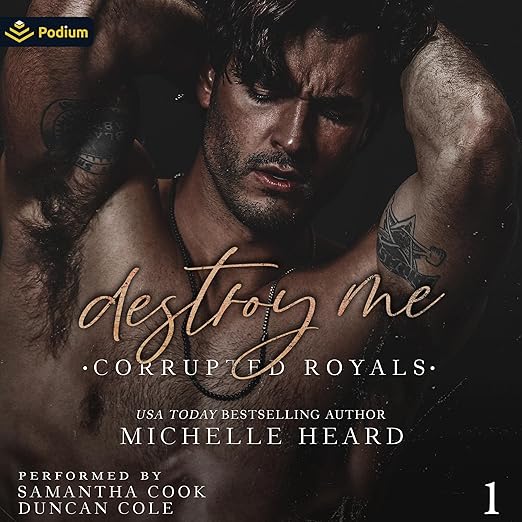
Nightclub sparks, then an explosion, then three hours trapped in rubble with a stranger you tell everything to except your name. That is the opening move here, and it is a good one, because Michelle Heard spends everything that follows making both people pay for it. Two years later that stranger turns out to be Misha Petrov, a Russian enforcer for the bratva, and the woman he cannot forget belongs to a family sworn against him. Samantha Cook reads the audiobook edition.
A Closer Look at Destroy Me
Misha is written as a wall, and the book's whole engine is the slow business of finding the door. The description makes his hostility functional rather than performative: her family are enemies of both the bratva and the Italian mafia, which makes her a security problem before she is anything else. That is a sturdier obstacle than most enemies-to-lovers plots bother with, because it gives him an actual reason to keep saying no, and it means the eventual thaw has to be earned against something real rather than talked away.
Familiarity is not a criticism in this genre, and the book leans into it. The beats arrive on schedule, the antagonism is telegraphed, and the resolution is never seriously in doubt. What separates a good entry from a filler one is the specificity of the world around the couple, and Heard supplies more of that than the premise requires. The Russian and Italian factions are not interchangeable scenery; the alliances have consequences that reach into scenes the romance would otherwise own.
Switzerland turns out to be the setting, which the description never mentions. One three-star response fills in what the page leaves out: the nightclub is Swiss, the reunion happens at a castle used for leadership training, and the heroine arrives there with a best friend named Abbie who is a mafia daughter in her own right. That same response is also the only place the heroine gets a name, Aurora, since the description is written entirely in her voice and never supplies one.
What Makes Destroy Me Worth Hearing
Pacing is the thing buyers most want to know about, and the answer sits in a five-star account: a slow burn, with the first sexual encounter arriving around the midpoint and praised there for its intensity and its sensory detail. That note also confirms a happy ending and reports that the final chapter functions as an epilogue jumping forward in time. For anyone deciding whether to spend eight hours here, that is more useful than any adjective.
Samantha Cook has a specific casting problem to solve. The description is written in first person from the heroine's side, which means whoever reads it inhabits her interiority continuously, and the male lead is characterized almost entirely by how he sounds: low-rumbling threats forced through clenched teeth, a voice the narration treats as a physical event. A single reader has to make that convincing from inside another character's head, in a second accent, without tipping into caricature.
Speed is the headline in another five-star note, whose writer got through the entire book in under a day and placed it among the five titles that hooked them fastest of anything they had read. The same note observes that the flow never sagged, that scenes moved on before boredom set in, and that the academic setting came as a surprise the reader ended up liking. A book that keeps somebody up all night has solved the only problem that matters in this category.
Things to Know Before Starting Destroy Me
Instructions from one four-star response do not survive the format change. Warning squeamish readers about a couple of gruesome torture scenes, it tells them to skip those paragraphs. By ear you cannot. A recording gives you a scrub bar and a guess, and skipping blind in an eight-hour audiobook means either landing back inside the scene or overshooting past plot you needed. The same response describes a facility where characters undergo torture training and kidnap-escape drills, so the violence is structural rather than incidental.
Standalone is what the description calls this book, in the same sentence that calls it full-length, and the claim does not survive contact with the page it sits on. The listing carries a series name, Corrupted Royals, with the series number left blank. Responses treat it as the first entry and anticipate the next one. Somebody buying a self-contained novel on the strength of that word deserves to know they are entering a sequence whose position the page declines to state.
Tags compound the confusion. This is filed under mystery, thriller and suspense with a crime fiction label, while the description's own closing line identifies it as a mafia romance containing mature content. A listener who found it on the thriller shelf is going to get a love story with organized crime as its setting, not the reverse. One five-star response, from a book blog, grades the title on a scorecard that includes a rating for the cover art, which is its own comment on how these listings get built.
Who Michelle Heard Is Writing For
Romance listeners who want the criminal underworld played straight are the right audience, especially anybody who likes an enemies premise with a genuine structural obstacle rather than a misunderstanding. The training-facility setting gives it an unusual shape for the subgenre, closer to a closed campus than to the usual penthouse-and-warehouse circuit, and readers who enjoy found-family dynamics around the couple will find Abbie doing real work.
Torture on the page is a hard limit for some listeners, and this is not the book to test it with, because you cannot navigate past it here. Readers irritated by predictability should also pass, since the arc announces itself early and then keeps every one of its promises. Anybody hunting a crime thriller is on the wrong shelf entirely, and readers who want a genuinely self-contained novel should treat the standalone claim with suspicion until they can confirm where this sits in the sequence.
Heard is doing competent, confident work inside a crowded subgenre, and the Swiss setting plus the training-castle conceit give this more architecture than most of its shelfmates manage. The couple are given a real obstacle and made to work through it rather than around it. The reasons to hesitate are all on the listing rather than in the book: a series position nobody will state, a genre tag pointing the wrong way, and violence a print reader was told to skip and a listener cannot. Understand all three going in and the running time holds up fine.