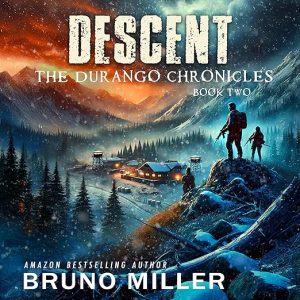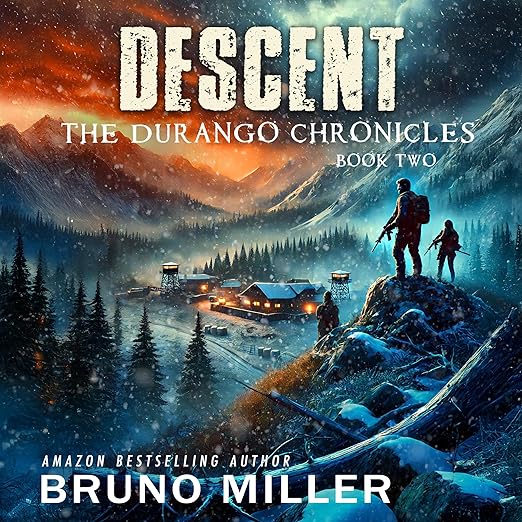
I picked up Descent on a Sunday afternoon that was already going gray, the kind of day that wants you to stay indoors and not think too hard about anything cheerful. I was somewhere in the middle of a long review backlog and needed something that would just move, and Bruno Miller's Durango Chronicles Book 2 delivered exactly that. By the time Andrew Tell had set the scene in those frozen Colorado mountains above Durango, I had stopped thinking about the backlog entirely.
What I want to say upfront is that this is a series book through and through. Miller writes Ben, Joel, and Allie as if he expects you to already care about them, and if you do, if you've read the Dark Road series and its continuation, you will. If you haven't, there's a ceiling on how much this cold-opening kidnapping plot will grab you. The emotional stakes depend on accumulated history.
What We Made of It
Miller has a specific talent that doesn't get discussed enough in post-apocalyptic fiction: he writes survival not as an abstract struggle against nature, but as a deeply personal reckoning with other human beings who want what you have. Victor Slade, the outlaw faction leader who abducts Ben's youngest son Brad, is not a complex villain in the literary sense, he's a pressure mechanism. And that's the right call for this kind of story. The point is not to understand Slade; it's to feel how badly Ben needs to get to his son before the storm does.
The Colorado winter functions almost as a second antagonist. Miller is good at environmental specificity. The cold isn't decorative, it constrains options, slows movement, and turns what might have been a straightforward rescue into something exhausting and genuinely dangerous. That physical texture is what separates Miller's work from the flat-terrain post-apoc thrillers that fill out the genre.
The Best Parts of Descent
Andrew Tell has been with this world long enough to know how it breathes. His narration lands with the kind of matter-of-fact grimness that fits Miller's prose style, he doesn't dramatize unnecessarily, and he knows when to let a moment sit. The action sequences are crisp, the quiet moments between family members register as genuine, and he handles the ensemble (Ben, Joel, Allie, the various threats they encounter) with enough vocal differentiation to keep things clear at pace.
Fan reviews consistently call this series hard to put down, and from a craft standpoint I understand why. Miller plots in compressed windows of time, so there's always something closing in, the storm, the deadline, the approaching faction. Tell's narration matches that compression. You don't feel the eight-plus hours passing.
Points to Consider
There's a thematic thread running through this book about what peace actually costs in a collapsed world, whether you can hold onto it or whether the world simply won't let you. Ben's belief that he'd carved out something stable gets dismantled by page one, and Miller doesn't reassure you that it can be rebuilt easily. That's honest writing, even if it makes for a relentless listen.
One reviewer noted that Miller avoids gratuitous content, no filler violence, no exploitative scenes, and that restraint shows. The darkness in Descent serves the story rather than decorating it. Readers who come from literary fiction and are cautious about the genre will find Miller cleaner than they expect.
The book's weaknesses are largely structural genre constraints: character interiority is limited, the villain exists to create plot rather than meaning, and the resolution sets up the next book in ways that feel slightly mechanical. These are minor complaints in the context of what Miller is doing, but worth naming.
Who Should Pick Up Descent
Listen if you've completed at least some of the Dark Road series or the earlier Durango Chronicles volume, the emotional payoff is calibrated for readers who've made that investment. This is also well-suited to anyone who prefers action-forward post-apocalyptic fiction with a family-survival focus and minimal supernatural elements. Skip it if you're new to Miller's world, or if you want villains with psychological depth rather than menace-as-plot-function. And skip it if relentless forward momentum without narrative breathing room isn't your thing on a given day, this book does not pause.